 Ferndale Siding
 A Local Crew That Knows Sudden Valley
Sudden Valley homes sit in a part of Whatcom County that gets more shade, more standing moisture, and more moss pressure than a lot of open, wind-exposed lots elsewhere in the region. Tree cover holds humidity against exterior walls longer after a storm passes, and many homes here were built or re-sided in eras when the go-to materials were whatever was cheap and locally stocked — not necessarily what held up best over twenty or thirty years in this kind of microclimate. We're a Ferndale-based exterior crew, and we treat Sudden Valley as one of the communities we know well, not a stop on a route that starts somewhere else in the state.
That local familiarity matters more than it sounds like it should. A siding material that performs fine in a dry, open subdivision can struggle on a shaded, moisture-retentive lot, and a roofer who doesn't normally work in mossy, tree-heavy terrain can miss the small details — ventilation, flashing, drainage planes — that make the difference between a wall system that lasts and one that doesn't.
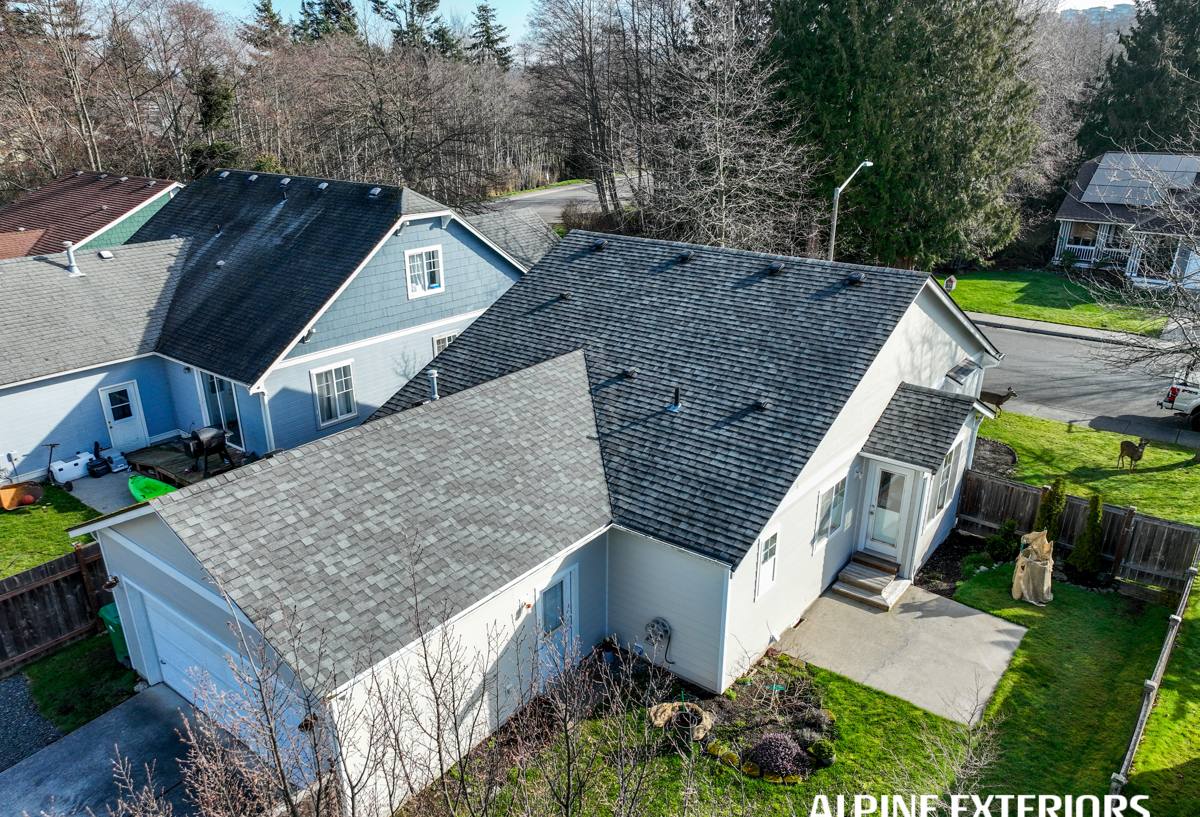
What This Climate Does to a House Over Time
Whatcom County's broader climate brings a combination that's tough on exteriors: salt-tinged coastal air that accelerates corrosion on fasteners and trim, driving rain that gets pushed sideways into wall assemblies during winter storms, and a moss season that, in shaded areas like Sudden Valley, can run most of the year rather than just a few soggy months. None of these forces on their own would be a big deal. Together, over a decade or two, they're exactly what wears down the wrong siding choice.
The Three Stressors, Broken Down
- Moisture intrusion: Driving rain finds gaps at seams, fastener heads, and butt joints. Materials that swell, delaminate, or wick water hold that moisture against the wall long after the rain stops.
- Moss and organic growth: Shaded, damp siding surfaces are exactly where moss, algae, and mildew take hold. Left unaddressed, that growth holds even more moisture against the substrate and accelerates whatever decay process is already underway.
- Salt-influenced air: Even set back from open water, this part of the county gets enough coastal air movement to speed up corrosion on cheap fasteners, staples, and unprotected trim — a slow problem that shows up as rust streaking and failed connections years down the road.
Why We Standardized on James Hardie Fiber Cement
We install James Hardie fiber cement siding exclusively. We don't install vinyl, LP SmartSide, Cemplank, Allura, or primed wood species like spruce or cedar, and that's a deliberate call based on what actually holds up in Whatcom County conditions — not a sales pitch against any one brand.
Vinyl siding is inexpensive and easy to install, and for a lot of climates it's a perfectly reasonable choice. But it's a petroleum-based product that expands and contracts significantly with temperature swings, and in a shaded, moisture-heavy setting like Sudden Valley, trapped moisture behind vinyl panels has nowhere good to go. Engineered wood products like LP SmartSide use a wood-strand core with a resin coating — durable when the coating stays intact, but vulnerable at cut edges and fastener penetrations if that seal is compromised, which is a real risk in a climate this wet. Other fiber cement brands, like Cemplank and Allura, are chemically similar to Hardie, but we've standardized around one manufacturer for consistency in warranty terms, factory finish quality, and product engineering — and Hardie's HZ5 product line is specifically engineered for the kind of wet, temperate climate Whatcom County sits in. Primed cedar or spruce siding looks great on day one, but it depends entirely on an unbroken paint film to keep water out, and that film fails faster under constant shade and moss pressure than most homeowners expect.
James Hardie fiber cement is non-combustible, doesn't support moss growth the way bare wood or algae-prone vinyl can, and comes from the factory with a baked-on ColorPlus finish that resists fading and chipping far better than field-applied paint. It won't rot, it won't delaminate like some engineered wood products can if water gets behind the seal, and Hardie backs it with a strong transferable limited warranty — meaningful if you ever sell the house. None of this makes fiber cement maintenance-free, but it removes the failure modes that cause the most trouble in a climate like this one.
Beyond Siding: Roofing, Windows, and Decks in the Same Climate
Siding doesn't work in isolation — the roof, windows, and any exterior decking on a Sudden Valley home are all fighting the same rain, moisture, and moss pressure, and they need to work together as a system.
Roofing
A roof under tree cover accumulates moss and organic debris faster than an open, sun-exposed roof, and clogged valleys or gutters send water somewhere it shouldn't go — often straight down the wall behind the siding. Roof condition and gutter function directly affect how long new siding lasts underneath it.
Windows
Window flashing and sealant are common points where driving rain finds its way into a wall assembly. When we re-side a home, we treat window integration as part of the job, not an afterthought — poor flashing detail around openings is one of the most common causes of hidden water damage we find when we open up an old wall.
Decks
Decks in a shaded, damp setting deal with the same moss and moisture exposure as siding, just on a horizontal surface where standing water is an even bigger problem. Board spacing, ledger flashing, and drainage matter as much as the decking material itself.
Comparing Siding Options for a Community Like This
| Material | Moisture Behavior | Moss/Algae Resistance | Long-Term Maintenance |
|---|---|---|---|
| James Hardie Fiber Cement | Does not rot or absorb water like wood | Factory finish resists organic growth well | Occasional wash; no repainting needed for years |
| Vinyl | Can trap moisture behind panels | Prone to algae/mildew streaking in shade | Low upfront effort, but early failure common in wet shade |
| LP SmartSide (engineered wood) | Vulnerable at cut edges/fasteners if coating fails | Moderate; depends on intact seal | Requires vigilant caulking/paint upkeep |
| Primed Cedar/Spruce | Absorbs water once paint film cracks | Low; organic material feeds growth | Frequent repainting and moss treatment |
This is a general comparison, not a claim about how any specific product will perform on your house — actual results depend heavily on installation quality, sun exposure, and upkeep. It's simply the reasoning behind why we install one product line rather than several.
What to Look For When Hiring a Contractor Here
Sudden Valley's terrain rewards contractors who actually understand shaded, moisture-heavy lots — and it can be unforgiving of ones who don't. A few things worth checking before you hire anyone for siding, roofing, window, or deck work in this area:
- Ask whether the crew has worked on shaded, tree-covered lots in Whatcom County specifically, not just the region broadly.
- Confirm they carry current Washington state contractor licensing and liability insurance, and ask to see the numbers directly.
- Ask how they handle moisture barriers and flashing at windows and penetrations — this is where most long-term problems start.
- Get the manufacturer and product line in writing, not just "fiber cement" or "premium siding" as a vague category.
- Ask what the warranty actually covers — materials, labor, or both — and whether it's transferable if you sell.
- Be cautious of bids that are dramatically lower than others; on a moisture-sensitive job, corners cut on flashing or fastening show up as expensive problems years later.
Living with Moss and Shade: Ongoing Care
Even the best siding material benefits from basic upkeep in a shaded, moss-prone setting. A periodic soft wash to remove organic buildup, keeping gutters and downspouts clear so water isn't dumping onto walls, and trimming back vegetation that keeps siding in constant shade all extend the life of whatever's on your house. Fiber cement handles neglect better than most alternatives, but "handles it better" isn't the same as "needs nothing" — a five-minute walk-around after major storms to check for debris buildup or damaged trim is worth the habit.
Why Local Still Matters
A crew based in Ferndale that regularly works Sudden Valley and the surrounding Whatcom County communities sees the same drainage patterns, the same shaded lots, and the same moss cycles year after year. That repetition is what turns into judgment calls on the job — where to add extra flashing, which walls need more ventilation clearance, how a particular lot's tree cover will affect a new install five years out. It's not something you can shortcut by reading a spec sheet once.
If you're weighing a siding, roofing, window, or deck project on a Sudden Valley home, we're glad to come take a look and talk through what we're seeing and what it would take to address it — no pressure, no obligation. Use the form below to request a free estimate.