 Ferndale Siding
 Exterior Work for Nooksack Homes
Nooksack sits inland from the salt water, but that distance doesn't buy a home much protection from what Whatcom County weather does to exterior siding over time. Between the valley's fog patterns, the long stretch of wet months, and the moss and mildew pressure that comes with them, houses out here take a steady, grinding kind of wear rather than one dramatic storm event. We work throughout the Ferndale area, and Nooksack is a regular stop for us — close enough that a service call or a full siding replacement doesn't turn into a half-day round trip, which matters when you're trying to get a crew back out for a warranty check or a quick repair.
We handle siding, roofing, windows, and decks, and we treat them as one connected system rather than four separate trades. Water doesn't care which contractor installed which part of your house — it finds the weak seam, wherever it is. A siding job that ignores flashing details at the roofline, or a deck ledger that isn't properly isolated from the wall assembly, creates problems that show up two winters later as a stain, a soft spot, or worse. Because we do all four, we look at the whole envelope, not just the piece we happen to be quoting.
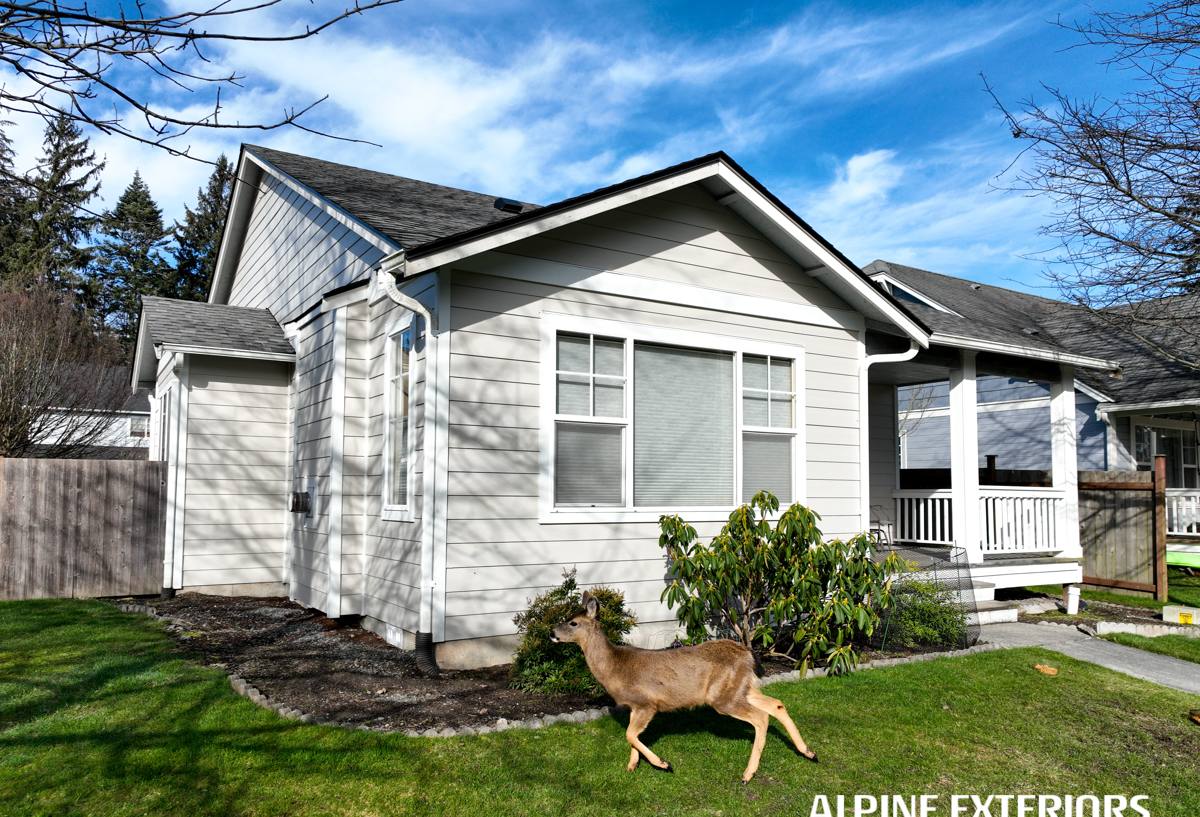
What the Local Climate Actually Does to Siding
Whatcom County's marine climate is mild compared to a lot of the country — we don't get the freeze-thaw cycling that tears apart siding in colder regions, and we don't get the UV load that bakes materials in the Southwest. What we get instead is duration. Moisture sits on exterior surfaces for months at a stretch, driving rain pushes in at odd angles during winter systems, and the shaded, tree-lined lots common around Nooksack keep siding damp longer after every rain than an open, sunny lot would.
The specific stress points
- Moss and algae growth on north-facing walls and anywhere tree cover blocks sun and airflow
- Swelling and softening in wood-based products where paint film has worn thin or seams have opened
- Caulk and seam failure from repeated wet-dry cycling over many years
- Trim and butt-joint rot where water collects and doesn't fully dry between rain events
- Gutter and flashing overload during heavy winter rain, which pushes water into places it was never meant to go
None of this is unique to any one street or subdivision — it's the reality of building an exterior in this part of the state. The difference between a siding job that holds up for decades and one that needs attention in year eight usually comes down to material choice and installation detail, not luck.
Why We Only Install James Hardie Fiber Cement
We made a decision as a company to install one siding system: James Hardie fiber cement. We don't offer vinyl, LP SmartSide, Cemplank, Allura, or primed wood species like spruce or cedar as alternatives, and we want to be upfront about why, rather than just quietly steering every conversation toward one product.
Wood-based sidings — including engineered wood products and traditional cedar — depend on an intact factory or field-applied coating to keep moisture out. In a climate where that coating is under near-constant damp pressure for months at a time, any breach in that seal (a nail pop, a scuff, a seam that opens slightly with age) becomes an entry point for water. Wood fiber, once it takes on moisture repeatedly, is vulnerable to swelling and softening in a way that's hard to reverse. Vinyl handles moisture differently — it doesn't absorb water — but it has its own trade-offs in a place like this: it expands and contracts with temperature swings, it can distort in direct sun exposure on south and west walls, and thinner profiles have never had a strong reputation for holding paint or matching the tighter, more architectural look many homeowners want now.
Fiber cement doesn't face either of those failure modes. It's made from cement, sand, and cellulose fibers, which means it doesn't absorb and swell the way wood does, and it doesn't expand and contract with heat the way vinyl does. James Hardie backs it with a factory-applied ColorPlus finish that's baked on rather than field-painted, and their HZ5 product line is engineered specifically for climates like ours — freeze-thaw and moisture exposure included. It's also non-combustible, which is worth something in a state that's had its share of wildfire smoke and ember exposure in recent summers, even if house fires are the more common concern.
We're not going to tell you every alternative product is a bad choice in every application — they all have a place, and plenty of houses around here still wear them without major issues. But we install exteriors we're willing to stand behind for the long haul, and for the climate Nooksack sits in, fiber cement is the material we trust to still look and perform the way it should ten, twenty, and thirty years out.
Comparing Siding Materials for This Climate
| Material | Moisture Behavior Here | Long-Term Upkeep | Fire Rating |
|---|---|---|---|
| James Hardie fiber cement | Doesn't absorb/swell; engineered HZ lines for wet climates | Low — factory finish holds color for years | Non-combustible |
| Vinyl siding | Sheds water but expands/contracts with temperature | Low cost, but can fade, distort, or crack over time | Combustible |
| LP SmartSide / engineered wood | Coated wood strand product; vulnerable if coating breaches | Moderate — depends on caulking/paint maintenance | Combustible |
| Cedar / primed spruce | Natural wood; absorbs moisture without diligent upkeep | High — repainting, caulking, and inspection cycles | Combustible |
The James Hardie Product Lines We Install
Hardie makes several plank and panel profiles, and the right one depends on the home's style and what's being matched or replaced.
- HardiePlank lap siding — the most common choice, available in several exposure widths and textures, from smooth to a more traditional cedar-grain look
- HardiePanel vertical siding — used for board-and-batten looks or as an accent on gables and entries
- HardieTrim — matching trim boards that give window, door, and corner details a clean, finished line
- HardieShingle — a shingle-style profile for homes where that texture fits the architecture
All of it comes in Hardie's ColorPlus finish system if you want factory-baked color with a matching touch-up kit and a stronger finish warranty than field-painted siding gets, or in primed form if you'd rather have it painted to a custom color on site.
What Correct Installation Looks Like
Fiber cement performs the way it's designed to only when it's installed to Hardie's specifications — this is where a lot of the horror stories about "siding that failed" actually originate, and it's rarely the material's fault.
The details that matter most
- Proper starter strip and clearance off grade so the bottom edge isn't sitting in standing moisture
- Correct fastener type, spacing, and penetration depth — over-driven or under-driven nails both cause problems down the line
- A weather-resistant barrier installed and lapped correctly behind the siding, not just stapled up as an afterthought
- Proper flashing at every window, door, and roofline transition — the single most common source of hidden leaks
- Correct joint treatment at butt seams, sealed or engineered per Hardie's published details
- Field-cut edges primed or sealed before installation, since raw cut edges are the most vulnerable part of the panel
This is also part of why we don't subcontract installation out to whoever's available that week. A crew that installs Hardie regularly knows these details without having to look them up, and it shows in how the finished wall performs after its first few winters.
Roofing, Windows, and Decks — The Rest of the Envelope
Siding is often what triggers the call, but it's rarely the only thing worth looking at. A roof nearing the end of its service life, single-pane or failed-seal windows, or a deck built before current ledger-flashing standards were common all interact with how well new siding performs.
- Roofing — we check flashing, valleys, and ventilation as part of any siding scope, since roof-wall intersections are a frequent leak point
- Windows — replacement windows installed alongside new siding get integrated flashing details that are harder to retrofit correctly later
- Decks — ledger attachment and flashing where a deck meets the house wall is one of the most common rot locations we find during siding tear-off
If you're only budgeting for siding right now, that's completely normal — most homeowners tackle these in stages. But we'll flag anything we see during an estimate that's likely to cause trouble for the new siding, so you can make that call with full information rather than finding out later.
Warranty and What It Actually Covers
James Hardie's manufacturer warranty on ColorPlus products covers both the substrate and the factory finish, and it's transferable to a new owner if you sell the home within the coverage window — worth mentioning if resale is on your mind at all. That's a separate warranty from whatever labor and installation warranty your contractor provides, and both matter: a strong material warranty doesn't help you if a poor installation causes a leak that the manufacturer attributes to workmanship rather than the product itself. Ask any contractor you're considering, for any product, exactly what their installation warranty covers and for how long.
A Practical Checklist Before You Choose a Contractor
- Ask what siding brand and product line they actually install — not just "fiber cement" in general terms
- Confirm they carry current liability insurance and workers' comp, and ask to see proof
- Ask how they handle flashing at windows, rooflines, and deck ledgers specifically
- Get the installation warranty in writing, not just verbally described
- Ask how long their crews have been installing the specific product they're quoting
- Check whether the estimate includes tear-off, disposal, and any needed sheathing repair, or if those are separate
Getting Started
If your Nooksack home is starting to show the wear this climate puts on siding — moss buildup that won't stay ahead of cleaning, soft spots near the trim, paint that's failing faster than it should — we're happy to come take a look. We'll give you a straightforward, no-pressure estimate and an honest read on what your siding, roofing, windows, or deck actually need, with no obligation to move forward. Use the form below to get in touch.