 Ferndale Siding
 Why Ferndale Homes Take a Different Kind of Beating
Every siding material on the market is rated to handle "normal" weather exposure. The problem is that Ferndale doesn't get normal weather exposure. Sitting close to Bellingham Bay and the Strait of Georgia, homes here deal with a near-constant drift of salt-laden air, long stretches of driving rain off the water, and a wet season that can stretch from October well into May. Add in the shade and humidity that collects under mature trees on many Whatcom County lots, and you have three separate stressors — salt, water, and organic growth — all working on the same wall at the same time.
None of these factors are dramatic on their own. A homeowner in a drier part of the state might never notice the difference between a siding product that sheds water well and one that doesn't, because the exposure just isn't there. In Ferndale, that difference shows up as peeling paint, soft trim, or a musty smell in a back bedroom within a few years instead of a few decades.
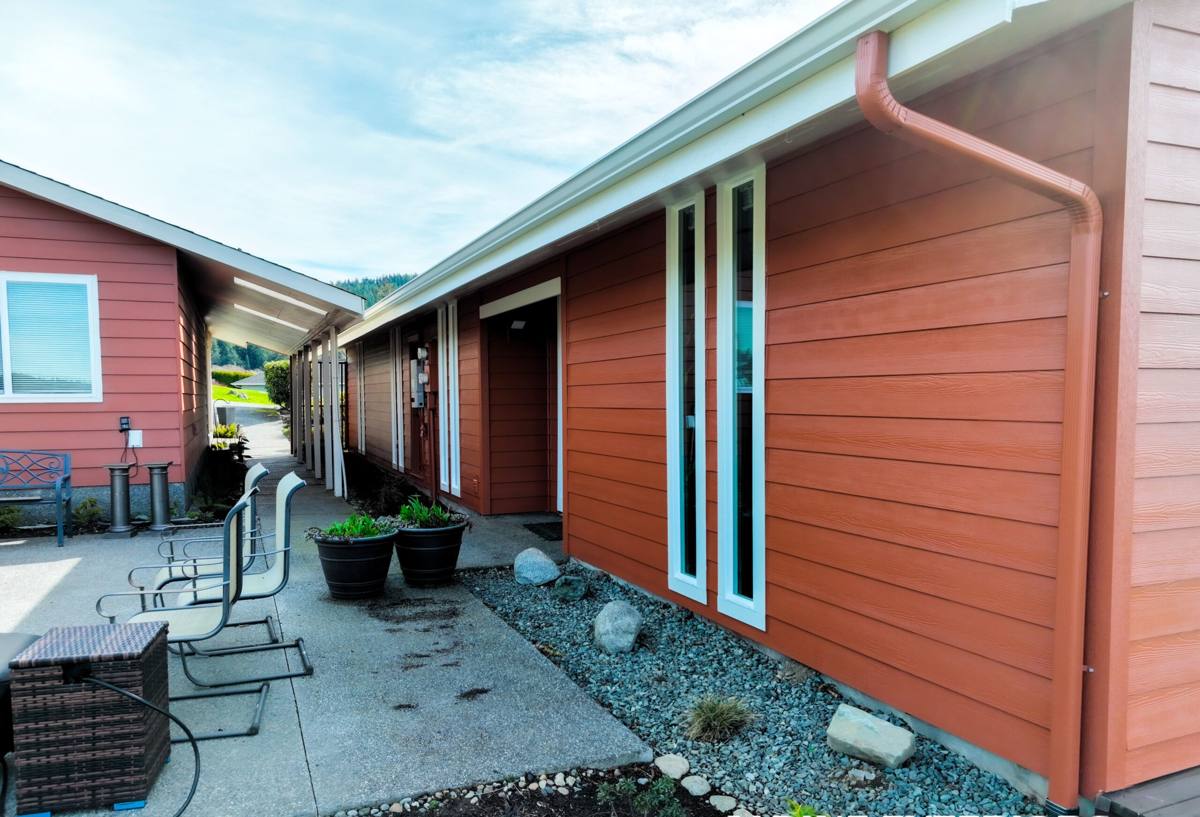
How Moisture Actually Gets Into Siding
Rot doesn't happen because siding gets rained on — every exterior wall gets rained on. It happens when water finds a way in and then has no way to leave. There are a handful of common entry points we see over and over on local homes:
Wind-Driven Rain
Storms coming off the water don't just fall straight down — they push rain sideways into laps, seams, and joints that were only ever designed to shed water moving vertically. Over time, wind-driven rain works its way behind poorly lapped boards or under caulking that has started to crack.
Failed or Missing Caulk Joints
Caulk is a wear item, not a permanent seal. Around window trim, corner boards, and penetrations for hose bibs, vents, or light fixtures, it typically needs attention every few years. Once it cracks or pulls away, that joint becomes a direct path for water behind the siding.
Poor Flashing
Flashing above windows, doors, and where a roofline meets a wall is what actually keeps water out — siding is the visible layer, but flashing is the working layer behind it. Missing or improperly lapped flashing is one of the most common causes of hidden rot, because the damage happens behind the siding where nobody is looking.
Splashback and Grade Issues
Siding installed too close to grade, or below a deck or patio where rain splashes back up off a hard surface, stays wet far longer than siding higher up the wall. This is a very common problem on older Ferndale homes where landscaping has crept up over the years.
Trapped Moisture With No Way Out
This is the one that surprises people the most. A wall doesn't just need to keep water from getting in — it needs a way to let the small amount of moisture that always gets in dry back out. Siding installed tight against the wall with no drainage gap behind it can trap water against the sheathing, where it does damage slowly and invisibly.
Warning Signs Worth Taking Seriously
Most rot problems don't announce themselves. They're quiet until they aren't. These are the signs we tell Ferndale homeowners to walk their house and check for, ideally twice a year:
- Paint that's peeling, bubbling, or alligatoring in a localized area rather than evenly across the whole wall
- Siding that feels soft, spongy, or gives slightly when pressed with a thumb
- Dark staining or streaking below window sills, corner boards, or seams
- Visible gaps, warping, or buckling in individual boards or panels
- A musty smell in an interior room that backs up to an exterior wall
- Moss or algae buildup that stays wet for days after a storm, especially on north-facing walls
- Nail heads that have started to rust, pop, or streak the siding below them
Any one of these on its own might be minor. Two or three in the same area is usually a sign that water has been getting behind the siding for a while, and it's worth having someone pull a board or panel to look at the sheathing underneath before it spreads.
Not All Siding Materials Handle Moisture the Same Way
This is where material choice actually matters, and it's worth understanding honestly rather than taking a sales pitch at face value. Every product has a moisture profile — how it behaves when it gets wet, how forgiving it is of small installation gaps, and how it holds up over years of the wet-dry cycling that's normal in this climate.
| Material | How It Behaves When Wet | Maintenance Reality | Long-Term Concern in This Climate |
|---|---|---|---|
| Cedar / primed wood | Absorbs moisture readily; swells and contracts with wet-dry cycles | Needs repainting or restaining on a regular cycle to stay protected | Once the finish fails in one spot, rot can start underneath before it's visible |
| Engineered wood (OSB-based) | Wood-fiber core is vulnerable if the factory coating is breached at a cut edge or fastener | Cut edges and fastener holes need to be sealed at install; gaps need caulk upkeep | Edge and seam swelling if moisture gets past the coating, which is easier to happen given the wind-driven rain here |
| Vinyl | Doesn't absorb water itself, but isn't a sealed system — water can travel behind panels | Low upkeep on the material itself, but trapped moisture behind it goes unnoticed longer | Doesn't rot, but hides sheathing rot happening underneath it for longer before symptoms show |
| James Hardie fiber cement | Cement-based composition doesn't swell, warp, or absorb water the way wood-based products do | Factory ColorPlus finish reduces repainting cycles; caulk joints and flashing still need normal upkeep | Engineered specifically for wet climates; performance depends heavily on correct installation |
The last line in that table is the honest caveat: no siding material, including fiber cement, is moisture-proof if it's installed poorly. Material quality gets you part of the way. Installation quality is what actually determines whether a wall stays dry for 30 years or starts showing problems in five.
Moss, Algae, and the North Wall Problem
Whatcom County's moss season is long enough that it deserves its own mention. Shaded, north-facing walls — especially under overhangs or near mature trees — can stay damp for days after a storm passes. That constant dampness is exactly what moss and algae need to take hold, and once organic growth is established on a wall, it holds moisture against the surface even longer, extending the wet cycle further.
This matters more than it sounds like cosmetically. A wall that's damp more often than it's dry is a wall where any small gap, crack, or failed caulk joint has more opportunity to let water travel further before it dries out. Keeping growth cleaned off shaded walls, trimming back vegetation that blocks airflow, and making sure gutters aren't dumping water onto lower siding sections are simple, low-cost habits that meaningfully extend the life of any siding material.
Installation Details That Matter More Than the Brand on the Box
We say this even though we only install one product: the material is not the whole story. A few installation details separate a wall that handles decades of Ferndale weather from one that doesn't, regardless of what siding is on it.
Drainage Gap Behind the Siding
A small air gap between the siding and the water-resistive barrier lets any moisture that does get in drain and dry out instead of sitting against the sheathing. This single detail is one of the biggest factors in long-term wall performance in a wet climate.
Proper Flashing at Every Penetration
Windows, doors, hose bibs, vents, light fixtures — every place something passes through the siding is a place water wants to follow it in. Flashing needs to be lapped correctly, top piece over bottom, every time.
Correct Fastening
Fasteners driven too tight, too loose, or into the wrong material can create small gaps or stress points that let water in over time, even on a high-quality product.
Clearance From Grade, Decks, and Roof Lines
Siding needs a minimum clearance from soil, patios, and roof surfaces below it. Skipping this during installation — or letting landscaping build up over the years — is one of the most common causes of rot we find at the bottom of a wall.
What to Do If You Find Rot
Finding a soft spot or stained area doesn't automatically mean a full re-side. It does mean the area needs to be opened up and actually looked at — not just recaulked and repainted over the top, which hides the problem without fixing it. A proper assessment involves:
- Removing the affected siding to check the condition of the sheathing and framing underneath
- Identifying the actual water entry point, not just the spot where damage is visible — water often travels before it shows
- Replacing any rotted sheathing or framing before new siding goes back on
- Correcting the flashing, drainage, or clearance issue that caused the problem in the first place
- Matching or replacing the siding in a way that doesn't leave a repaired area more vulnerable than the surrounding wall
Skipping steps two and four is the most common mistake in DIY and low-bid repairs — the visible damage gets patched, but the actual cause is still there, and the same spot fails again in a year or two.
Why We Standardized on One Product
After years of repairing and replacing siding on homes across Whatcom County, we made the decision to only install James Hardie fiber cement. It's not the only siding product that can perform well here, but its cement-based composition holds up to the wet-dry cycling, salt air, and driving rain that define this climate better than wood-based or OSB-core alternatives, and its factory-applied ColorPlus finish means less recoating over the life of the siding. That's a meaningful advantage in a place where paint and stain maintenance cycles run shorter than they do inland.
We back every installation with the installation details covered above — proper drainage gap, correct flashing, correct fastening, and correct clearances — because we've seen firsthand that skipping those steps is what turns a good product into a future rot problem, on any material.
Getting Ahead of It
Moisture damage in this climate is rarely a surprise if you know what to look for. A wall that's checked twice a year, kept clear of moss and vegetation, and re-caulked before joints fail will almost always outperform one that's left alone until something looks obviously wrong. If you're noticing soft spots, staining, or peeling on your home, or you'd simply like an honest look at how your current siding is holding up against Ferndale's weather, we're happy to come take a look and give you a straightforward assessment — no pressure, no obligation, just a clear picture of where things stand.