 Ferndale Siding
 Why This Question Comes Up So Often in Whatcom County
Every siding contractor gets some version of the same call: a homeowner has a soft spot near a downspout, a cracked panel from a wind-thrown branch, or paint that's peeling in sheets, and they want to know whether they need a patch job or a whole new exterior. There's no universal answer, but there is a reliable way to think it through — and the climate here plays a bigger role in that decision than most homeowners realize.
Ferndale sits close enough to Bellingham Bay and the Strait of Georgia that salt-laden air is a real factor on siding, trim, and fasteners, especially on homes closer to the water or exposed to prevailing westerly winds. Combine that with Whatcom County's long, wet winters and the shaded, moss-friendly conditions under mature evergreens, and you get an exterior environment that's tougher on siding than the regional average. Repairs that would hold up fine in a dry inland climate can fail here in a fraction of the time if the underlying material or installation wasn't built for constant moisture exposure.
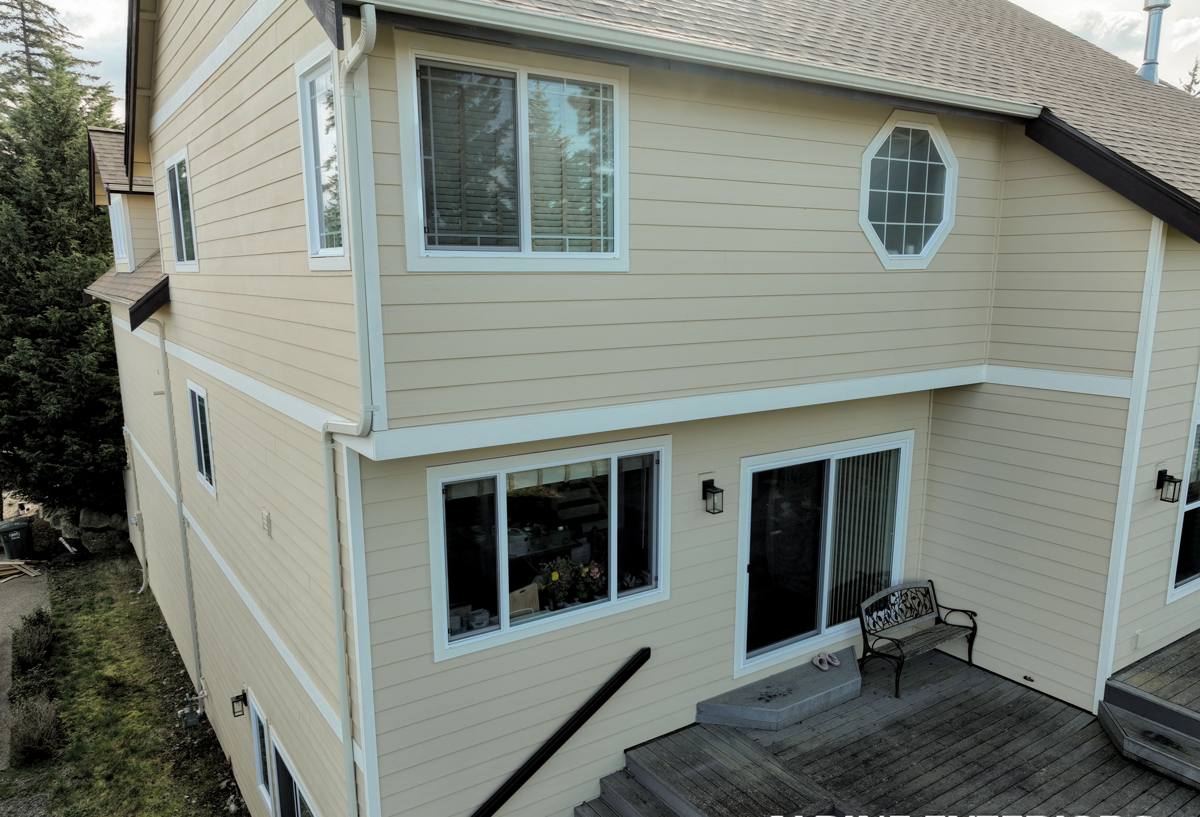
The Real Question Isn't "How Bad Does It Look" — It's "What's Happening Behind It"
Cosmetic damage and structural damage are not the same problem, and siding is deceptive because the two can look nearly identical from the ground. A short list of what actually matters when we're assessing a home:
- Is water getting behind the siding, or just sitting on top of it?
- Is the damage isolated to one course of boards, or is it a pattern that shows up at every corner, seam, and penetration?
- Is the siding material itself failing (delaminating, swelling, rotting), or is the finish just worn out while the board underneath is sound?
- How old is the current siding relative to its expected service life?
- What's underneath — is the house wrap and sheathing still doing its job, or has moisture already reached the framing?
A homeowner can't answer most of these from a ladder. This is where an honest, in-person assessment matters more than a quick estimate over photos — probing soft areas, checking behind a few removed boards, and looking at flashing details around windows and rooflines tells us far more than surface appearance does.
When Repair Is the Right Call
Repair makes sense when the damage is contained and the rest of the siding system — house wrap, flashing, sheathing — is intact. Good candidates for repair include:
Isolated impact damage
A cracked or punctured panel from storm debris, a ladder mishap, or a wayward baseball is usually a straightforward swap of individual boards, especially if the siding is a lap product where sections can be replaced without disturbing the whole wall.
Failed caulking and sealant joints
Caulk has a service life of roughly 10-15 years even when applied correctly, and it fails faster in a climate with constant rain cycling. Re-sealing joints around trim, windows, and penetrations is cheap insurance and doesn't require touching the siding itself.
Localized rot from a single, findable source
A leaking gutter, a missing kickout flashing, or a sprinkler head hitting the same spot on the wall for years can rot a defined area while the rest of the siding is fine. Fix the water source, replace the damaged section, and the repair holds — as long as the cause was actually the cause.
Paint and finish issues on otherwise sound wood or fiber cement
Peeling or chalking paint on boards that are still structurally solid is a refinishing problem, not a siding problem. This is common on older cedar and primed wood siding that was never given a factory-cured finish.
When Repair Turns Into a Losing Bet
The harder conversation is when a homeowner wants a repair but the underlying material or installation won't support one. A few patterns we see regularly in this area:
Rot that shows up in more than one place
If soft siding turns up at multiple corners, under multiple windows, or along more than one wall, that's rarely bad luck — it usually means the original house wrap, flashing, or siding material itself is failing systemically. Patching each spot as it appears becomes an expensive game of whack-a-mole.
Engineered wood or untreated wood siding past its prime
Wood-based siding products rely entirely on an intact factory or field-applied finish to keep moisture out. Once that finish is compromised at scale — not one board, but a wall's worth — the material is absorbing water faster than it can dry, particularly under the tree cover and long wet seasons common around Ferndale. At that point, repairs are cosmetic delays, not fixes.
Vinyl siding that's brittle, faded, or warped
Vinyl has a real lifespan, and UV exposure plus temperature cycling makes older panels brittle. Cracked panels can sometimes be swapped if a matching color still exists, but color-matching 15-year-old vinyl is often impossible since formulations change, and heat-warped sections rarely lie flat again even when reinstalled correctly.
Moss and organic growth that's more than surface-level
Light moss on the surface is a cleaning issue. Moss that's established in seams, under lap joints, or that's holding moisture against the wall long-term is a sign the siding has been staying wet for extended periods — which accelerates whatever material failure is already underway.
How Long Should Siding Actually Last?
Expected service life varies a lot by material, and it's the single biggest factor in whether a repair is worth doing.
| Siding Material | Typical Lifespan (Pacific NW climate) | Repair Viability Late in Life |
|---|---|---|
| Vinyl | 20-30 years, shorter with heavy sun/wind exposure | Low — color match and brittleness issues |
| Untreated or primed wood | 10-20 years depending on maintenance | Low — moisture-dependent finish failure |
| Engineered wood siding | Varies widely by product and installation | Moderate, if caught early |
| Fiber cement (factory-finished) | 30-50+ years with proper installation | High — durable base material, isolated repairs hold |
This is a big part of why we install only James Hardie fiber cement siding on the homes we replace. It's not that other products can't be installed correctly — it's that fiber cement with a factory-applied finish gives homeowners a material that isolated repairs actually make sense on for decades, instead of a material where every repair is a temporary patch on a finish that's degrading everywhere at once.
What a Real Replacement Decision Should Weigh
Replacement is a bigger investment, so it deserves a clear-eyed comparison, not a reflexive "just patch it" or "just tear it all off."
| Factor | Leans Toward Repair | Leans Toward Replacement |
|---|---|---|
| Extent of damage | One or two isolated areas | Damage on multiple walls or elevations |
| Age of siding | Well within expected lifespan | At or past expected lifespan |
| Underlying structure | House wrap and sheathing intact | Sheathing soft, wrap failed, or unknown history |
| Material | Fiber cement, quality wood in good shape | Aging vinyl, degraded engineered wood, untreated wood |
| Plans for the home | Short-term hold or budget-limited | Long-term ownership, planning other exterior work |
Homeowners planning to sell within a year or two sometimes lean toward targeted repairs to address obvious issues without the cost of a full replacement — that's a legitimate strategy as long as it's disclosed honestly and doesn't paper over a structural problem. Homeowners planning to stay long-term, especially in an area with this much sustained moisture exposure, usually get better value putting money into a full, correctly installed system once rather than repeating repairs every few years.
Why We Don't Try to Talk Everyone Into Replacement
It would be easy for any contractor to walk up, see a few damaged boards, and recommend a full tear-off. We don't operate that way. Part of an honest assessment is telling a homeowner when a $600 repair solves the actual problem and a $20,000 replacement isn't warranted yet. Our reputation in Ferndale and the surrounding county depends on being right about that call, not on maximizing the size of every job.
That said, when a home's siding has reached the point where repair is genuinely just delaying the inevitable — recurring rot, a material that's failing broadly, or an installation that never had proper flashing and drainage — we'll say so plainly, explain why, and show you what's driving that recommendation rather than just asserting it.
What to Ask Before You Commit Either Way
- Can you show me, not just tell me, why this is (or isn't) isolated damage?
- What's the condition of the house wrap and sheathing behind the affected area?
- What caused this damage, and has that cause been fixed?
- If I repair now, what's the realistic timeline before I'm dealing with this again?
- If I replace, what material and installation details actually address our climate — not just the national average?
- What warranty coverage applies to a repair versus a full replacement, and who backs it?
Any contractor who can't answer these clearly, or who pushes a recommendation without walking you through the reasoning, is worth getting a second opinion on.
If you're not sure which side of this decision your home falls on, we'll come take a look and give you a straight answer — repair, replacement, or somewhere in between — with no pressure either way. Fill out the form below for a free estimate.