 Ferndale Siding
 Fiber Cement Isn't All the Same Product
Fiber cement siding has earned a strong reputation in Whatcom County because it holds up to the things that wreck other siding materials here: driving rain off the Pacific, salt-laden air near Bellingham Bay, and a moss season that seems to stretch longer every year. But "fiber cement" is a category, not a single product, and the brand behind the board matters more than most homeowners realize. Cemplank is one of several fiber cement lines sold as a lower-cost alternative to James Hardie, often through big-box retailers rather than a certified contractor network. We get asked about it regularly, and we want to be straightforward about why we don't install it, rather than just quietly steering every quote toward Hardie.
This isn't a claim that Cemplank is defective or that it will fail on your house. It's a fiber cement product, and fiber cement is fundamentally sound chemistry. Our concern is with the things that surround the board itself: how consistently it's manufactured, how the finish is warrantied, how available matching material will be in ten or twenty years, and how it's distributed to the people installing it. Those factors matter as much as the board's raw composition, especially in a climate as demanding as ours.
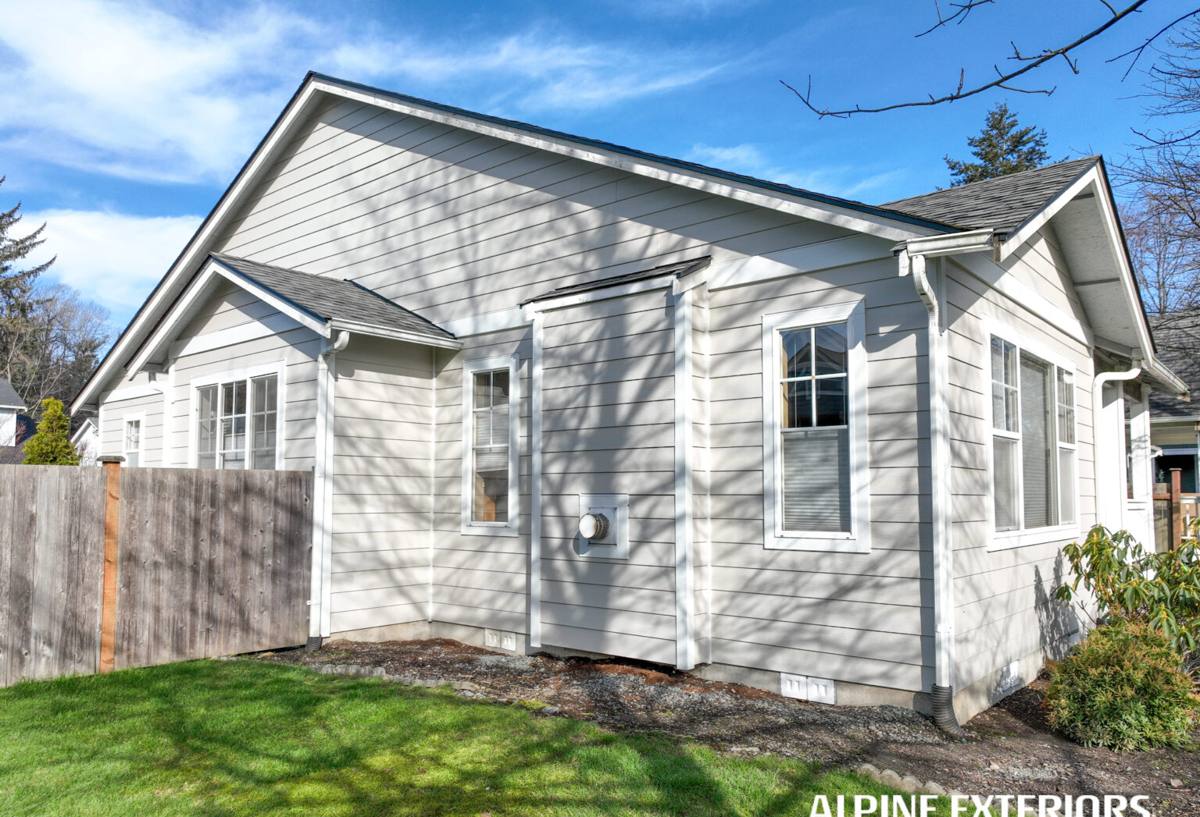
What Cemplank Gets Right
To be fair to the product: fiber cement in general resists rot, won't feed pests, and holds paint far better than wood or engineered wood siding. Cemplank boards are non-combustible like other fiber cement products, and they're dimensionally stable compared to wood-based sidings that swell and shrink with our wet winters and dry summer stretches. For a homeowner on a tight budget who understands the trade-offs, a fiber cement product sold through a home improvement store is a legitimate step up from vinyl or engineered wood. We're not disputing the material science. Our objection is about sourcing, finish accountability, and long-term support, which is where the real risk to a homeowner shows up ten or fifteen years down the road, not in year one.
The Manufacturing and Sourcing Question
James Hardie manufactures its own siding, engineers its own formulations by climate zone, and controls its own factory-applied ColorPlus finish from raw material to painted board. Cemplank, as a private-label fiber cement brand, has been produced under different manufacturing arrangements over the years as it has changed hands and suppliers. That's not a scandal, but it does mean that batch consistency, finish process, and even board specifications can shift over the life of the product line in ways that are harder for a contractor or homeowner to track down after the fact. When you need to match an addition to existing siding, or replace a few boards after storm damage, that history matters.
Factory Finish and Warranty Structure
James Hardie's ColorPlus finish is baked on in a controlled factory process and backed by a manufacturer warranty specific to the finish, separate from the substrate warranty, with terms that are consistent nationwide. Big-box fiber cement lines like Cemplank are more commonly sold primed, meaning the paint job — and the warranty on that paint job — depends heavily on the installing contractor's prep and product choice, not a factory process. In our climate, where UV exposure, salt air, and moisture cycling all attack a paint film, the difference between a factory-cured finish and field-applied paint is not cosmetic. It shows up as chalking, fading, and touch-up work years earlier than it should.
Why Distribution Model Matters More Than It Seems
James Hardie sells almost exclusively through a network of trained, often certified contractors, with technical specs, installation training, and manufacturer field support behind the product. Cemplank and similar private-label lines are typically sold through retail lumber and home-improvement channels, where the person at the counter may know very little about correct fastening patterns, clearances, or joint treatment for our specific rain exposure. Fiber cement is installation-sensitive — get the flashing, gapping, or fastener placement wrong and moisture problems follow no matter whose name is on the board. A retail distribution model doesn't put a bad installer in your yard by itself, but it removes a layer of manufacturer-driven training and accountability that we've come to rely on.
Long-Term Repair and Matching
Whatcom County homes take a beating from windstorms off the Strait, falling branches, and the occasional ladder mishap during gutter cleaning. At some point, most homes need a few boards replaced. James Hardie's product lines and colors are stable and widely stocked for years at a time, so matching an existing wall is usually straightforward. Private-label lines sold through retail channels are more exposed to discontinuation, reformulation, or regional stocking changes, which can leave a homeowner unable to find a true match a decade after installation. That's a real cost that doesn't show up on the initial quote.
Climate Engineering: Why Zone-Specific Matters Here
James Hardie engineers separate formulations for different climate zones — a version built for freeze-thaw regions is not the same board as one built for the Pacific Northwest's wet, moderate-temperature exposure. Ferndale sits close enough to Bellingham Bay and the Strait of Georgia that homes deal with salt-influenced air, near-constant moisture for months at a time, and moss and algae growth that never fully lets up. A siding product engineered generically, without that regional moisture profile in mind, is more likely to show early finish wear or joint problems in our specific conditions. This is one of the clearest reasons we don't treat all fiber cement as interchangeable — the engineering behind the board is doing real work in a climate like ours.
Cemplank vs. James Hardie: A Side-by-Side Look
| Factor | Cemplank | James Hardie |
|---|---|---|
| Manufacturing control | Produced under shifting private-label supply arrangements | Manufactured and formulated in-house |
| Finish process | Commonly sold primed; field-painted | Factory-baked ColorPlus finish |
| Finish warranty | Depends on installer's paint and prep | Manufacturer-backed finish warranty, separate from substrate |
| Climate-specific engineering | General-purpose formulation | Zone-specific HZ formulations, including a Pacific Northwest-suited line |
| Distribution | Retail / big-box channels | Trained contractor network |
| Long-term matching for repairs | Exposed to discontinuation and regional stocking gaps | Stable, widely stocked product lines |
Why We Standardized on James Hardie
We made a decision, as a company, to install one fiber cement system rather than quote whatever a homeowner's budget points them toward. That means we install James Hardie, exclusively, on every siding job we take in Ferndale and the surrounding parts of Whatcom County. It's not because Hardie is the only fiber cement product on the market — it's because we've seen what happens to homes finished with generic or retail-sourced fiber cement after a decade of Pacific Northwest weather, and we'd rather stand behind a single, well-engineered system with a manufacturer that backs its own finish and formulation than manage warranty claims and matching headaches across multiple product lines. Hardie's non-combustible core, factory finish, and climate-engineered HZ product lines line up with the actual demands of this region — salt air, driving rain, and a moss season that tests every seam and joint on a house.
This also simplifies things for homeowners. When every job we do uses the same manufacturer, we know the fastening specs, clearances, joint treatments, and finish requirements cold, and we're not relearning installation quirks between one private-label product and the next.
What to Ask Before You Choose a Siding Product
Whether you hire us or another contractor, these are worth asking about any fiber cement product on the table:
- Is the finish factory-applied and warrantied by the manufacturer, or is it primed and field-painted?
- Does the manufacturer offer a climate- or region-specific formulation, and is it appropriate for a marine, high-moisture area?
- Who backs the warranty — the manufacturer directly, or the installing contractor alone?
- How long has this specific product line been in continuous production, and is it likely to be stocked in 10-15 years for repairs?
- Is the installer trained or certified by the manufacturer, or is this their first time working with this particular product?
- What does the fastening and joint-treatment spec require, and does the installer follow it as written?
The Bottom Line
Cemplank is a real fiber cement product, and we're not here to tell you it will fall off your house. But between manufacturing consistency, finish warranty structure, climate-specific engineering, and long-term repair matching, we don't think it holds up as well as James Hardie against the specific conditions Ferndale and Whatcom County homes face year after year. We'd rather install fewer product lines and know every one of them thoroughly than spread ourselves across whatever's cheapest that week.
If you're planning a siding project and want an honest look at what's right for your home, we're happy to walk the exterior with you and talk through the options — no pressure, no hard sell. Reach out for a free estimate using the form below.