 Ferndale Siding
 Siding Built for Everson's Weather, Not Against It
Everson sits in the Nooksack River valley in Whatcom County, and homes here deal with a specific combination of weather stress that a lot of siding products simply weren't designed for. Long stretches of steady rain, high humidity that lingers through fall and spring, and moisture that gets pulled off the Puget Sound and Georgia Strait and pushed inland across the county all add up over a year. Add tree cover and shaded north walls that stay damp for days after a storm, and you have conditions that will find every weak point in a siding system eventually.
We're an exterior contractor based in Ferndale, and Everson is part of our regular service area. That matters more than it sounds like it should. A crew that works this specific climate week in and week out knows how water actually moves on a house here, which details fail first, and which products hold up over a full Whatcom County winter versus which ones just look good on the day they're installed.
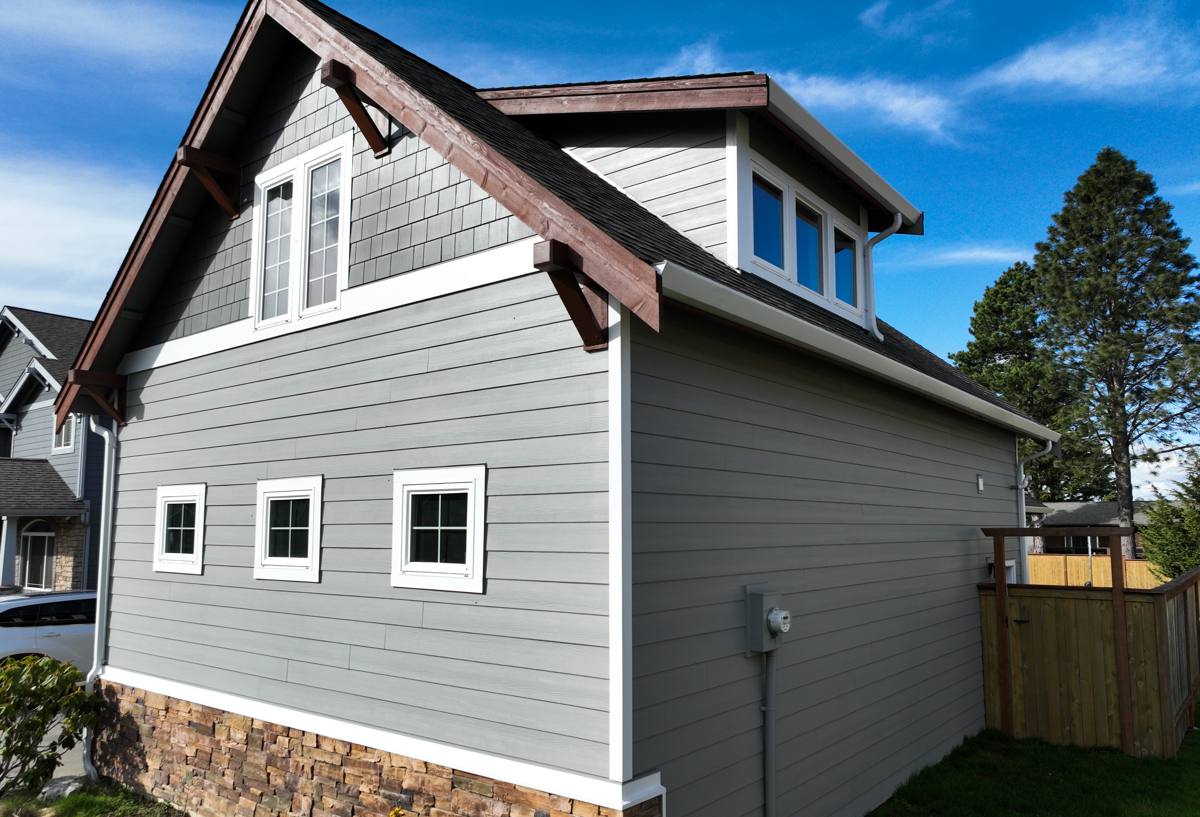
What Wet Climate Does to a House Over Time
No single storm damages a home. It's the accumulation — dozens of wet-dry cycles a year, moss and mildew that never fully dry out on shaded siding, and driving rain that finds its way behind poorly sealed joints and trim. A few specific failure points show up again and again on homes we inspect in this area:
- Moss and algae staining on north- and west-facing walls that stay shaded and damp longest
- Swelling, delaminating, or soft spots at butt joints and around window and door trim on wood-based siding
- Paint that fails early because the substrate underneath is absorbing moisture
- Caulk joints that crack and open up gaps for water intrusion within a few years
- Fascia, corner boards, and other trim rotting from the inside out before the siding itself shows damage
Fiber cement wasn't invented to solve a marketing problem — it was developed specifically because wood-based and composite sidings struggle with exactly this kind of sustained moisture exposure. That's the core reason we standardized on it.
Why We Install Only James Hardie Fiber Cement
We get asked fairly often why we don't offer vinyl, LP SmartSide, or other engineered wood and composite siding products. It's a fair question, and the honest answer is that we made a professional decision to stop installing products we'd seen fail, or fail early, in this climate — not because those products are worthless everywhere, but because they're not what we want standing behind our name on a house in Whatcom County.
Vinyl
Vinyl is inexpensive and low-maintenance in the sense that it doesn't need painting, but it's a thin plastic product that expands and contracts with temperature swings, can crack in impact or extreme cold, and telegraphs every wave or dip in the wall behind it. It also isn't a fire-rated product, which matters more every year as insurance underwriting tightens.
Engineered Wood (LP SmartSide and similar)
Engineered wood products have improved a lot over the years and hold paint well when new. The trade-off is that they're still wood-based, meaning the long-term risk is moisture intrusion at cut edges, seams, and fastener penetrations — exactly the kind of chronic dampness Whatcom County delivers for months at a stretch. When these products fail, it's usually not dramatic; it's slow, hidden swelling that shows up as soft trim or a failing paint job years down the road.
Other Fiber Cement Brands (Cemplank, Allura, etc.)
These are legitimate fiber cement products and share the core material advantages of the category — noncombustible, dimensionally stable, resistant to moisture and pests. We standardized on James Hardie specifically because of its factory-applied ColorPlus finish, its HZ5 product engineering for cold, wet climates, and the depth of its installer network and warranty support in this region. It's a business decision built on consistency, not a claim that competing fiber cement is defective.
Why Hardie Fits This Climate
James Hardie fiber cement is cement, sand, and cellulose fiber — noncombustible, dimensionally stable, and engineered specifically for wet Pacific Northwest conditions through its HZ5 product line. It doesn't absorb water the way wood-based products do, it holds paint and factory finish far longer, and it resists the moss, mildew, and staining that show up fast on shaded Everson walls. The ColorPlus factory finish carries its own separate finish warranty, and the product itself carries a long transferable warranty when installed to Hardie's specifications — which is the part that actually determines how it performs.
Siding Material Comparison
| Factor | Vinyl | Engineered Wood | James Hardie Fiber Cement |
|---|---|---|---|
| Moisture resistance | Doesn't absorb water, but seams leak | Vulnerable at cut edges and seams | Engineered for wet climates (HZ5) |
| Fire rating | Not fire-rated | Combustible | Noncombustible |
| Finish longevity | Can fade, doesn't repaint easily | Field-painted, repaints on a cycle | Factory ColorPlus finish, separately warrantied |
| Typical lifespan | 20-30 years | 15-30 years depending on maintenance | 30-50+ years with proper install and upkeep |
| Impact resistance | Can crack in cold or impact | Moderate | High |
Cost is a real factor too. Hardie generally sits above vinyl and roughly in line with or above engineered wood on installed price, but the comparison only makes sense when you weight it against repainting cycles, trim repair, and how many years you actually get before replacement. A homeowner planning to stay in an Everson home for the long haul usually comes out ahead with a product that isn't quietly degrading behind the paint.
What a James Hardie Install Actually Involves
Fiber cement performs the way it's rated to perform only when it's installed correctly, and installation quality is where a lot of the difference between contractors shows up. Correct installation for this climate includes:
- Proper water-resistive barrier and flashing details at every window, door, and penetration
- Correct fastener type, spacing, and placement per Hardie's published specifications
- Manufacturer-specified clearances at grade, roofline, and deck ledger connections so siding isn't sitting in standing moisture
- Properly sealed and caulked joints using compatible sealants
- Factory-finished panels handled and cut in ways that don't compromise the ColorPlus coating
This is also where a local crew earns its keep. We know which details on an Everson home need extra attention — a shaded north wall, a low-clearance area near a deck, a roofline that dumps water onto a specific section of siding — because we've seen the same layouts and the same failure patterns on homes throughout this part of the county.
The Rest of the Exterior: Roofing, Windows, and Decks
Siding doesn't work in isolation. A roof that's shedding water onto a wall, windows that leak at the flange, or a deck ledger that's trapping moisture against the house will undermine even a perfect siding job. We handle all four exterior trades — siding, roofing, windows, and decks — so we can look at a home as one connected system rather than patching one component while ignoring what's happening around it.
That's particularly relevant in Everson, where a lot of homes have mature tree cover, complex rooflines, or decks built directly against the house. When we quote a siding project, we're looking at flashing, roof-to-wall transitions, and window integration as part of the same conversation, not as separate problems to deal with later.
Signs It's Time to Look at Your Siding
- Persistent moss or algae staining that comes back within a season of cleaning
- Paint that's peeling, bubbling, or chalking faster than it should
- Soft or spongy spots when you press on trim, corner boards, or siding panels
- Visible gaps opening up at seams, corners, or around windows
- Rising energy bills that suggest the wall assembly isn't performing the way it used to
- Siding that's original to a home built more than 20-25 years ago with a wood-based or early composite product
Any one of these on its own might not mean much. A few of them together, especially on a home with wood-based or older composite siding, is usually a sign the material has reached the point where repair is just delaying an inevitable full replacement.
Maintenance That Actually Fits This Climate
Even the right siding material needs some upkeep in a climate like Whatcom County's. The difference with James Hardie is how little that upkeep actually is compared to wood-based alternatives. A rinse to knock back moss and grime once or twice a year, keeping gutters clear so water isn't sheeting down a wall, and a quick visual check of caulk joints after a hard winter is realistically most of what's needed. There's no repainting cycle to plan around, because the ColorPlus finish is baked on at the factory rather than field-applied.
A Local Crew That Knows This Ground
We're a Ferndale-based company, and Whatcom County is the whole of our business — not a territory we drive into once and never see again. When we install siding in Everson, we're standing behind work in a community we service continuously, which means warranty follow-up, honest answers about what a home actually needs, and a crew that's already dealt with the moss, the rain, and the humidity that define exterior work here.
If your siding is showing its age, or you're planning ahead of a bigger renovation, we're happy to take a look and give you a straightforward assessment. Reach out for a free, no-pressure estimate using the form below — we'll walk the property, tell you what we actually see, and give you options without a sales pitch attached.