 Ferndale Siding
 Why Siding Wears Differently on a Sudden Valley Lot
Most homes in Sudden Valley sit among mature trees on sloped ground near Lake Whatcom, and that setting changes how siding behaves compared to a home on an open, cleared lot elsewhere in Whatcom County. Tree canopy blocks direct sun and wind from reaching large sections of the exterior wall, which means those walls take much longer to dry out after rain. Combine that with the marine air that moves through this part of Washington off the Sound and the Strait, and you get walls that stay damp for extended stretches of the fall, winter, and spring.
That combination — shade, standing moisture, and long stretches without a real drying window — is exactly the condition under which moss, algae, and mildew take hold on siding, and it's the condition under which lower-grade or moisture-sensitive materials start to fail years before they should. A siding job in Sudden Valley isn't just "the same install, but in the woods." The material, the detailing, and the drying path all need to account for it.
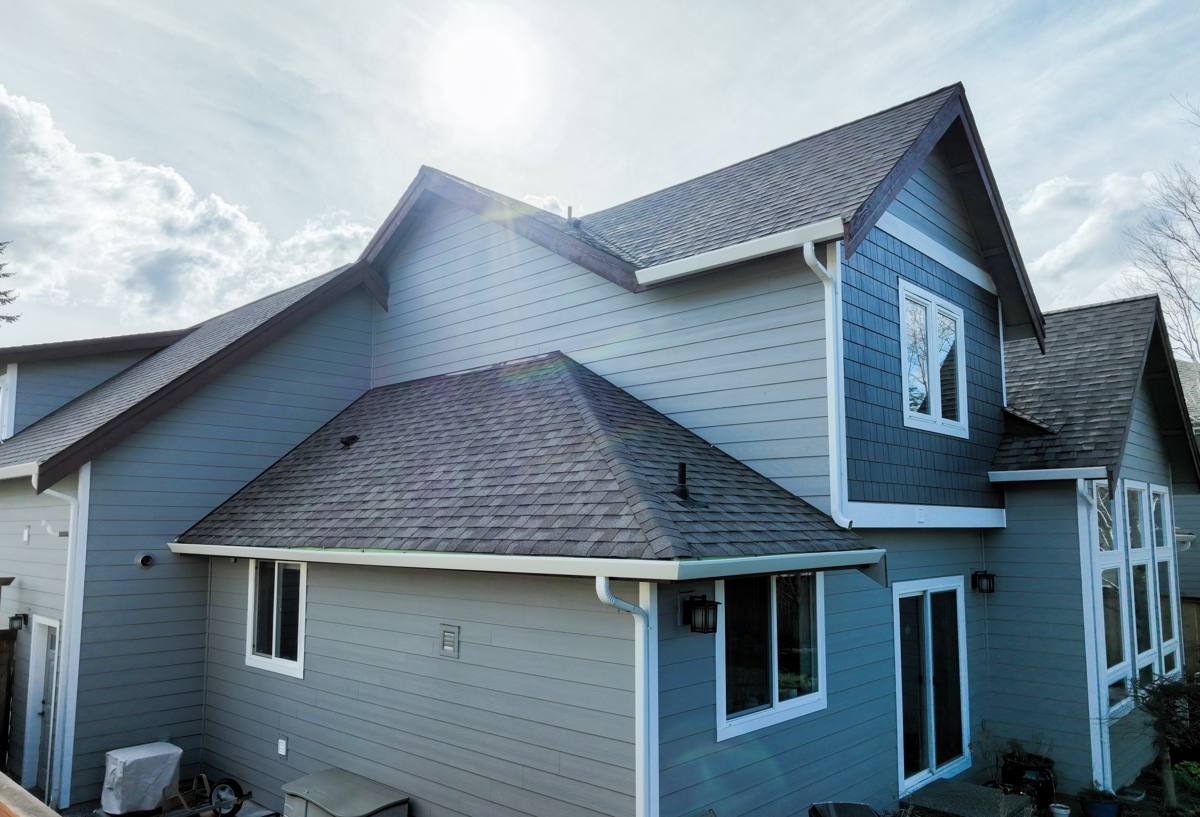
What Constant Shade and Moisture Do to the Wrong Siding Material
Wood-based siding products — cedar, primed spruce, and engineered wood products like LP SmartSide — are cellulose at their core. Cellulose absorbs water. In a sunny, well-ventilated location that's manageable, because the material gets regular chances to dry. On a shaded Sudden Valley wall that rarely gets direct sun, moisture has more time to work into cut edges, seams, and any spot where the factory coating has been compromised. Over years, that shows up as swelling, soft spots, edge delamination, and paint or coating failure that keeps coming back no matter how often it's touched up.
Vinyl siding has a different problem on wooded lots: it's a thin, flexible material that doesn't hold up well to falling branches, wind-driven debris, or the general wear of being tucked under a tree canopy — it cracks, fades unevenly in dappled light, and can't be spot-repaired without leaving a visible patch. Neither of these material categories is "bad" in every setting. They're just a poor match for the specific combination of moisture and cover that defines a lot like this one.
This is why our crew installs only James Hardie fiber cement siding. It's not a marketing preference — it's the product we've found actually holds up to this climate without turning into a recurring maintenance project for the homeowner.
How James Hardie's System Is Built for This Kind of Site
Climate-Engineered HZ Product Lines
James Hardie manufactures siding in different formulations for different climate zones — a moisture- and mildew-resistant HZ5 formulation is engineered for the wetter, colder regions that include western Washington. The point of that engineering is a fiber cement composition and factory finish designed to resist moisture intrusion and mold growth in exactly the conditions a shaded Sudden Valley wall creates.
Non-Combustible Core
Fiber cement is non-combustible. On a heavily treed lot near Lake Whatcom, where defensible space and wildfire exposure are real considerations for homeowners in this region, that's a meaningful difference from wood-based siding — not a replacement for proper landscaping and clearance, but one less combustible surface on the house itself.
ColorPlus Factory Finish
James Hardie's ColorPlus finish is baked on at the factory under controlled conditions, rather than field-applied paint drying in whatever weather shows up that week. On a lot with limited sun exposure, that matters — a factory finish cures fully before it ever goes on the wall, so you're not relying on a damp, shaded jobsite to properly cure a coat of paint. It also holds color and resists the fading and chalking that on-site paint jobs are prone to over time.
What a Correct Installation Involves Here
Fiber cement is a forgiving material in the right conditions, but the details of the install matter more, not less, on a shaded, moisture-prone lot. A correct installation includes:
- A properly lapped weather-resistive barrier behind the siding, with all penetrations (pipes, vents, fixtures) flashed before a single course goes up
- Correct ground clearance — typically a minimum of 6 inches from soil and 1-2 inches from decks, patios, and roof lines — so the bottom edge isn't sitting in standing moisture from mulch beds or ground cover common under tree canopy
- Factory-cut edges kept intact wherever possible, since factory edges already carry sealed, finished surfaces; any field cuts get properly sealed per manufacturer specification
- Correct fastener type, spacing, and depth — over-driven or under-driven nails are one of the most common causes of early siding problems, and they're not visible once the job looks "done"
- Proper gaps at trim, window and door openings, and butt joints, sealed with a quality sealant rated for exterior use rather than caulked shut with no room for the material to move
- Attention to which walls get the least sun and airflow, so those elevations get extra care on flashing and drainage rather than the same generic treatment as a south-facing wall
Skipping any one of these doesn't show up on day one. It shows up two or three winters later, as moisture finds the one gap that wasn't sealed or the one nail that split the board underneath its finish.
Our Process for a Sudden Valley Project
We start with a walk-around that pays specific attention to which walls sit in shade for most of the day, where moss or discoloration has already appeared, and how water currently drains around the foundation. If we're replacing existing siding, we check the sheathing underneath once it's exposed — this is the only point in the project where hidden moisture damage from the old siding can actually be found and addressed, rather than sealed back up and forgotten.
From there, installation follows manufacturer specification for flashing, clearance, and fastening as outlined above, with extra attention on the shaded elevations. If your property is part of an association with architectural or color guidelines, we work within those requirements during color and trim selection. We finish with a walk-through so you know exactly what was done and what maintenance, if any, to expect going forward.
Cost Factors on a Sudden Valley Lot
| Factor | Why It Affects Cost |
|---|---|
| Tree cover and lot access | Staging materials and equipment on a wooded, sloped lot takes more planning and labor than a flat, open lot |
| Existing moisture damage | Rotted sheathing or framing found once old siding comes off adds repair work beyond the siding itself |
| Home size and wall complexity | Multiple stories, dormers, and cut-up wall lines mean more cutting, flashing detail, and labor hours |
| Trim and accessory selection | Fascia, soffit, and trim board choices add to material cost beyond the field siding |
| Color and finish selection | Standard ColorPlus colors versus custom or premium finish options carry different price points |
We won't quote a number without seeing the property, but these are the variables that actually move the estimate — not vague "site conditions," but specific, explainable factors.
Why a Crew That Already Works Sudden Valley Matters
Sudden Valley is a private residential community with its own internal roads and access procedures, which is a real logistical factor for any contractor working here — a crew unfamiliar with the community has to figure out gate access, guest coordination, and staging on tighter, tree-lined roads for the first time on your project. A crew that already works in the area has that sorted before the job starts.
More importantly, a contractor who's done multiple jobs on lots like this already knows what to expect once old siding comes off a shaded wall near the lake — where moisture damage tends to show up, which elevations need extra flashing attention, and how the tree cover on a given lot affects drying time during the install itself. That familiarity doesn't replace doing the work correctly, but it does mean fewer surprises and a more accurate estimate from the start.
A Straightforward Checklist Before You Hire
- Ask whether the contractor is a James Hardie-focused installer or one that also sells vinyl or wood-based alternatives — the answer tells you where their default recommendation will land
- Ask how they handle ground clearance and flashing on shaded, moisture-prone walls specifically
- Ask what happens if they find rotted sheathing once old siding is removed — get this in writing before work starts
- Ask whether they've worked in Sudden Valley or similar wooded, private communities before
- Ask for the manufacturer's installation instructions they follow, and whether their crew is trained to that specification
A siding job you can't see the details of is a siding job you're trusting entirely to reputation. Ask the questions above of anyone bidding the work, including us.
If you're weighing a siding replacement in Sudden Valley, we're glad to walk the property, look at what your walls are actually dealing with, and put together a straightforward, no-pressure estimate using the form below.