 Ferndale Siding
 Why Sudden Valley Decks Wear Out Faster Than People Expect
Sudden Valley sits close enough to the water and up against enough tree cover that decks here take a different kind of beating than decks in a drier inland town. It's not one big event that ruins a deck — it's the slow accumulation of small ones. Salt-tinged air off the water works into fasteners and metal connectors. Driving rain off Bellingham Bay gets pushed sideways by wind and finds its way under railings and around post bases. And the long moss season — which in this part of Whatcom County can run from October clear through April — keeps deck boards damp for days after a storm has already passed everywhere else.
Put those three things together and you get a deck that looks fine from the porch but is quietly failing where you can't see it: ledger boards holding moisture against the house, joists softening from underneath, and fasteners corroding inside wood that still looks solid on top. By the time a deck feels spongy underfoot or a railing wiggles, the damage is usually well past a patch-and-paint fix.
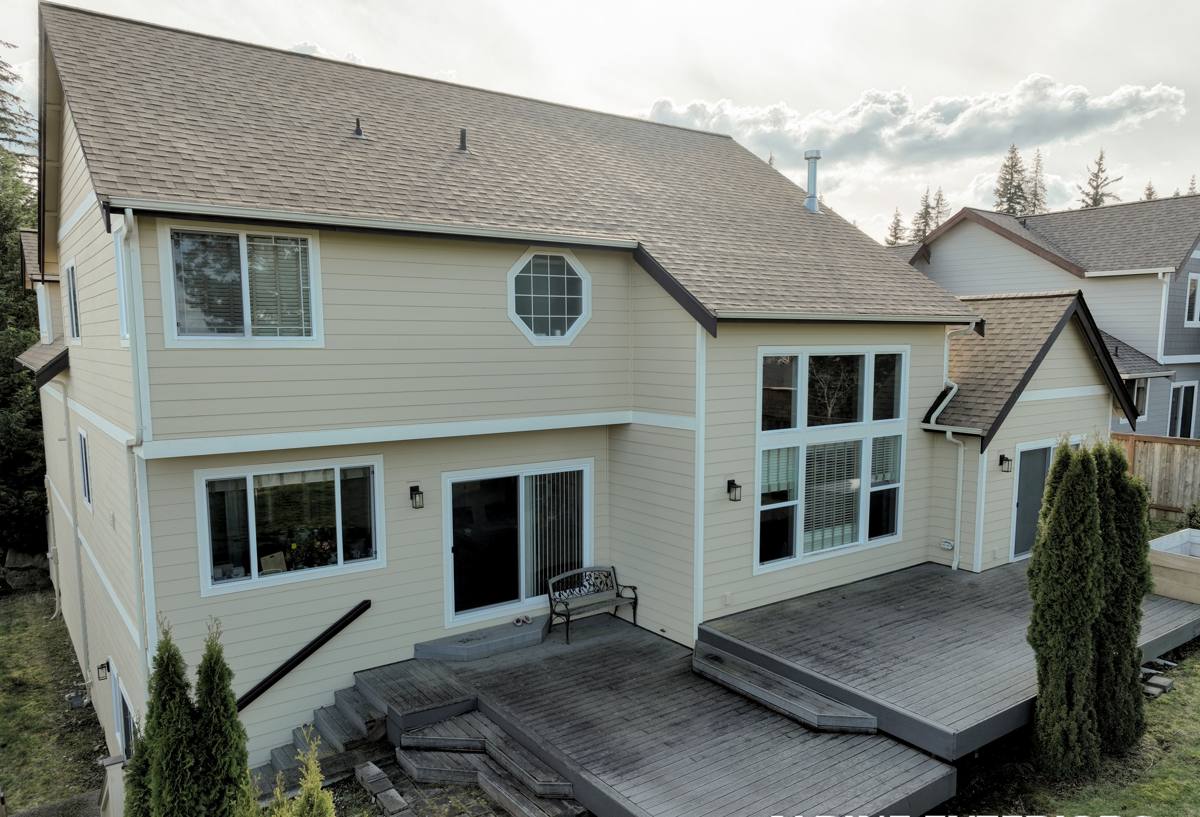
What "Deck Replacement" Actually Means Here
We use the term deliberately, not loosely. A deck replacement is a full teardown and rebuild — not a resurfacing job where new boards get screwed down over an old, possibly compromised frame. For Sudden Valley homes, that distinction matters more than it might elsewhere, because a frame that's been sitting under moss and standing water for years can look structurally fine while the connections holding it together have already started to fail.
A proper replacement includes:
- Full removal of the old decking, railings, and (where needed) the substructure
- Inspection of the ledger board attachment to the house — a common failure point in wet climates
- Replacement of posts, beams, and joists that show rot, insect damage, or soft spots
- Correct flashing at the ledger so water sheds away from the house instead of behind the siding
- Proper post footings sized and set for our soil and frost conditions
- New decking, railing, and fastener systems matched to the deck's height, exposure, and use
Skipping the substructure inspection is the single most common shortcut in deck work, and it's the one that costs homeowners the most a few years down the road when the new boards on top are fine but the frame underneath isn't.
How the Climate Shapes Our Material Choices
We don't recommend the same deck package for every property. A deck under heavy tree cover in Sudden Valley, shaded most of the day and slow to dry, needs a different approach than a more open, sun-exposed deck a few streets over. The variables we weigh:
Moisture exposure
Decks that stay damp longer need better ventilation underneath, larger gaps between boards for drainage and airflow, and fasteners rated for wet, corrosive conditions. Standard interior-grade hardware has no business on an exterior deck out here — we use fasteners and connectors rated for exterior and coastal exposure as a baseline, not an upgrade.
Moss and organic buildup
Composite and capped-composite decking resist moss growth better than raw wood because they don't provide the same organic surface for spores to take hold. Wood decking can still be the right choice — it has a look and feel a lot of homeowners want — but it needs a maintenance commitment to washing and sealing that composite doesn't.
Salt air near the water
Anything ferrous corrodes faster this close to the coast. We spec stainless or coated fasteners and hidden fastener systems rated for coastal use, and we're careful about which railing systems and hardware we'll stand behind for properties with direct water exposure.
Decking Material Comparison for This Area
| Material | Moss/Moisture Resistance | Maintenance | Typical Lifespan Here |
|---|---|---|---|
| Pressure-treated wood | Moderate — needs regular sealing | Annual cleaning and re-sealing recommended | 10-15 years with upkeep |
| Cedar | Good natural resistance, but surface still needs care | Periodic cleaning, staining or sealing | 15-20 years with upkeep |
| Capped composite | Strong — resists moss and moisture absorption | Occasional washing, no sealing | 25-30+ years, backed by manufacturer warranty |
| PVC decking | Very strong — non-organic surface | Occasional washing | 25-30+ years, backed by manufacturer warranty |
None of these is a wrong answer. The right one depends on your budget, how much upkeep you want to take on, and how much shade and moisture your specific lot deals with. We'll walk your property with you and give you a straight recommendation rather than pushing whatever's easiest for us to install.
What a Correct Job Involves, Step by Step
1. On-site assessment
We start under the deck, not on top of it. That means checking ledger attachment, post footings, joist condition, and any signs of standing water or moss buildup that point to a drainage problem rather than just a material problem.
2. Scope and material selection
Based on what we find, we put together a scope that's specific to your deck — not a generic package. If the frame is sound and only the surface needs replacing, we'll tell you that. If the frame needs rebuilding, we'll explain why and show you what we found.
3. Demolition and disposal
Old decking, railings, and any compromised framing come out and get hauled off. We protect the surrounding landscaping and structure during this phase, which matters more on tighter Sudden Valley lots where the deck may sit close to plantings or a slope.
4. Structural rebuild
New ledger flashing, posts, footings, beams, and joists go in to current code requirements, sized for the deck's actual use — not the minimum that'll pass and nothing more.
5. Decking, railing, and finish work
Surface material goes down with proper spacing for drainage and expansion, railings are installed to code height and spacing, and all fastener heads and connections get a final check.
6. Final walkthrough
We walk the finished deck with you, point out anything you should know about care and maintenance for the material you chose, and make sure you're clear on what warranty coverage applies to what.
Signs a Sudden Valley Deck Needs Replacing, Not Repairing
- Boards feel spongy, springy, or noticeably different underfoot in certain spots
- Visible moss or algae staining that keeps returning within weeks of cleaning
- Railings that flex, wobble, or feel loose when leaned on
- Gaps or rust staining around fasteners, especially near the ledger board
- Visible daylight or water staining where the deck meets the house
- A deck older than 15-20 years that hasn't had the substructure inspected
- Persistent musty smell near or under the deck after rain
Any one of these on its own might be a minor fix. Two or three together, especially on an older deck, usually mean it's time for a real inspection before you spend money patching something that needs to come out.
Why It Matters That We Already Work in Sudden Valley
A crew that mostly works drier, more sheltered parts of Whatcom County will build a deck to a general standard and hope it holds up. A crew that already works Sudden Valley regularly has seen which details actually fail here — which fastener types corrode first, which ledger flashing details let water in over a few winters, which decking surfaces stay slick under moss longer than the manufacturer's brochure suggests. That's not something you can fully substitute with a generic install, no matter how good the crew is on paper.
It also means we're realistic with you about timelines. Deck work in this area needs to work around wet ground conditions and a shorter reliable dry-weather window than a lot of homeowners expect, and we plan the job accordingly instead of promising a schedule the weather won't cooperate with.
Permits and Code Considerations
Most deck replacements that involve rebuilding the structure — not just swapping surface boards — require a permit. Requirements cover things like railing height, guard spacing, footing depth, and ledger attachment method, and they exist because these are exactly the failure points that cause injuries when they're done wrong. We handle the permitting process as part of the job and build to what's required, not to a shortcut version of it.
What a Sudden Valley Deck Replacement Typically Involves in Cost
We're not going to hand you a number that means nothing until we've seen the deck, but here's what actually drives the cost so you know what you're paying for:
- Size and shape of the deck, including multiple levels or built-in features like benches or stairs
- Whether the substructure needs full replacement or only partial repair
- Material choice — wood is generally less expensive upfront than composite or PVC, which cost more initially but less over time in maintenance
- Height off the ground and complexity of railing and stair requirements
- Site access — decks on slopes or tight lots common in this area can add labor time
- Permit and inspection requirements for the scope of work
We give a written estimate after seeing the deck in person, broken down so you know what you're paying for and why — not a flat number pulled from a price list that doesn't account for your specific situation.
Maintaining Your New Deck in This Climate
Whatever material you choose, a little seasonal attention goes a long way here. Clearing leaves and debris before the wet season sets in, keeping gutters and downspouts directing water away from the deck rather than onto it, and washing off moss and algae before it has a chance to establish are the basics that extend any deck's life regardless of material. We'll give you specific care guidance for whatever you choose, since a cedar deck and a composite deck need different upkeep to hold up through a Whatcom County winter.
If you're weighing whether your Sudden Valley deck needs a repair or a full replacement, we're happy to take a look and give you an honest answer — including telling you if repair is genuinely the right call. Reach out for a free, no-pressure estimate using the form below.