 Ferndale Siding
 Siding Repair for Sudden Valley Homes
Sudden Valley sits along Lake Whatcom, tucked into the trees in a way that makes it feel like a different world from the open, in-town lots closer to downtown Ferndale. That setting is part of what draws people to live there, but it also means the siding on these homes is working against a specific combination of conditions: salt-influenced air moving in off the water, driving rain that gets pushed sideways into walls during fall and winter storms, and a moss season that runs longer under tree cover than it does on a cleared, sun-exposed lot. Siding repair here isn't just about matching a board and moving on — it's about understanding why that board failed in the first place and making sure the fix holds up against the same conditions that caused the damage.
We work in Sudden Valley regularly, and this page is about what siding repair actually involves for homes in this specific setting: what to look for, what a correct repair covers, how we approach the work, and when a repair is the right call versus when it's time to talk about something bigger.
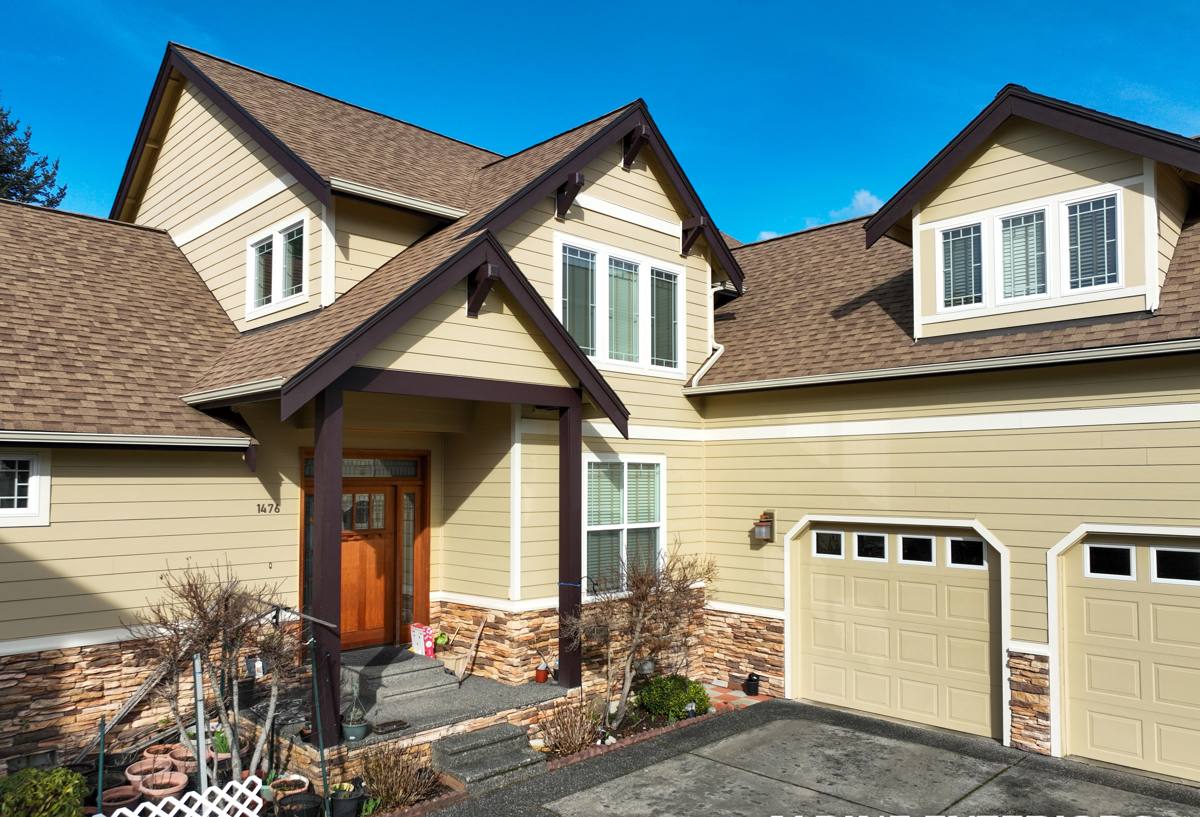
What Sudden Valley's Climate Does to Siding Over Time
Driving Rain at Seams and Corners
Storms moving through Whatcom County rarely drop rain straight down — they push it sideways into walls, and that wind-driven angle finds weaknesses that vertical rain never would. Lap joints, corner boards, and trim intersections that were fine for years can start letting water through once a seal ages, a fastener backs out, or a board shifts slightly out of alignment. On a Sudden Valley property, that exposure is constant through the wet months, which is why the same few spots on a wall tend to be where repair calls originate.
Marine-Influenced Air and Fastener Corrosion
Air moving inland off the water carries salt content that accelerates corrosion in fasteners, flashing, and any exposed metal trim. A corroding nail or staple loses its holding strength gradually, and as it works loose it opens a small gap around itself — a direct path for water to get behind the siding that often isn't visible from the ground until the damage underneath has already started.
Tree Cover and an Extended Moss Season
Sudden Valley's tree canopy is heavier than most in-town lots in the area, and that shade keeps walls damp longer after every rain. Moss and algae don't just look bad on a shaded, north-facing wall here — they stay active for most of the year rather than dying back in a dry stretch, and any organic growth left in place holds moisture directly against the siding surface. That's often the real reason a board that looks fine from a distance turns out to be soft or delaminating once you get close.
Wet-Dry Cycling on Wood-Based Products
A lot of homes in this community were sided years ago with cedar, primed wood trim, or engineered wood products, and all of them absorb and release moisture with the seasons. Repeated wet-dry cycling causes cupping, checking, and swelling at cut edges over time, and in a climate that stays damp as long as this one does, that cycling happens more often than it would on a drier site.
Repair or Replace? How We Make That Call
Not every damaged section needs to come off the house, and not every problem can be solved with a patch. The honest answer depends on how far the damage has spread and what's happening behind the siding, not just what's visible on the surface.
| Situation | Usually a Repair | Usually Points to Replacement |
|---|---|---|
| Damage extent | One board, one section, or an isolated impact area | Multiple walls or elevations showing similar failure |
| Moisture behind the wall | Sheathing underneath is still dry and solid | Sheathing is soft, discolored, or shows rot when probed |
| Cause of damage | A single event — impact, a failed caulk joint, storm damage | Ongoing material failure — widespread cupping, splitting, or delamination |
| Age and material | Siding is otherwise sound and reasonably current | Siding is near the end of its service life or a discontinued product |
| Matching feasibility | Replacement boards can be reasonably matched to existing siding | Existing siding is too weathered or faded to match new material into |
We check both boxes on a repair call — what's visible and, where we can access it, what's happening on the other side of the board. A patch that goes over trapped moisture without addressing it just hides the problem for another season.
What a Correct Siding Repair Actually Involves
Diagnosing the Real Cause, Not Just the Symptom
A cracked or stained board is a symptom. Before we replace anything, we look at why that spot failed — a missing or undersized piece of flashing, a caulk joint that opened up, grade or plantings sitting too close to the wall, or a fastener that's corroded and backed out. Replacing the board without fixing the underlying cause just buys a few more years before the same spot fails again.
Checking What's Behind the Board
Once a section is opened up, we check the water-resistive barrier and sheathing behind it for staining, softness, or signs that moisture has been tracking in longer than the visible damage suggests. This is the step that separates a real repair from a cosmetic one — a new board over compromised sheathing looks fine for a while and fails again quickly.
Matching Material and Profile
Whether the existing siding is cedar, vinyl, engineered wood, or Hardie, the repair needs to match the profile, reveal, and finish closely enough that it doesn't stand out as an obvious patch. For non-Hardie siding, that sometimes means sourcing a compatible replacement piece; for Hardie siding, it usually means matching the exact plank width and ColorPlus finish so the repair blends into the field.
Correct Fastening and Sealing
New material has to go in with the right fastener type and spacing for that specific product, correctly lapped joints, and sealant only where the manufacturer calls for it — caulk isn't a substitute for proper flashing, it's a secondary layer of protection. Rushed repairs tend to lean on caulk to cover a detailing shortcut, which fails faster than doing the flashing correctly the first time.
Common Repair Scenarios We See in Sudden Valley
The specific repair a home needs usually tracks pretty closely with what's currently on the walls. A few patterns come up often enough in this community to be worth calling out.
- Cedar boards cupping or splitting near ground level or under heavy tree cover, usually tied to a finish that's overdue for recoating
- Corner trim and window casing separating where caulk has failed and wind-driven rain has been getting behind it
- Isolated impact damage from a fallen branch or storm debris, common on tree-lined lots
- Moss-driven staining and softness on shaded, north-facing walls where organic growth has been sitting against the surface for an extended period
- Corroded or backed-out fasteners on older installations, especially on walls with the most direct wind exposure
- Deck ledger or attachment points where trapped moisture has damaged the siding immediately around the connection
We repair whatever material is currently on the house — we don't turn away a repair call just because it isn't Hardie siding. But when we're the ones sourcing new material for a patch, or when a homeowner asks what we'd put on if it were a full re-side, James Hardie fiber cement is what we recommend and install, for the same reasons it's what we exclusively install as a company: it's dimensionally stable, doesn't feed the wet-dry cycling that drives most of the repairs above, and its ColorPlus finish doesn't depend on a field coat the way stained or painted wood does.
Our Repair Process, Start to Finish
- A walk-through of the affected area and the rest of the exterior, since one visible problem often isn't the only one
- An honest read on whether this is a straightforward repair or something that points toward a larger issue
- Opening the damaged section to check the sheathing and water-resistive barrier before closing anything back up
- Sourcing matching material — or discussing options if an exact match isn't realistic
- Correct flashing, fastening, and sealing detail on the repaired section, not just a cosmetic patch
- A written explanation of what we found and what we did, including anything worth keeping an eye on going forward
Why a Crew That Already Works Sudden Valley Matters
Siding repair looks different on a shaded, tree-covered lot than it does on an open, sun-exposed one across town, and a crew that works Sudden Valley regularly already knows that going in. We know which wall orientations in this community stay damp the longest under tree cover, how far the moss and algae season actually stretches here compared to more open parts of Whatcom County, and where corrosion tends to show up first on fasteners exposed to lake-side, marine-influenced air. That experience shows up in small decisions on a repair call — whether a patch is enough or whether we should be looking harder at what's behind it, which flashing details are worth extra time given this specific exposure, and when a homeowner is better served by an honest "this needs more than a patch" than a quick fix that won't hold through the next wet season.
Siding Repair Checklist for Sudden Valley Homeowners
- Walk the exterior after major storms and check for loose, cracked, or missing siding sections
- Look closely at shaded and tree-covered walls for moss, algae, or persistent dark staining
- Check caulk joints at corners, trim, and window casing for cracking or separation
- Press gently on any board that looks discolored or feels soft to check for hidden moisture damage
- Inspect deck ledger connections and any point where a structure attaches to the house
- Note whether damage is isolated to one area or showing up in similar patterns on multiple walls
Get an Honest Look at Your Siding
If you're seeing damage, staining, or soft spots on your Sudden Valley home's siding, we're glad to take a look and give you a straight answer about what's actually going on — repair, partial replacement, or something bigger — before any work starts. Reach out using the form below to schedule a free, no-pressure estimate.