 Ferndale Siding
 Metal Roofing for Everson: Built for the Nooksack Valley
Everson sits along the Nooksack River in Whatcom County, close enough to the water that salt-laden air off the Sound still reaches it on a regular basis, and far enough inland that it also picks up the damp, low-lying valley moisture that settles over farmland and river-bottom lots. That combination — salt air, driving rain that rarely falls straight down, and a moss season that stretches through most of the year — is hard on every part of a roof, and it's especially hard on roofs that weren't detailed or fastened with this specific exposure in mind. We install metal roofing on homes in Everson regularly, and the approach here is built around what this valley actually does to a roof over ten, twenty, and thirty years, not just how a product performs on a spec sheet.
Metal roofing isn't the right fit for every home or every budget, and we'll tell you that honestly. But for an Everson property dealing with sustained moisture, wind-driven rain, and a long moss season, it's a material that solves problems other roofing types tend to fight against for the life of the roof.
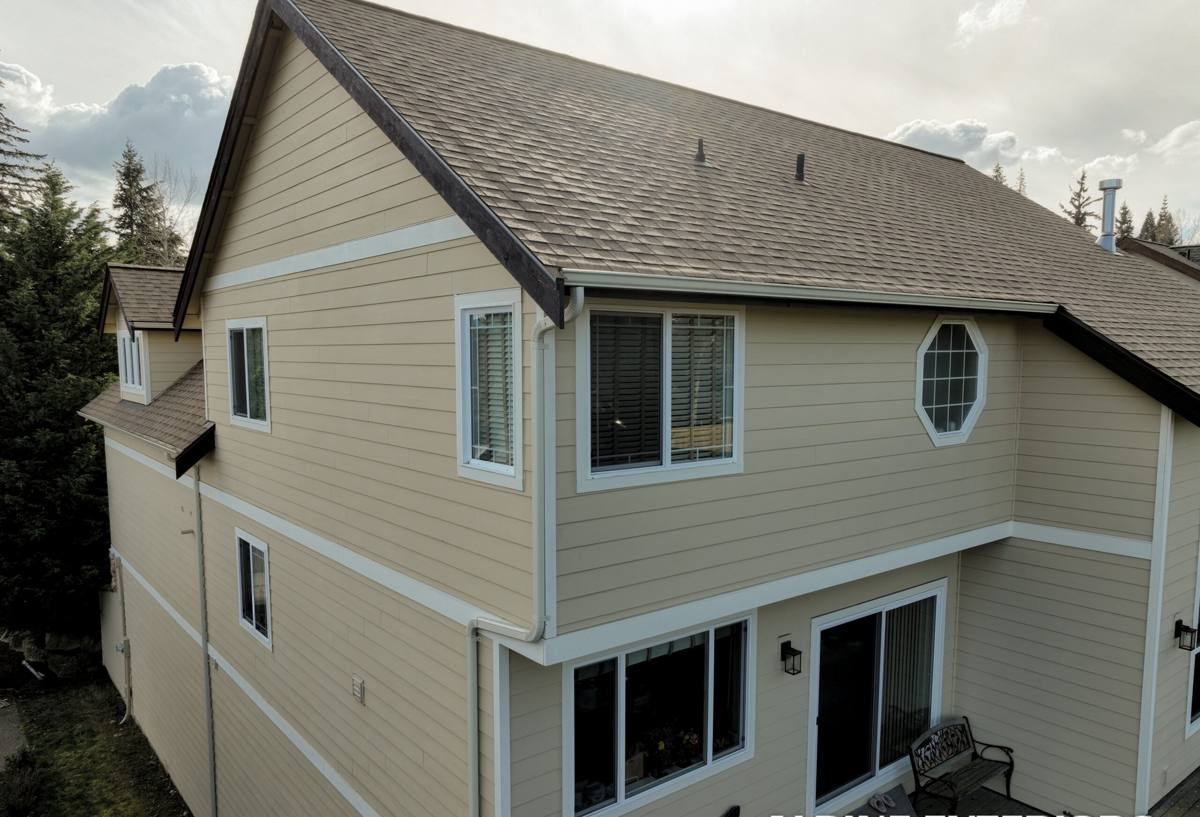
What Everson's Climate Does to a Roof
Salt Air and Corrosion
Everson isn't a waterfront town, but it's close enough to Bellingham Bay and the Sound that airborne salt still reaches roofs here, especially on days with wind off the water. Salt-laden air accelerates corrosion on fasteners, flashing, and any metal component that isn't rated for coastal-adjacent exposure. It's a slower process than it is right on the shoreline, but it's real, and it shows up as rust streaking and premature fastener failure on roofs that weren't specified for it.
Driving Rain Off the Valley Floor
The Nooksack valley funnels weather systems through in a way that pushes rain sideways as often as it falls straight down. On a roof, that means water gets driven up under lapped edges, into valleys, and around penetrations at angles a purely vertical rainfall never would. Flashing and seam details that would hold up fine on a sheltered, calm-weather roof get tested harder here, particularly during fall and winter storm systems moving up the valley.
A Long Moss and Algae Season
Mild temperatures and persistent dampness mean moss and algae have a long growing window in this part of the county — often most of the year on shaded or north-facing roof planes. On porous roofing materials, moss holds moisture directly against the surface, works into seams, and can lift or degrade material over time. It's one of the more visible signs of how this climate wears on a roof, and it's a major reason smooth, non-porous roofing materials perform differently here than they do in drier regions.
River-Bottom Humidity and Freeze-Thaw
Low-lying land near the Nooksack holds humidity longer than higher, better-drained ground, and Everson also sees more frequent hard frosts than milder coastal towns closer to the Sound. That combination means moisture that gets into a roofing system has more opportunity to freeze and thaw repeatedly through the colder months, which accelerates cracking and material fatigue in anything that absorbs water rather than shedding it.
Why Metal Roofing Fits This Climate
We recommend metal roofing to Everson homeowners specifically because of how it responds to the conditions above, not because it's the newest or most expensive option on the market.
- Smooth, non-porous surface: Metal doesn't absorb water the way wood shake or aging asphalt granules can, which means less opportunity for moss to establish and less material degradation from sustained dampness.
- Sheds wind-driven rain effectively: A properly installed standing seam or panel system has far fewer lapped edges and exposed fasteners for driving rain to work its way under compared to shingle-based roofing.
- Corrosion-resistant coatings: Quality metal roofing systems use coatings and finishes specifically engineered to resist salt-air corrosion, which matters for a property this close to Bellingham Bay's influence.
- Long service life: A correctly installed metal roof commonly outlasts asphalt shingle roofing by two to three times, which matters on a valley property where re-roofing access and disruption are worth minimizing.
- Better snow and moss shedding on pitch: On roofs with adequate slope, metal's slick surface sheds both moss spores and any winter snow load more readily than a textured shingle surface.
Metal roofing does carry a higher upfront cost than asphalt shingle, and it's a different look than a traditional roof — some homeowners love that, others prefer a more conventional profile. We'll walk through the honest trade-offs for your specific home rather than pushing metal as a universal answer.
Standing Seam vs. Metal Panel: Which Fits an Everson Home
| System | How It Sheds Water | Best Fit | Considerations |
|---|---|---|---|
| Standing seam | Raised, interlocking seams with no exposed fasteners on the field of the roof | Homes wanting maximum long-term weathertightness and a clean, modern line | Higher material and labor cost; requires precise seaming work to perform as designed |
| Exposed-fastener metal panel | Overlapping ribbed panels with fasteners driven through the panel face | Budget-conscious projects, outbuildings, or homes wanting the metal look at lower cost | Fasteners and their gaskets need periodic inspection since they're a potential entry point over time |
For a primary residence in a valley climate like Everson's, we lean toward standing seam when budget allows, specifically because it minimizes the number of penetration points exposed to driving rain and salt air over the roof's life. Exposed-fastener panel systems are a legitimate option too, especially on outbuildings, shops, or budget-driven projects — the difference is mainly in long-term maintenance and how many points on the roof need periodic checking.
What Correct Metal Roof Installation Requires
A metal roof is only as good as the details underneath it. Metal roofing failures we see almost never trace back to the panels themselves — they trace back to shortcuts in the underlayment, flashing, or fastening that don't show up until years later.
Underlayment and Moisture Barrier
Metal roofing needs a high-temperature-rated synthetic underlayment or self-adhered membrane suited to metal's thermal movement, not a basic felt product. In a valley climate with sustained moisture exposure, this layer is doing real work whenever wind drives rain under a seam or around a penetration.
Flashing at Every Transition
Valleys, chimneys, vent penetrations, and roof-to-wall transitions are where nearly every roof leak actually originates, metal or otherwise. Flashing at these points needs to be formed and lapped correctly for metal's expansion and contraction, not just caulked and hoped for.
Fastening and Panel Movement
Metal expands and contracts with temperature swings more than asphalt does, and fastening systems need to accommodate that movement rather than fighting it. Standing seam systems use concealed clips that allow the panel to move; exposed-fastener systems need correctly torqued, gasketed fasteners set at the right spacing for local wind exposure.
Ventilation
Trapped attic moisture condensing against the underside of metal roofing is a real problem if ventilation is inadequate. Proper intake and exhaust airflow keeps that moisture moving instead of settling against the deck.
Metal Roof Installation Checklist
- High-temperature synthetic underlayment or self-adhered membrane rated for metal roofing
- Corrosion-resistant fasteners and clips matched to the panel material to avoid galvanic reaction
- Formed and lapped flashing at every valley, chimney, vent, and roof-to-wall transition
- Panel and seam layout planned to minimize field cuts and exposed edges
- Correct fastener spacing and torque for exposed-fastener systems, or properly spaced concealed clips for standing seam
- Balanced intake and exhaust attic ventilation confirmed before panels go on
- Ice-and-water shield at eaves and valleys where moisture and debris collect
Repair, Recoat, or Full Replacement?
Not every issue on an existing metal roof means starting over. A failed seam, a section of loose or rusted exposed fasteners, or isolated flashing failure at a single penetration can often be repaired without touching the rest of the roof. An older metal roof with widespread coating breakdown but a sound structural panel underneath may be a candidate for recoating rather than full replacement. Where we usually recommend full replacement is when the underlying deck has taken on moisture damage, when a roof has multiple recurring leak points that keep reappearing after patching, or when an aging asphalt or wood roof is being converted to metal and needs the underlayment and flashing system built correctly from scratch. We'll tell you plainly which category your roof falls into.
Cost Factors for Metal Roofing in Everson
| Factor | What It Affects | Why It Matters Here |
|---|---|---|
| Standing seam vs. exposed-fastener panel | Material and labor cost | Standing seam costs more but minimizes long-term maintenance points on a valley property |
| Roof pitch and complexity | Labor time and material waste | Valleys, dormers, and multiple roof planes all add seaming and flashing work |
| Tear-off vs. overlay | Substrate access and repair scope | Tear-off reveals hidden deck moisture damage common on older roofs in this climate |
| Coating and gauge selection | Corrosion resistance and long-term appearance | Proximity to Bellingham Bay's salt influence makes coating quality a real long-term factor |
| Site access | Labor time and equipment needs | Rural and river-adjacent lots in the Everson area can have longer access routes than in-town properties |
Exact pricing depends on your roof's specific pitch, size, and condition, which is why we walk the property before giving a real number rather than quoting off a generic range.
Why a Local Crew Matters for Metal Roofing in Everson
Metal roofing rewards precise installation and punishes shortcuts more visibly than some other roofing types — a poorly formed valley or under-spec'd fastener shows up as a leak or a rust streak years before it would on a more forgiving material. A crew that installs metal roofs across Whatcom County regularly, and specifically in valley communities like Everson, understands how salt air, driving rain, and freeze-thaw cycling actually behave on real roofs here over time. That translates into practical decisions on install day: which coating and fastener specification actually holds up this close to the Sound's influence, how much ice-and-water shield a given valley or eave needs, and which flashing details are worth the extra time so you're not calling us back after the first serious winter storm.
Beyond the Roof: Siding, Windows, and Decks in Everson
A roof rarely fails in isolation. Moisture that gets past a roof-to-wall transition or an aging flashing detail often shows up first as siding or trim damage before anyone traces it back to the roof. Because we also handle siding, window replacement, and deck construction, we can look at an Everson home's exterior as one connected system exposed to the same salt air, driving rain, and freeze-thaw cycling, rather than treating the roof as disconnected from everything below it.
Get a Free, No-Pressure Estimate
If your Everson home needs a new metal roof, a repair on an existing one, or you just want an honest opinion on whether metal is the right fit for your property, we're glad to take a look. Reach out using the form below to schedule a free, no-pressure estimate.