 Ferndale Siding
 Why Everson-Area Homes Go Through Siding Faster Than You'd Expect
Everson sits in the part of Whatcom County that gets the full weather cycle year-round: long stretches of driving rain off the Pacific, damp air that never fully dries out between storms, and a moss and algae season that can stretch from October into May. None of that is dramatic on any given day. It's the accumulation that wears siding down — years of moisture sitting against a wall, freeze-thaw cycles nudging seams apart, and organic growth that holds water against the surface far longer than a dry-climate home would ever see.
Homes in this area, whether they're closer to Ferndale proper or out toward Everson, deal with the same underlying problem: siding here isn't just cladding, it's the first and most important line of defense against a wall assembly that stays damp more often than it stays dry. When siding starts failing — cracking, delaminating, holding paint poorly, or letting moisture behind it — the clock on rot and structural damage starts running quietly, often behind the wall where nobody sees it until a repair becomes a much bigger job.
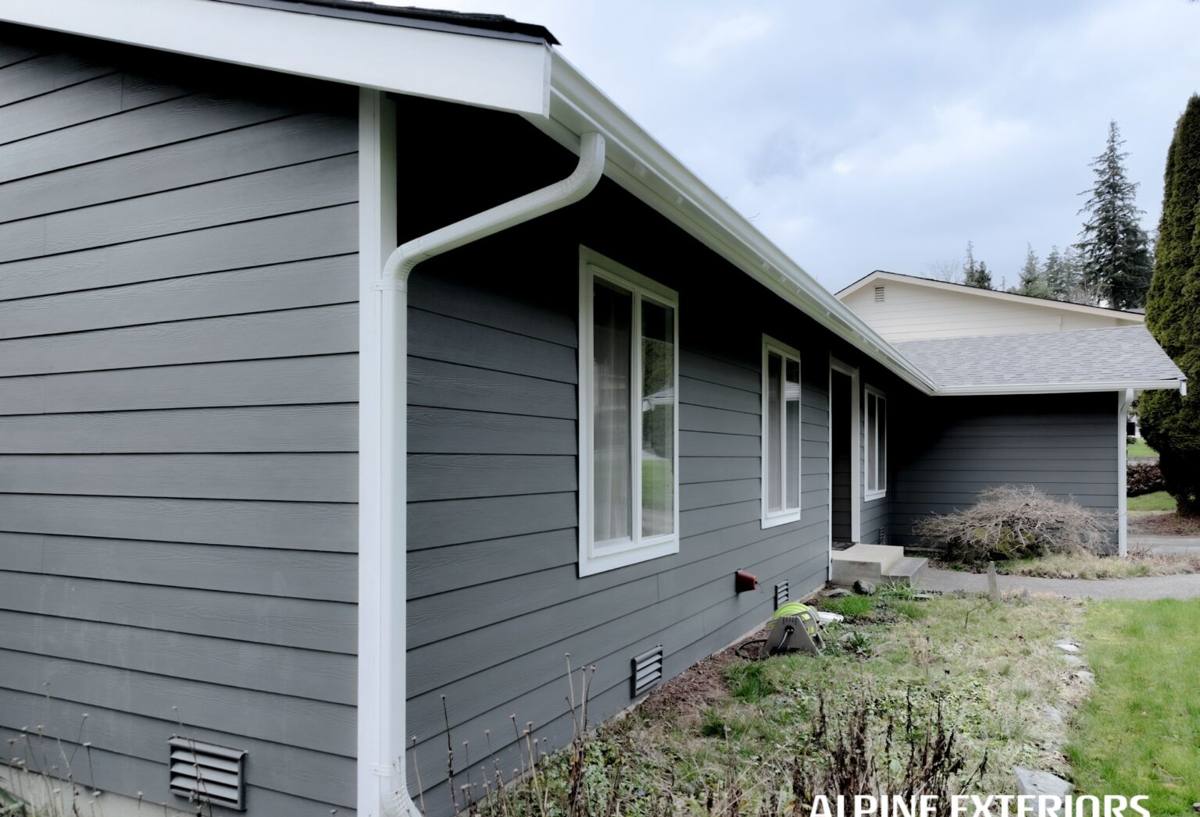
Signs Your Siding Needs Replacement, Not Another Patch Job
Not every siding problem calls for a full replacement. But in a climate like this, it's worth knowing the difference between something that can be spot-repaired and something that's telling you the whole system is compromised.
Repairable issues
- A single cracked or impact-damaged board in an otherwise sound wall
- Minor caulking failure around trim that hasn't let moisture behind the siding yet
- Surface staining or light moss growth on siding that's still structurally solid
Signs you're past the point of patching
- Soft or spongy spots when you press on the siding, especially near the bottom courses
- Paint that keeps failing within a year or two no matter how it's prepped
- Visible warping, cupping, or delamination across multiple boards
- Persistent moss or algae staining that returns within months of cleaning
- Gaps at seams and corners that have widened over several seasons
- Musty smell or visible staining on interior walls that share an exterior wall with damaged siding
If you're seeing more than one or two of the second list on an Everson home, it's usually more cost-effective in the long run to replace the siding system as a whole rather than keep chasing individual repairs while moisture keeps working on the wall behind it.
What a Correct Siding Replacement Actually Involves
Siding replacement is not just pulling off old boards and nailing up new ones. Done right, it's a full rebuild of the wall's weather-resistive layer, and in a climate that stays wet as much of the year as Whatcom County does, skipping steps here is exactly how homeowners end up with the same rot problem again in ten years instead of thirty or forty.
The parts that matter most
- Full tear-off and inspection. Every old board comes off so the sheathing underneath can actually be checked for soft spots, rot, or prior moisture damage — not guessed at.
- Sheathing repair before anything else goes back up. Any compromised sheathing gets replaced. Covering damaged sheathing with new siding just hides the problem.
- A continuous, correctly lapped weather-resistive barrier. This is the layer that actually keeps bulk water out of the wall assembly — the siding sheds most of it, but the barrier behind it is what handles what gets through.
- Proper flashing at every penetration. Windows, doors, hose bibs, vents, and any other wall penetration need flashing detailed so water is directed out and down, never trapped behind the siding.
- Correct fastening. Fastener type, spacing, and depth all affect how the siding holds up to wind-driven rain and how well it resists cracking over time. This is where a lot of unqualified installs go wrong.
- Proper clearances. Siding held too close to grade, decks, roofs, or hardscaping stays wet longer and is one of the most common causes of premature rot in this region.
Why We Install Only James Hardie Fiber Cement
We standardized on James Hardie fiber cement siding and don't install vinyl, LP SmartSide, cedar, primed spruce, or other fiber cement brands. That's a deliberate call, not a sales preference. Fiber cement is non-combustible, dimensionally stable in wet-dry cycling, and doesn't feed moss and algae growth the way wood-based products can. Hardie's ColorPlus factory finish is baked on under controlled conditions rather than field-applied, which matters directly for a climate where field-applied paint has a shorter useful life due to how often the surface stays damp.
Hardie also builds region-specific product engineering — its HZ5 line is formulated for the Pacific Northwest's wet-freeze conditions specifically, which is a meaningful difference from a one-size-fits-all siding product in a climate like ours. Combined with a strong transferable warranty, that's why it's the product we put our name behind on Everson and Ferndale homes rather than something that looks similar on day one but behaves differently after five winters of driving rain.
Our Siding Replacement Process
The process is the same whether the home is right in Ferndale or out toward Everson — what changes is how we account for a given lot's exposure, drainage, and shade.
1. On-site assessment
We walk the exterior, check current siding condition, look for existing moisture damage, and note site-specific factors — tree cover, drainage patterns, wind exposure — that affect both the current problem and how the new siding should be detailed.
2. Scope and product selection
We go over which Hardie product line and profile fits the home, walk through color options, and put together a clear, itemized scope so there's no ambiguity about what's included.
3. Tear-off and sheathing inspection
Old siding comes off, sheathing gets inspected and repaired as needed, and we flag anything unexpected before covering it back up.
4. Weather barrier and flashing
New water-resistive barrier goes on continuous and correctly lapped, with flashing detailed at every window, door, and penetration.
5. Hardie installation to manufacturer spec
Fastening, clearances, and joint treatment follow James Hardie's installation requirements, which is also what keeps the manufacturer's warranty intact.
6. Final walkthrough
We walk the finished job with the homeowner, check trim and caulking details, and make sure everything matches what was scoped.
What Siding Replacement Costs Depend On
There's no honest flat number for siding replacement — the real cost depends on a handful of factors specific to each home. The table below covers what actually moves the price, so you know what you're evaluating rather than just comparing bottom-line quotes.
| Factor | Why It Matters |
|---|---|
| Home size and wall complexity | More square footage and more corners, gables, and trim details mean more material and labor time |
| Sheathing condition | Hidden rot found during tear-off adds repair work that can't be accurately quoted until the old siding is off |
| Siding profile and accessories | Lap width, trim style, and accessory boards (fascia, soffit, corner trim) all affect material cost |
| Number of stories and access | Second-story and hard-to-access walls take longer and require more scaffolding or lift work |
| Window and door count | Each penetration needs individual flashing work, which adds labor regardless of siding brand |
| Existing siding removal | Multiple layers of old siding or asbestos-era materials require extra handling and disposal |
Because sheathing condition is often unknown until the old siding comes off, a firm final number usually isn't possible until tear-off — anyone quoting a guaranteed final price before seeing what's under the existing siding is guessing.
Why It Matters That the Crew Already Works Everson and Ferndale
Siding installation isn't identical everywhere in the country, and it isn't identical within Whatcom County either. A crew that regularly works this area already knows how local exposure to wind-driven rain off the water affects flashing details, how long moss season really runs here versus what a manufacturer's generic install guide assumes, and which parts of a wall assembly tend to take the most punishment on homes in this specific part of Washington.
That local pattern recognition shows up in small decisions — where to add extra flashing attention, how tight to run clearances near grade, which corners of a house typically need the most moisture management — that a crew unfamiliar with the region wouldn't necessarily think to prioritize. It's also worth confirming directly with any contractor you're vetting, local or not:
- Are they a factory-certified installer for the specific siding product they're proposing?
- Will the installation qualify for the manufacturer's full warranty, or a reduced one?
- Do they carry current liability insurance and workers' comp, and can they show proof?
- Will sheathing repairs be itemized and shown to you before being covered up?
- Is the quote itemized enough to compare against other bids apples-to-apples?
Caring for Your Siding After Replacement
New siding is only as good as the maintenance behind it, especially in a climate that pushes moss and algae growth as reliably as this one does. A little routine attention goes a long way toward getting the full lifespan out of the investment.
- Rinse siding annually to knock down early moss and algae growth before it establishes
- Keep gutters clear so overflow doesn't run down the wall face
- Trim back vegetation and tree limbs that shade siding and keep it damp longer
- Inspect caulking at trim and penetrations yearly and touch up before it fails fully
- Address any impact damage promptly rather than letting moisture find its way in
- Keep an eye on areas near grade, decks, and patios where clearance issues tend to develop over time
Timeline and What to Expect During the Project
Most single-family siding replacement projects run from a few days to a couple of weeks depending on home size and complexity, with weather playing a real role in scheduling given how much rain this region sees. We sequence work to minimize the amount of time a wall sits open, and we'll walk you through the schedule up front so you know what to expect — including how weather delays are handled if a wet stretch interrupts the work.
If your Everson or Ferndale home is showing signs its siding is past its useful life, or you just want a straight answer on where it stands, we're happy to take a look. Reach out for a free, no-pressure estimate using the form below.