 Ferndale Siding
 Deck Replacement for Everson Homes
Everson sits in the part of Whatcom County where marine weather off the Salish Sea meets river-bottom humidity from the Nooksack corridor. That combination is hard on outdoor structures. A deck built without that reality in mind — using generic framing lumber, minimal drainage, and no plan for standing moisture — will show its age within a handful of years. We replace decks for homeowners in the Everson area as part of our regular service territory out of Ferndale, and the decks we build are engineered for this specific climate, not a national average one.
This page covers deck replacement specifically: when a deck is past repairing, what a correct replacement actually involves, how we handle the job from tear-off to final walkthrough, and why local experience matters more with decks than almost any other exterior project.
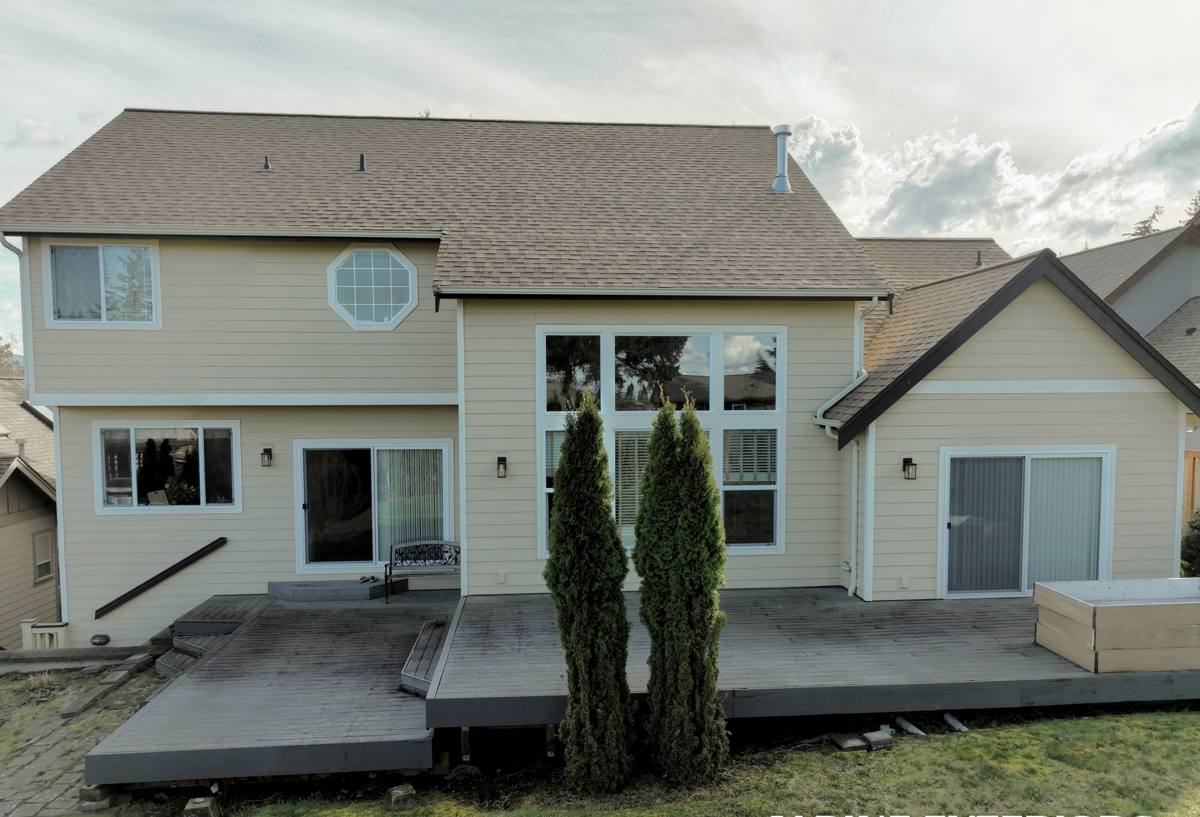
Why Decks Fail Faster Here Than People Expect
Whatcom County doesn't get the harshest storms in the state, but it gets something arguably worse for wood structures: long stretches of driving rain followed by long stretches of damp, low-sun weather that never fully dries things out. Add the salt-tinged marine air that moves inland off the bay, and you get a slow, steady corrosion and moisture cycle that a lot of decks simply aren't detailed for.
The three things that actually break decks around here
- Trapped moisture — ledger boards, joist tops, and post bases that stay wet longer than they stay dry, leading to rot from the inside out before it's visible from below.
- Fastener corrosion — standard hardware wasn't built for near-constant humidity plus salt-bearing air; corroded fasteners lose grip long before the wood around them looks obviously bad.
- Moss and organic buildup — moss doesn't just look bad, it holds moisture against decking boards and stair treads for months at a time during our long wet season, accelerating surface rot and making boards slick and unsafe.
None of these are exotic problems. They're just the predictable result of building a deck the same way you'd build one in a dry climate, then leaving it to face a Whatcom County winter.
Signs Your Deck Needs Replacement, Not Another Repair
Not every tired-looking deck needs to come out. But there's a point where patching individual boards stops making sense and a full replacement is the honest recommendation. We look for a combination of these signs before we ever suggest tearing a deck out:
- Soft, spongy spots in the decking surface, especially near the house or along the rim joist
- Visible rot or crumbling wood at the ledger board where the deck attaches to the house
- Wobbly or loose railings that flex under normal weight, not just heavy use
- Support posts that have shifted, settled unevenly, or show rot at the base near ground contact
- Persistent moss or algae growth that returns within weeks of cleaning
- Rust streaking around fasteners, or fasteners that back out on their own
- A deck more than 20-25 years old built to older code, especially if you're not sure how it was attached to the house
If it's mostly cosmetic — faded stain, a few loose boards, minor surface graying — repair or refinishing is usually the right call and we'll tell you that. Replacement makes sense when the structure itself, not just the surface, is compromised.
What a Correct Deck Replacement Actually Involves
Tear-off and inspection
We remove the old decking, railings, and as much of the substructure as needed to see what's actually going on underneath. This is where a lot of hidden problems show up — rot at the ledger connection, undersized or rusted joist hangers, footings that were never properly set below frost depth. You can't fix what you can't see, so we don't skip this step to save time.
Ledger and flashing
The ledger board — where the deck ties into the house — is the single most common failure point on decks in wet climates, and it's also the point most tied to structural safety. A correct replacement includes proper ledger flashing that directs water away from the house rather than letting it wick into the rim joist. This is not an area to cut corners on, regardless of what the original deck did.
Footings and framing
Post footings need to be sized and set to current code depth, not just poured to match whatever was there before. We use fasteners and hardware rated for exterior, high-moisture use — this matters more here than in drier parts of the state, since standard hardware corrodes faster in our air.
Decking surface and drainage
Board spacing, gapping, and any under-deck drainage system need to account for how much rain this area actually gets, not a generic install spec. Poor drainage is one of the fastest ways to shorten the life of an otherwise well-built deck.
Choosing the Right Decking Material for Everson's Climate
There's no single "best" decking material — it depends on your budget, how much upkeep you're willing to do, and how long you want the deck to last without major work. Here's how the common options actually compare in a wet, moss-prone climate like ours:
| Material | Upfront Cost | Maintenance | How It Handles Our Climate |
|---|---|---|---|
| Pressure-treated wood | Lowest | Annual cleaning, periodic re-sealing | Good if maintained; rot risk rises quickly if sealing lapses |
| Cedar | Moderate | Regular sealing, moss removal | Naturally rot-resistant but still needs upkeep in constant moisture |
| Composite decking | Higher | Occasional washing | Resists rot and moss staining well; quality varies by brand |
| PVC decking | Highest | Minimal | Fully resists moisture absorption; best long-term option in wet climates |
We install all of the above depending on what the homeowner wants — our job is to lay out the honest trade-offs, not push whatever has the best margin. What we won't do is install any product in a way that ignores its known moisture sensitivities, because in this climate, installation detailing matters as much as the material itself.
Our Deck Replacement Process
- On-site assessment — we inspect the existing deck, ledger connection, footings, and framing to determine actual scope, not just surface condition.
- Written estimate — clear scope, material options, and timeline before any work starts.
- Permitting — we handle the local permit process for structural deck work so you don't have to navigate it yourself.
- Tear-off and structural rebuild — old deck removed, framing and footings corrected or replaced as needed.
- Decking, railing, and finish work — installed to spec with attention to drainage and fastener placement.
- Final walkthrough — we go over the finished deck with you before calling the job done.
Permits and Local Considerations Around Everson
Deck replacement that involves structural changes — new footings, a rebuilt ledger connection, or a deck above a certain height — typically requires a permit and inspection. We build to current code rather than matching whatever the original deck happened to be, since older decks in this area were often built before current ledger-attachment and footing-depth standards existed. If your property is on a slope or has drainage that runs toward the house, that's also something we account for in footing placement and under-deck grading, since standing water near the foundation is a common issue in low-lying parts of Whatcom County.
What Deck Replacement Typically Costs
Costs vary based on deck size, material choice, and how much structural work the tear-off reveals — a deck with a compromised ledger or undersized footings costs more to correct properly than one that just needs new decking boards. Broadly, pressure-treated replacements sit at the lower end of the range, cedar and composite in the middle, and PVC or larger multi-level decks at the higher end. We give exact numbers only after seeing the site, since guessing on a structural project does neither of us any favors.
Why Hiring a Crew That Already Works in Everson Matters
A deck built for a dry inland climate and a deck built for the Whatcom County corridor near Everson are not the same project, even if they look identical on paper. Crews unfamiliar with this area sometimes under-detail flashing, skip drainage planning, or use standard hardware where corrosion-resistant fasteners are the better call — not out of carelessness, but because they're used to building for a different climate. We work this area regularly, we know what moisture and moss do to decks left unaddressed for a season or two, and we build accordingly the first time.
If your deck is showing soft spots, loose railings, or persistent moss that won't quit, we're happy to take a look and give you a straight answer on whether it needs replacing or just some targeted repair. Reach out for a free, no-pressure estimate using the form below.