 Ferndale Siding
 Deck Repair Built for Everson's Weather, Not Just Any Deck
A deck in Everson takes a different kind of beating than a deck in a dry climate. Whatcom County's long, wet stretch of fall through spring means your deck spends months at a time damp, shaded, and slow to dry out between rains. Add in the driving rain that comes through sideways during winter storms and the salt-tinged marine air that moves inland off the Sound, and you've got a structure that's constantly fighting moisture on every surface, top and bottom. Moss doesn't just grow on roofs here — it takes hold on deck boards, railings, and the framing underneath where nobody's looking. Left alone, that combination turns a simple maintenance issue into a structural one.
We repair decks throughout Ferndale and the surrounding Whatcom County area, including Everson homes, and the pattern is consistent: the damage that actually threatens the deck is rarely the damage a homeowner notices first. Surface graying and a little moss look bad but aren't dangerous. Soft framing, corroded fasteners, and a ledger board pulling away from the house are dangerous, and they often hide in plain sight until someone steps on a spot that gives.
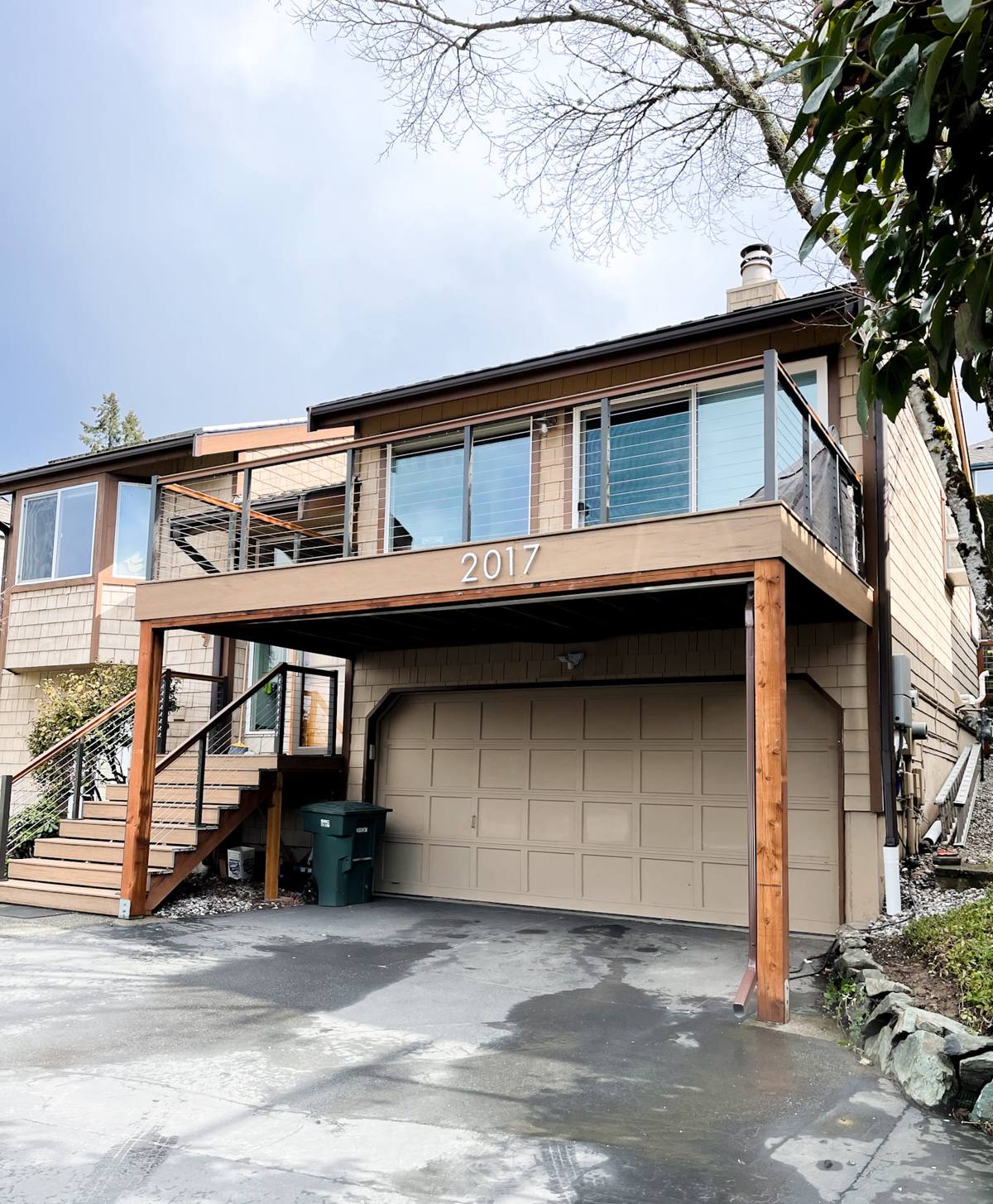
Signs an Everson Deck Needs Repair, Not Just Cleaning
Pressure washing and a fresh coat of stain make a deck look better, but they don't fix what's actually failing underneath. Before you book a cosmetic refresh, walk your deck and check for these:
- Boards that feel spongy or flex more than they used to, especially near the edges or where boards meet
- Dark staining or a slightly sunken look around fastener heads — often a sign of moisture trapped under the screw or nail
- Visible gaps or movement where the deck ledger attaches to the house
- Rust streaks running down from screws, joist hangers, or railing hardware
- Moss or algae holding moisture in the gaps between boards long after the rest of the deck has dried
- Wobbly railings or posts that shift when you lean on them
- Stair stringers that show splitting or crumbling at the base, where they sit closest to the ground
Any one of these on its own might be minor. Two or three together usually means water has been getting into the structure for a while, and it's worth having someone look underneath, not just at the surface.
Why the Underside Matters More Than the Top
Most Everson decks that fail early fail from the bottom up. The top surface gets sun, air movement, and whatever maintenance the homeowner does. The underside — joists, beams, ledger connections, and the ground clearance beneath — gets none of that. It stays damp longer, gets less airflow, and is where moss and mildew establish first. A proper repair inspection always includes getting underneath the deck, not just walking the top.
What a Correct Deck Repair Actually Involves
A repair that holds up in this climate isn't just swapping a bad board for a new one. It starts with figuring out why that board failed in the first place, because if the cause isn't addressed, the replacement fails the same way on the same timeline.
Our approach on Everson jobs generally covers:
- Structural assessment — checking joists, beams, posts, footings, and the ledger connection to the house for soundness, not just the decking boards
- Fastener condition — identifying corroded or failing hardware, which is common where galvanized fasteners were used instead of stainless or coated fasteners rated for ground contact and moisture exposure
- Moisture pathways — finding where water is actually getting in and staying in, whether that's a flashing gap at the ledger, board spacing that's too tight, or grade that's built up too close to the framing
- Selective replacement — replacing only what's genuinely compromised, matched to the existing structure where possible
- Reassembly with the right fasteners and flashing — so the repaired section doesn't become the next weak point
Skipping the diagnosis step is the most common shortcut in deck repair, and it's why some repairs need to be redone within a couple of years. Replacing a rotten board without fixing the drainage or flashing issue that rotted it just buys time.
Repair or Replace? A Straight Answer
Not every deck problem calls for a full rebuild, and not every deck is worth patching. The honest answer depends on where the damage is and how much of the structure it's touched.
| Condition | Usually Repairable | Usually Needs Replacement |
|---|---|---|
| Ledger board / house connection | Minor flashing or fastener issues caught early | Rot has spread into the rim joist or house framing |
| Deck boards | Isolated soft spots, a handful of boards | Widespread graying, splitting, or softness across most of the surface |
| Joists and framing | One or two joists with localized rot | Multiple joists compromised, or main beams affected |
| Railings and posts | Loose connections, single damaged baluster | Posts rotted at the base or no longer meeting code height/spacing |
| Footings | Rarely — footing issues usually mean settlement | Heaving, cracking, or a deck that's visibly pulled away from level |
If more than a quarter or so of the framing shows real damage, a rebuild is usually the more honest recommendation, even though it costs more upfront. Patching a deck that's structurally failing in multiple places just delays the same conversation a year or two later, at a higher cost.
Materials: What We Use and Why
For repairs, we generally match materials to what's already there when the existing structure is sound, since mixing wood species or fastener types can create new problems. For sections that need full replacement, homeowners usually choose between a few options.
| Material | Maintenance | Moisture Behavior | Typical Trade-off |
|---|---|---|---|
| Pressure-treated lumber | Needs re-staining or sealing every 1-3 years | Resists rot when sealed, but end cuts and fastener holes need re-treatment | Lowest upfront cost, highest ongoing maintenance |
| Cedar | Periodic sealing to maintain color and moisture resistance | Naturally rot-resistant but still needs finish maintenance in this climate | Better look, moderate maintenance, moderate cost |
| Composite decking | Occasional washing, no staining or sealing | Doesn't rot, but can trap moisture against framing if ventilation underneath is poor | Higher upfront cost, lowest long-term maintenance |
We don't push one material over another as a blanket rule — it comes down to what the existing structure can support, what the homeowner wants to maintain, and budget. What we will say plainly: whatever decking material sits on top, the framing underneath and the fasteners holding it together matter more to how long the repair lasts than the decking choice itself.
Fasteners and Hardware
This is where a lot of quiet failures start. Standard galvanized fasteners can corrode faster than the wood around them in a climate this wet, especially in contact with treated lumber. We use fasteners and joist hardware rated for the specific wood and exposure conditions on your deck, which costs a little more per repair but avoids the rust-streak, loosening-connection cycle that brings homeowners back to us a few years later for the same spot.
Our Process for Everson Deck Repairs
We keep the process straightforward because most homeowners just want to know what's wrong, what it'll take to fix, and what it'll cost before anyone touches a tool.
- On-site inspection — we walk the deck top and bottom, check moisture levels where we can, and identify every area of concern, not just the one that prompted the call
- Straight explanation — we tell you what's cosmetic, what's structural, and what can wait versus what shouldn't
- Written estimate — scope and cost before any work starts, with repair and replacement options laid out separately if both are on the table
- Repair work — removal of compromised material, correction of the underlying moisture or fastener issue, and rebuild with appropriately rated materials
- Final walkthrough — we go over what was done and what to watch for going forward
Preventing the Next Repair
A repair is a good time to head off the next one. A few habits make a real difference in a climate that stays wet as long as ours does:
- Sweep leaves and moss off the deck surface regularly through fall and winter, since trapped debris holds moisture against the boards
- Keep gutters and downspouts clear and directed away from the deck footprint, so runoff isn't landing on or under the structure
- Check for standing water in low spots on the deck surface after a hard rain — pooling means drainage or slope issues that will shorten the deck's life
- Look underneath once or twice a year, particularly after the wettest months, for early moss growth or dark staining on joists
- Re-seal wood decking on schedule rather than waiting until it visibly needs it — sealant failure is invisible until the wood underneath starts absorbing water
Why It Matters to Hire a Crew That Already Works in Everson
Deck repair isn't identical everywhere. A crew used to working in a dry climate will diagnose and fix things differently than one that works Whatcom County's wet season every year. We know what moss buildup looks like at three months versus three years, which fastener choices hold up here and which ones don't, and how much ventilation a deck actually needs underneath to survive a Ferndale-area winter without trapping moisture. That local pattern recognition is the difference between a repair that lasts and one that's a callback waiting to happen.
We're not a national outfit passing through — we work this region, on this kind of weather, on decks built the way homes in Everson and around Ferndale are typically built. That familiarity shows up in faster, more accurate diagnosis and repairs that account for what next winter will do, not just what the deck looks like today.
If your deck has a soft spot, a rusty streak, or just doesn't feel as solid as it used to, we're happy to take a look. Reach out for a free, no-pressure estimate — we'll tell you honestly what needs fixing and what doesn't, using the form below.