 Ferndale Siding
 Siding Repair for Everson-Area Homes
Everson sits inland from Ferndale in the Nooksack River valley, a quieter, more rural stretch of Whatcom County than the coastal parts of our service area. It doesn't get the same direct salt exposure as a waterfront lot, but it shares the same underlying weather pattern that drives siding failure across this region: driving rain that gets pushed sideways into walls instead of running straight off, a valley setting that holds humidity longer than higher, more exposed ground, and a moss season that stretches across most of the year. When we get called out to look at damaged siding on an Everson home, the cause is almost always some version of that same story — water finding a way in and staying longer than it should.
We install James Hardie fiber cement siding exclusively, and that shapes how we approach repair work too. Whether we're patching a section, replacing a few damaged boards, or telling a homeowner honestly that a full re-side makes more sense, the standard we hold repair work to is the same one we'd hold a brand-new installation to.
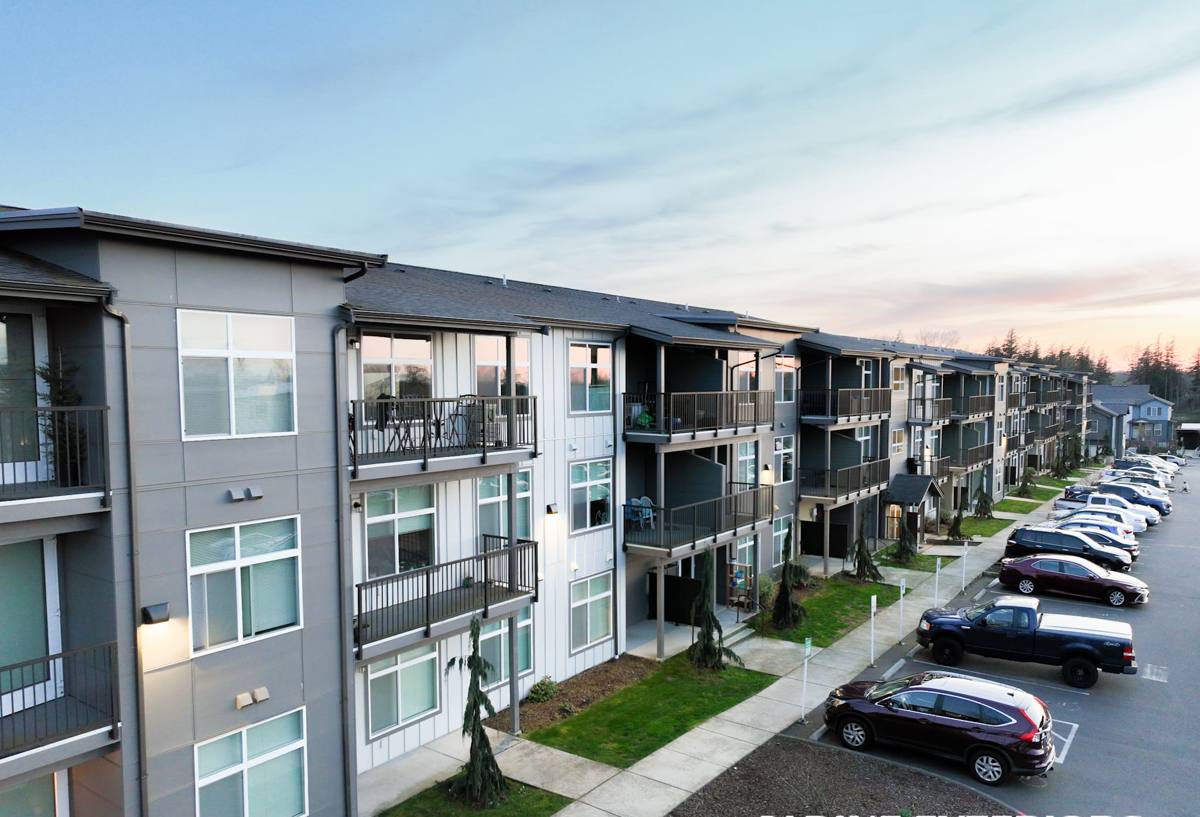
What Everson's Climate Does to Siding
Driving Rain and Wind-Driven Moisture
Storms moving through this part of Whatcom County rarely drop rain straight down. Wind pushes it sideways into siding, trim, and window flashing, and siding that isn't detailed to shed water at an angle tends to show damage first at seams, corners, and butt joints — the places where two pieces of material meet and a small gap can let water track behind the wall instead of off the face of it.
Valley Humidity That Lingers
Everson's inland, river-valley setting means moisture doesn't clear out as quickly after a storm as it does on a more open, breezy site. That lingering dampness gives water more time to work its way behind poorly sealed joints, and it's a big part of why repair issues here often turn out to be bigger than they first appear once a section of siding actually comes off the wall.
A Long Moss and Mildew Season
Shaded and north-facing walls in this area grow moss and mildew for a large part of the year, not just in the deep winter months. That growth is more than a cosmetic problem — it holds moisture directly against the wall surface, and sustained contact like that is exactly the condition that leads to soft, rotting substrate underneath siding that still looks intact from a few feet away.
Freeze-Thaw Cycling
Whatcom County's inland areas see more hard frosts through the colder months than the immediate coastline does. When water has already worked its way into a crack, a gap, or a porous section of siding, freezing expands it and speeds up the damage. A repair that only addresses the visible symptom without stopping the water source tends to fail again the next time temperatures drop.
How to Tell If Your Siding Needs Repair
Most siding problems don't announce themselves clearly. They show up as small, easy-to-dismiss signs long before anyone notices a real problem, and catching them early is usually the difference between a straightforward repair and a much bigger job.
- Soft or spongy spots when you press on the siding, especially near the bottom courses or below windows
- Visible gaps, cracking, or separation at seams, corners, and butt joints
- Persistent dark staining or moss growth that keeps coming back after cleaning
- Paint or finish that's bubbling, peeling, or chalking unevenly in specific sections
- Warping, bowing, or a wavy appearance across a wall or panel
- Interior signs — a musty smell, peeling wallpaper, or a soft spot on an interior wall near an exterior corner
Any one of these on its own doesn't necessarily mean a full re-side. But left unaddressed, they're the kind of thing that turns a same-day repair into a project involving sheathing and framing repair once the wall actually gets opened up.
What a Correct Siding Repair Actually Involves
A rushed siding repair often just covers up the visible damage without addressing why it happened, which means the same spot fails again within a year or two. We approach repair work in Everson the same methodical way every time.
Find the Real Source First
Damaged siding is frequently a symptom, not the actual problem. Before we replace anything, we look at what's feeding water into that section — a flashing detail around a window, a gutter that's overflowing onto the wall below, a roof valley shedding water in the wrong direction, or a gap where two dissimilar materials meet. Replacing siding without fixing the source just resets the clock on the same failure.
Check What's Behind the Wall
Once damaged boards come off, we inspect the house wrap, flashing, and sheathing underneath before anything new goes back up. If water has been getting behind the wall for a while, there's often soft or rotted sheathing that needs to be cut out and replaced — patching over compromised substrate is one of the most common shortcuts that leads to a repeat call a season or two later.
Match the Existing Siding Correctly
For homes that already have James Hardie siding, matching plank width, profile, and ColorPlus finish so a repair blends in rather than standing out as an obvious patch takes real attention to detail — Hardie's product lines and color offerings have changed over the years, so an older installation sometimes needs a close match rather than an exact one. For homes with a different siding product, we'll walk you through whether a like-for-like patch or a transition to Hardie on that section makes more sense long-term.
Reseal and Flash Properly
New boards go in with correct fastening patterns, proper overlap, and flashing or sealant at the joints and penetrations — not caulk used as a substitute for actual flashing detail. This is the step that determines whether a repair holds up through the next several wet seasons or becomes a callback.
Repair vs. Full Replacement: How We Decide
| Situation | Usually Points To | Why |
|---|---|---|
| Isolated impact damage or a single cracked board | Spot repair | Damage is contained and the surrounding siding and substrate are sound |
| Recurring moisture damage in one specific area (below a window, near a downspout) | Targeted repair with source fix | Addressing the actual water source alongside the visible damage prevents recurrence |
| Soft sheathing found in multiple, unrelated wall sections | Broader investigation, possibly partial re-side | Scattered rot usually means a systemic issue like poor original flashing or house wrap, not a one-off event |
| Siding is an older non-Hardie product nearing the end of its service life | Full replacement | Continuing to patch a failing material usually costs more over time than replacing it once, correctly |
| Widespread moss, staining, and fading across most walls | Full replacement likely more cost-effective | Repeated spot repairs on aging, uniformly weathered siding rarely match well and don't address the underlying age of the material |
We'll tell you plainly which category your home falls into. A repair-focused business model only works if we're honest about when repair isn't the right call — patching something that needs to be replaced just costs a homeowner money twice.
Why James Hardie Matters Even for a Repair
We install James Hardie fiber cement exclusively, and that standard doesn't change for repair work. When a repair calls for new material — whether it's a full panel or a short patch section — we use the same climate-engineered Hardie product line as the rest of the home, not a mismatched substitute chosen for convenience.
- Non-combustible core: Fiber cement doesn't add fuel to a fire the way wood-based siding can, which matters for both household safety and insurance considerations on repair sections too.
- Factory-applied ColorPlus finish: Baked-on color resists fading and moisture intrusion far longer than a field-painted patch, which helps a repaired section hold its appearance over time.
- Climate-engineered HZ formulations: Hardie builds specific product lines for regions with sustained moisture exposure, a real match for the valley dampness and long wet season Everson sees.
- Dimensional stability: Fiber cement doesn't swell or warp the way engineered wood can after repeated wet-season cycles, so a repaired section stays flat and tight against the wall instead of gapping over time.
We don't install LP SmartSide, vinyl siding, Cemplank, Allura, primed spruce, or cedar, including for repair or patch work. Those products can be reasonable choices for other contractors and other homeowners, but we made a professional decision to stand behind one system we trust completely — and that means not mixing in a different material just because it's on hand for a small job.
Our Siding Repair Process
- Initial walkthrough: We inspect the damaged area and the surrounding siding, looking for related issues before quoting anything.
- Source diagnosis: We identify what's actually letting water in, whether that's flashing, a gutter issue, or a failed seal, not just the symptom you called about.
- Honest scope discussion: We explain plainly whether you're looking at a spot repair, a broader repair, or a full re-side, and why.
- Written estimate: A clear, itemized estimate with no pressure to commit on the spot.
- Repair work: Damaged material and any compromised substrate removed, source issue corrected, new Hardie material installed and properly matched and flashed.
- Final walkthrough: We review the completed repair with you before considering the job done.
Cost Factors for Siding Repair in Everson
| Factor | What It Affects | Why It Matters Here |
|---|---|---|
| Extent of hidden substrate damage | Whether sheathing or framing repair is needed | Valley humidity gives water more time to spread once it's behind the wall, so hidden damage is often larger than the visible symptom suggests |
| Color and profile matching | Whether new material blends with existing siding | Older Hardie installations may need close color matching rather than an exact match if the original product has since changed |
| Access to the damaged area | Labor time and equipment needs | Second-story sections or areas near landscaping can require additional staging |
| Source repair (flashing, gutters, roof) | Whether the fix actually holds long-term | Skipping the source repair to save money on a rural or valley property usually means paying for the same repair again within a couple of wet seasons |
| Number and location of affected sections | Whether it's a single patch or multiple repair areas | Scattered damage across several walls often points to a broader underlying issue worth addressing at once |
We give a firm number after walking the property in person, not a phone estimate, since hidden damage is common enough on repair calls that a guess without eyes on the actual wall isn't a responsible one.
Siding Repair Readiness Checklist
- Note exactly where the damage or staining is and whether it's gotten worse recently
- Check nearby gutters and downspouts for overflow or misdirected water
- Look for a pattern — is it one spot, or several unrelated areas?
- Press gently on suspect areas to check for soft or spongy substrate
- Check for any musty smell or interior staining on the wall directly behind the damaged area
- Have any prior repair or paint work in that area noted, since it can affect how new material matches
Why a Crew That Already Works Everson Matters
A crew that regularly works this part of Whatcom County knows how valley humidity, driving rain, and a long moss season actually behave on real homes here over a full year, not just how a repair looks the day it's finished. That experience shows up in practical decisions on a repair call: which wall orientations hold moisture the longest, where a quick patch is genuinely enough and where it's better to open the wall up and check further, and which flashing details are worth the extra time so a homeowner isn't calling us back after the next winter storm. Everson's inland, river-valley setting is a little different from the coastal parts of Ferndale's service area, and a crew with hands-on local experience treats that difference seriously instead of applying the same generic fix everywhere.
What to Expect When You Call Us
We start with a straightforward walkthrough of the damaged area and anywhere else on the home that might be affected. From there, we give you an honest read on whether you're looking at a simple patch, a more involved repair, or something that makes more sense to address as part of a larger project — and we explain our reasoning either way. If your Everson home has siding damage, staining that won't go away, or you just want an honest opinion on what's happening behind an aging wall, reach out using the form below to schedule a free, no-pressure estimate.