 Ferndale Siding
 Roof Repair Built for Everson's Weather
Everson sits inland along the Nooksack River, but it isn't spared from the weather patterns that shape every roof in Whatcom County. The same marine air system that soaks the coastline pushes rain and moisture well inland, and Everson roofs take on the same driving rain, long damp winters, and stubborn moss growth as homes closer to the water. A roof here isn't just shedding the occasional storm — it's managing near-constant moisture exposure for most of the year, with only a short dry stretch in summer to catch up and dry out.
That climate reality changes what "roof repair" should mean. A patch that would hold up fine in a dry climate can fail within a season here if it doesn't account for how water actually moves across a roof plane, around penetrations, and into valleys during a sustained Pacific storm. Repair work in Everson has to be done with that in mind, not treated as a generic fix.
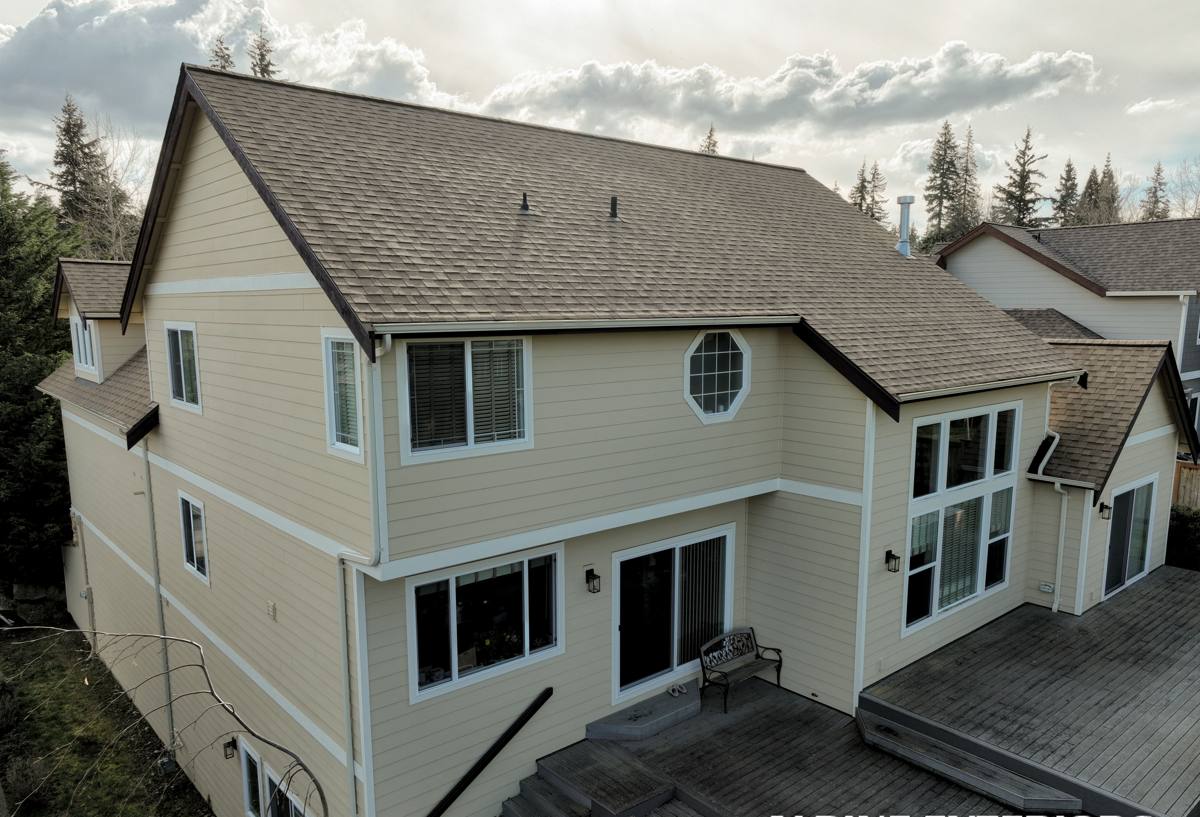
The Roof Problems We See Most in This Part of Whatcom County
Moss, Moisture, and Organic Growth
Moss is the most visible sign of a roof under long-term moisture stress, and it's nearly universal on older roofs in this area if it hasn't been managed. Moss holds water against the roofing material, keeps the surface from drying between rain events, and works its way under shingle tabs and around fasteners over time. On its own, light moss is mostly cosmetic. Left unaddressed for years, it becomes a moisture trap that shortens the life of the roofing material underneath it and can lead to soft spots in the decking.
Wind-Driven Rain and Flashing Failures
Everson's storms don't just drop rain straight down — wind pushes it sideways, up under shingle edges, and into gaps that would stay dry in calmer weather. Flashing around chimneys, skylights, vent pipes, and roof-to-wall transitions is where this shows up first. A flashing seam that's slightly open, sealant that's cracked, or a step-flashing detail that was never quite right will leak specifically in wind-driven rain, which is exactly the kind of weather this region gets several times a winter.
Ice, Frost, and the Occasional Freeze
Everson doesn't see the deep freeze-thaw cycles of a mountain climate, but it does get periodic hard frosts and the occasional snow event. When that happens right after a wet stretch, any water that's already worked its way under shingles or into a seam can freeze, expand, and widen the damage. It's not the dominant threat here the way it is further inland or at elevation, but it's part of why small, unaddressed leaks tend to get worse rather than staying the same size.
What a Correct Roof Repair Actually Involves
Diagnosing the Real Problem, Not Just the Symptom
A stain on a ceiling doesn't tell you where the water actually entered — roof water can travel along rafters or decking before it shows up inside, sometimes several feet from the real source. A correct repair starts with tracing the leak back to its actual entry point, usually by inspecting the roof itself rather than guessing from the interior damage. Sealing over the spot where water is visible inside, without finding the real entry point, is one of the most common reasons a "fixed" leak comes back.
Matching Materials and Getting Flashing Right
A repair is only as good as its integration with the existing roof. That means matching the shingle type, profile, and where possible the color of what's already installed, and rebuilding flashing details — step flashing, counter-flashing, valley metal — to shed water the way they're designed to, not just caulking a gap and hoping it holds. Sealant has its place, but it's a supporting detail, not a substitute for flashing that's cut, layered, and fastened correctly.
Ventilation: The Repair Homeowners Forget
Roof leaks aren't always about water getting in from outside. Poor attic ventilation lets warm, moist household air condense against the underside of the roof deck, which can look and behave a lot like a leak — and it will keep coming back no matter how many times the exterior is patched. Part of doing a repair correctly is checking that intake and exhaust ventilation are actually balanced before assuming the problem is purely an exterior one.
Our Roof Repair Process in Everson
- Inspection. We get on or safely access the roof, document the affected area and its likely cause, and check surrounding sections for related wear — not just the spot that's actively leaking.
- Honest assessment. We tell you plainly whether what you're looking at is a straightforward repair, a sign of a larger issue, or a roof that's closer to the end of its service life than a repair budget makes sense for.
- Written quote. You get a clear scope of work and price before anything is scheduled — no verbal estimates that shift once the work starts.
- Scheduling around the weather. Roof repair work needs a dry window to be done right. We plan around Whatcom County's forecast rather than rushing a repair into wet conditions that undermine it.
- The repair itself. Removal of the damaged material, correction of the underlying cause (flashing, decking, underlayment), and reinstallation matched to the surrounding roof.
- Cleanup and haul-away. Old material, fasteners, and debris are cleared from the property — including out of gutters and off the ground below the work area.
- Follow-up. We stand behind the work and want to know if anything about the repair doesn't hold up the way it should.
Repair or Replace? How We Help You Decide
Not every roof problem in Everson calls for a full replacement, and not every leak is fixable with a patch. The honest answer depends on the roof's age, how widespread the damage is, and what's happening underneath the surface layer.
| Factor | Repair usually makes sense | Replacement is often the better call |
|---|---|---|
| Age of roofing material | Roof is well within its expected service life | Roof is at or past the age where the material is naturally failing |
| Extent of damage | Isolated to one section, flashing detail, or penetration | Multiple areas failing independently across the roof |
| Decking condition | Decking underneath is solid | Decking is soft, delaminated, or rotted in more than one spot |
| Moss and granule loss | Light to moderate, surface-level | Heavy, long-term moss loss with visible granule stripping |
| History of repairs | First or second repair on this roof | Roof has needed repeated patching over recent years |
What Repairs Typically Cost — and What Drives the Range
Every repair is priced against the actual scope of work, but a few factors consistently move the number up or down. A small, isolated repair — resealing a vent boot or replacing a section of flashing — tends to be the least expensive category of work. Jobs that involve opening up decking, rebuilding a valley, or addressing damage across a larger section of roof cost more because they involve more material, more labor, and often steeper or harder-to-access roof planes. Roof pitch, height, and accessibility also factor in, since steep or multi-story sections take longer to work safely.
| Cost Factor | Why It Matters |
|---|---|
| Size of the affected area | More square footage means more material and labor time |
| Decking condition | Rotted decking has to be cut out and replaced before new roofing goes on |
| Flashing complexity | Chimneys, skylights, and valleys take more time than a flat field repair |
| Roof pitch and access | Steeper or harder-to-reach roofs require more setup and safety measures |
| Material matching | Matching an older or discontinued shingle can add sourcing time |
We put a firm, written number in front of you before any work begins, so there's no guessing involved on your end.
Materials We Work With for Roof Repairs
Most homes in and around Everson are roofed in asphalt composition shingles, and that's the material we handle repairs on most often — it's a well-understood system with predictable failure points, which makes it repairable rather than something that always needs full replacement. For flashing and valley work, we use metal flashing rather than relying on sealant alone, since sealant degrades in UV and temperature swings while properly formed metal keeps shedding water for decades. On repair sections where moisture exposure is highest — valleys, eaves, and around penetrations — we use self-adhering waterproof underlayment rather than standard felt, because it seals around fastener penetrations instead of just covering them.
Where a roof has multiple layers of past patchwork, mismatched materials, or a shingle line that's no longer manufactured, we'll say so directly rather than trying to force a cosmetic match that won't actually perform. That's a professional judgment call about long-term water management, not a sales pitch for a bigger job than you need.
Signs Your Everson Roof Needs a Professional Look
Most roof damage in this climate develops slowly, which means homeowners often live with a small problem for a while before it becomes an obvious one. A few checks from the ground or attic can catch issues early:
- Heavy moss growth, especially on north-facing slopes or in shaded areas of the roof
- Granules collecting in gutters or at downspout outlets
- Shingles that are curling, cracking, or visibly lifting at the edges
- Daylight visible through the roof deck when viewed from inside the attic
- Water stains, discoloration, or a musty smell in the attic or top-floor ceilings
- Sagging or soft-feeling sections when walked on the roof surface
- Rust streaking or gaps around flashing at chimneys, vents, or skylights
If any of these are showing up, it's worth having a roof looked at before the next storm cycle rather than after.
Why a Local Crew Matters for Everson Roof Repair
Roofing crews that work Whatcom County regularly know how this climate actually behaves on a roof — not in theory, but from having repaired hundreds of the same flashing details, the same moss patterns, and the same wind-driven leaks year after year. That familiarity shows up in faster, more accurate diagnosis and in repair decisions that account for what a Pacific Northwest winter will do to the work, not just what fixes the immediate symptom. A local crew is also easier to reach when a storm causes new damage or a prior repair needs a follow-up look, and understands what Whatcom County permitting does and doesn't apply to for repair-scale work.
If you're dealing with a leak, visible moss buildup, or storm damage on your Everson home, we're glad to take a look and give you a straightforward assessment — no pressure, no inflated scope. Reach out for a free estimate using the form below.