 Ferndale Siding
 Siding Built for the Nooksack Side of Ferndale
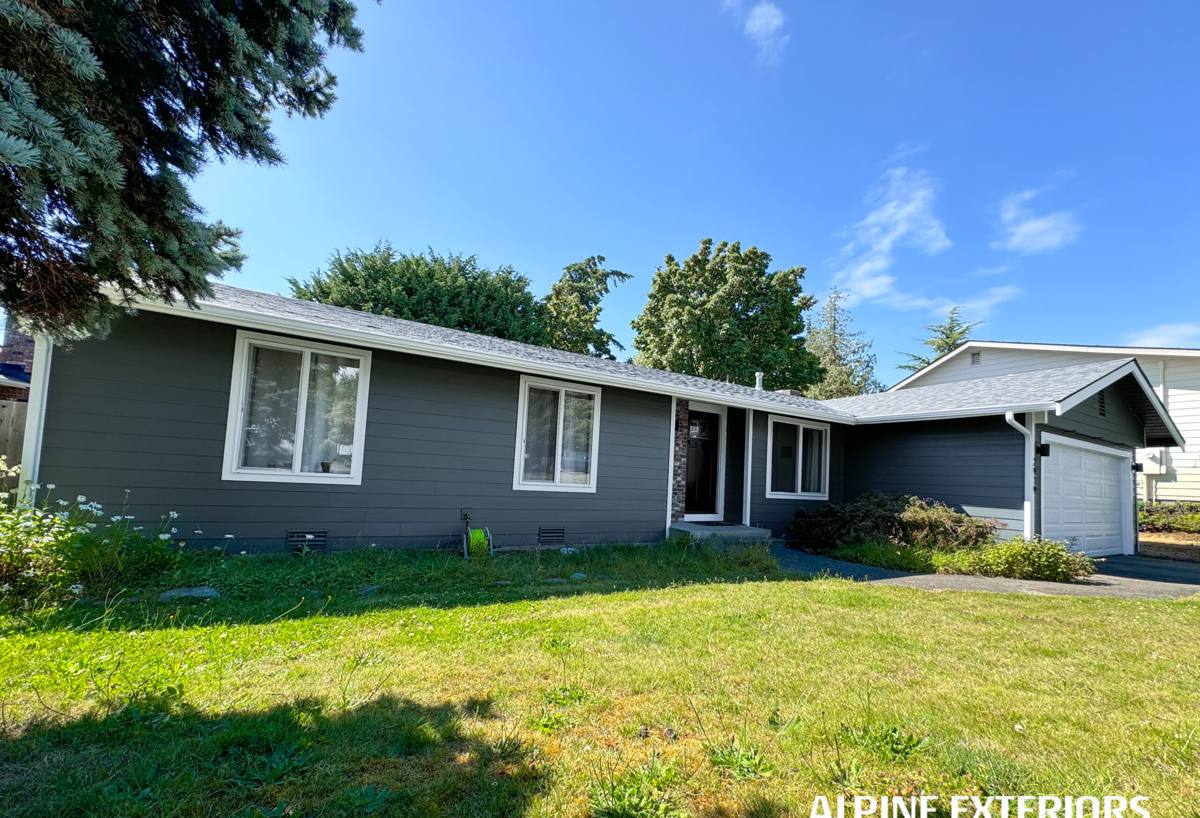
Homes in and around Nooksack sit inland from the coast but still catch the same weather pattern that defines Whatcom County: long stretches of driving rain off the Pacific, cool damp air moving up the valley, and short summers that never quite dry things out before the next system rolls in. Add the salt-laden air that reaches inland from Bellingham Bay and the Strait of Georgia on windy days, and you get a climate that is genuinely hard on exterior siding. We've replaced enough failing siding in this area to know the pattern well: moisture gets in low and behind, moss and algae take hold in the shaded, north-facing walls, and by year fifteen or twenty the original material is soft, delaminating, or simply worn through its finish.
This page is specifically about siding replacement for Nooksack-area properties near Ferndale — not a general overview of siding. If your siding is cupping, staining green or black in the shade, or you've found soft spots near the bottom courses, this is written for exactly that situation.
Why Nooksack's Climate Is Tougher on Siding Than It Looks
Salt Air Doesn't Stay at the Coast
Whatcom County's proximity to saltwater means airborne salt travels further inland than most homeowners assume, especially during winter storms with sustained onshore wind. Salt accelerates corrosion on fasteners, flashing, and any exposed metal trim, and it interacts with lower-quality paint films by drawing moisture into the surface. Over time this shows up as chalking, fading, and eventually cracking paint that lets water behind the siding.
Driving Rain Finds Every Gap
Rain here rarely falls straight down — wind-driven rain is the norm for a good chunk of the wet season, and it gets pushed sideways into joints, seams, and anywhere caulking has shrunk or separated. Siding systems that rely heavily on caulk and paint film as their primary defense (rather than a real drainage plane and correct lap detailing) tend to fail from the inside out, long before the surface looks bad.
Moss Season Runs Long
Between the shorter winter days, tree cover common on Nooksack-area lots, and consistent moisture, moss and algae growth has an extended season here compared to drier parts of the state. Moss holds water against the siding surface for days at a time. On wood-based products that moisture retention is what starts rot; on any siding, it's what stains and degrades a finish years before it should.
What a Correct Siding Replacement Actually Involves
Replacing siding is not a cosmetic swap. Done right, it's a chance to fix the moisture management behind the wall — something that's invisible once the new siding goes up, but determines whether it lasts 10 years or 40. Our process on every Nooksack-area replacement includes:
- Full tear-off and sheathing inspection — we don't side over existing material. Removing the old siding lets us find and repair rot, soft sheathing, or compromised framing before it's covered up again.
- Correct water-resistive barrier — a properly lapped and sealed weather barrier installed shingle-style so water is directed out, not trapped in.
- Flashing at every penetration — windows, doors, hose bibs, vents, and deck ledgers all get proper flashing detail, not just caulk.
- Rainscreen or drainage gap where called for — a small air gap behind the siding lets any incidental moisture drain and dry instead of sitting against the panel.
- Manufacturer-spec fastening and clearances — correct nail placement, butt joint treatment, and ground/roof clearance so the bottom edge of the siding isn't sitting in standing water or splashback.
Skip any one of these steps and the new siding can look great for a few years while the same underlying moisture problem quietly continues.
Why We Install Only James Hardie Fiber Cement
We standardized on James Hardie fiber cement siding for every home we replace, including the ones we do around Nooksack, and we don't install vinyl, LP SmartSide, cedar, primed spruce, or other fiber cement brands like Cemplank or Allura. That's a deliberate call, not a marketing line:
- Non-combustible material — fiber cement doesn't feed a fire the way wood-based products can, which matters more every year given regional wildfire smoke and ember exposure concerns.
- Built for wet, salt-exposed climates — Hardie's HZ5 product line is engineered specifically for regions with cold winters and damp, salt-influenced air like ours, with moisture and freeze-thaw performance that generic fiber cement and wood alternatives don't match.
- ColorPlus factory finish — the color is baked on at the factory under controlled conditions rather than field-applied, which holds up far better against UV, salt air, and the kind of driving rain we get, and it comes with its own finish warranty.
- Dimensionally stable — fiber cement doesn't swell, cup, or warp with moisture cycling the way wood-based siding can, which matters directly in a climate where the material is wet more months than it's dry.
- Strong transferable warranty — a real, documented warranty that adds resale value, versus warranties that are effectively voided by minor installation deviations.
We're not going to pretend other products are worthless — vinyl is cheap and low-maintenance in the right climate, cedar looks great when it's brand new, and LP SmartSide has its fans. But we've seen how each of those performs in this specific climate over 10-20 years, and we'd rather stand behind one product we trust completely than install several we have reservations about.
How Hardie Compares to the Alternatives Locally
| Factor | James Hardie Fiber Cement | Vinyl | Cedar / Wood | LP SmartSide |
|---|---|---|---|---|
| Moisture tolerance in wet climate | Excellent | Good (but can trap moisture behind it) | Fair — needs consistent maintenance | Fair — engineered wood is moisture-sensitive at cut edges |
| Salt air / coastal exposure | Excellent | Good | Fair | Fair |
| Fire resistance | Non-combustible | Combustible | Combustible | Combustible |
| Finish longevity | Factory finish, long warranty | Color molded in, can fade | Needs repainting/staining cycle | Factory finish, shorter track record |
| Typical lifespan installed to spec | 30-50+ years | 20-30 years | 15-25 years with upkeep | 20-30 years |
Signs Nooksack-Area Homeowners Should Watch For
- Green or black staining concentrated on shaded or north-facing walls, especially near tree cover
- Paint that's chalking, cracking, or peeling in sheets rather than just fading
- Soft or spongy spots when you press near the bottom courses or under windows
- Visible cupping, warping, or gaps opening at panel seams
- Corroded or rust-streaked fasteners and trim
- Musty smell or visible staining on interior walls that share an exterior wall with problem siding
Any one of these on its own might just mean it's time to repaint. Two or more together, especially the soft spots, usually mean the siding itself needs to come off.
Why Local Installation Experience Matters
Siding installation quality varies enormously by crew, and the mistakes that cause the most damage aren't visible on day one — they show up in year three or five as water intrusion. A crew that already works regularly in the Ferndale and Nooksack area understands the specific conditions here: how much clearance to leave at grade given our rainfall, where moss pressure is highest on a given lot, and how the wind-driven rain pattern off the bay affects flashing details on more exposed elevations. That's not something you get from a general handyman crew or an installer whose experience is mostly in a drier climate.
It also matters for warranty protection. James Hardie's product warranty has installation requirements attached to it — correct clearances, fastening, and flashing are part of keeping that warranty valid. An installer unfamiliar with local code and climate specifics is more likely to cut a corner that voids coverage without anyone noticing until there's a problem.
What to Expect From Our Process
- On-site inspection — we look at the current siding, check for moisture damage, and assess what's driving the failure.
- Honest scope and estimate — you'll know upfront whether this is a straightforward re-side or if there's sheathing/framing repair involved.
- Full tear-off — old siding and any compromised material comes off completely.
- Barrier, flashing, and drainage detail — the moisture-management work that determines long-term performance.
- Hardie installation to manufacturer spec — correct fastening, clearances, and joint treatment throughout.
- Final walkthrough — we go over the finished work and warranty documentation with you directly.
Cost Factors to Understand Before You Budget
| Factor | Why It Affects Cost |
|---|---|
| Extent of hidden moisture damage | Rotted sheathing or framing found during tear-off adds repair scope not visible from the outside |
| Home size and wall complexity | More corners, gables, and trim details increase labor time |
| Siding profile and accessory selection | Lap width, trim style, and color all affect material cost |
| Access and site conditions | Steep lots, tree cover, or tight setbacks common in wooded Nooksack-area properties can slow the job |
| Existing layer removal | Full tear-off costs more upfront than covering over old material, but it's the only way to fix underlying moisture issues |
If your siding is showing its age or you've spotted signs of moisture trouble, we're happy to take a look and give you a straightforward, no-pressure estimate for your home — just fill out the form below.