 Ferndale Siding
 Deck Repair Built for Nooksack's Weather
Decks in Nooksack take a different kind of beating than decks in drier parts of the country. Whatcom County's mix of salt-laden air moving in off the Sound, long stretches of driving rain, and a moss season that can run most of the year means a deck here ages on a different clock. Wood fibers stay damp longer between dry spells, fasteners corrode faster, and anything shaded by trees or a roofline builds up moss and algae that hold moisture right against the boards. A deck repair here has to account for all of that, not just patch what's visibly broken.
We work on decks throughout Ferndale and out toward Nooksack regularly, so we're not guessing at how this climate treats outdoor structures — we're looking at the same rot patterns, the same fastener failures, and the same drainage problems on a repeat basis.
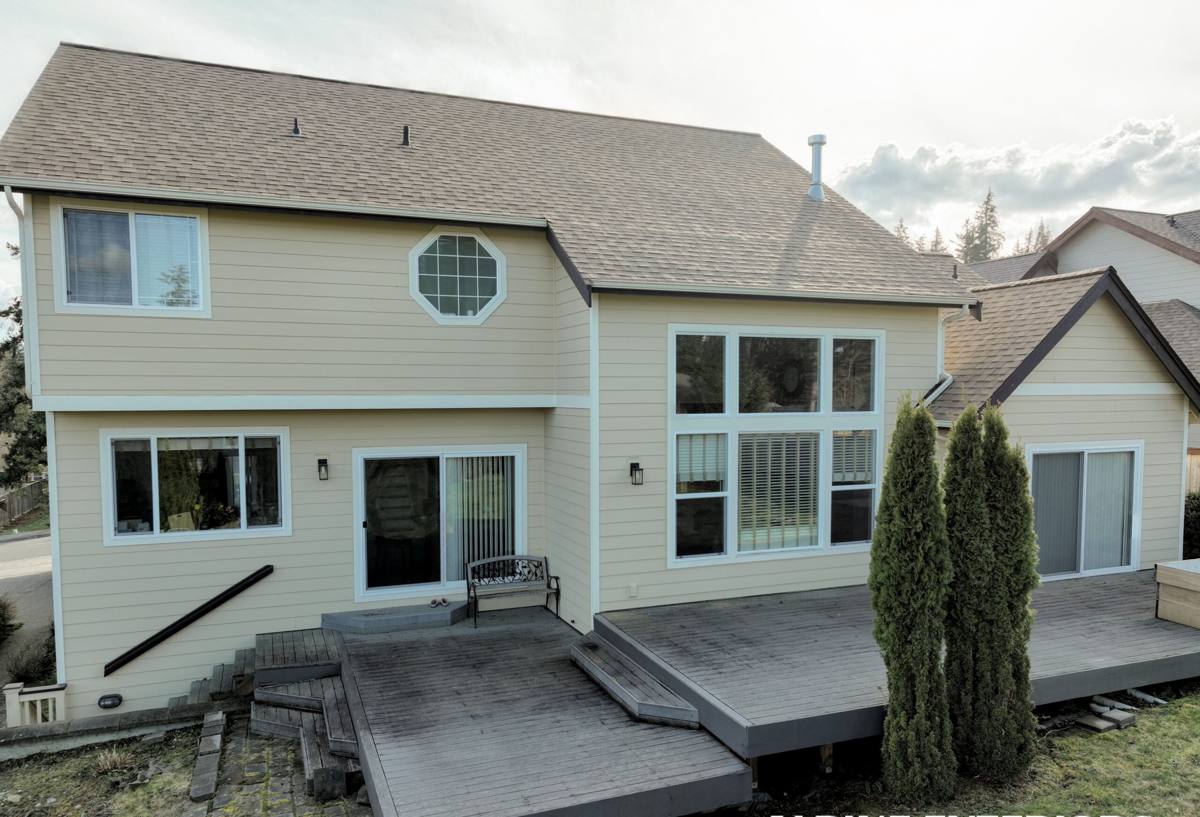
Why Decks Fail Faster Here Than the Marketing Says
Moisture That Never Fully Leaves
Most decking and framing lumber is rated assuming it gets real dry-out time between rain events. In Nooksack, that dry-out window is shorter and less reliable. Water sits in end grain, in fastener holes, and in the gaps between deck boards long enough to start breaking down wood fibers even under a coat of stain or sealant that looked fine last summer.
Moss and Organic Growth
Moss isn't just a cosmetic problem. Once it takes hold on a deck surface or in the gaps between boards, it holds water against the wood around the clock, blocks sunlight that would otherwise help boards dry, and its root structure works into soft or checked wood. A deck with heavy moss buildup is very often hiding rot underneath it.
Salt Air and Corroding Hardware
Even away from the immediate waterfront, airborne salt travels with the marine weather patterns that move through this part of Whatcom County. Fasteners, joist hangers, and ledger bolts that aren't rated for coastal exposure corrode from the inside of the connection outward, which is exactly why a deck can look structurally fine on the surface while the hardware holding it together is failing.
Signs Your Deck Needs Repair Now
Some deck problems are obvious. Others hide until someone puts weight in the wrong spot. Here's what we tell Nooksack homeowners to check for between professional inspections:
- Soft, spongy, or springy spots when you walk across the deck surface
- Boards that have visibly cupped, split lengthwise, or pulled away from fasteners
- Rust streaks running down from screws, nails, or joist hangers
- Moss or dark green-black staining concentrated in one area, especially near the house
- A railing that wiggles, flexes, or feels less solid than it did last year
- Gaps opening up where the deck ledger meets the house siding or band board
- Visible daylight or gaps under support posts, or posts that have shifted on their footings
- A musty smell coming from underneath the deck structure
Any one of these on its own might be minor. Two or three together usually means the underlying structure needs a real inspection, not just a surface fix.
What a Correct Deck Repair Actually Involves
Diagnosing Past the Surface
A repair that only replaces the board you can see is a repair that gets redone in two years. We check the ledger board connection, the joists underneath the affected area, the condition of fasteners and hardware, and the footings and posts before deciding what actually needs to come out. Rot rarely stays contained to one board — it tracks along end grain and fastener holes into whatever it's touching.
Structural Work Comes First
If joists, the ledger, or support posts are compromised, those get addressed before any decking goes back down. This is also where local code matters — ledger attachment, joist hanger specs, and post-to-footing connections all have requirements under Whatcom County's adopted building code, and a repair that skips those isn't a repair that will hold up or pass inspection if one's ever required.
Matching Fasteners and Hardware to the Climate
Every fastener and connector we install on a repair is rated for exterior, corrosion-prone exposure — not the general-purpose hardware that's cheaper but starts rusting within a season or two in this air. This is one of the most common shortcuts we see on prior repairs, and it's usually the reason the same spot fails again.
Board Replacement Done to Match
Whether the deck is wood or composite, replacement boards get matched for species or product line, fastened with the correct spacing for expansion and drainage, and finished to blend with the surrounding surface as closely as the existing material allows.
Repair vs. Replacement: How We Help You Decide
Not every deck problem calls for a full rebuild, and not every deck is worth repairing piece by piece. The table below covers the factors we walk through with homeowners.
| Factor | Leans Toward Repair | Leans Toward Replacement |
|---|---|---|
| Extent of rot/damage | Isolated to a few boards or one framing member | Rot found in multiple joists, the ledger, or several posts |
| Age of structure | Under 12-15 years, built to a solid original standard | Original construction is older or was undersized to begin with |
| Fastener/hardware condition | Isolated corrosion at a few connections | Widespread rust on hangers, bolts, and fasteners throughout |
| Footings and posts | Stable, level, properly sized for the deck | Undersized footings, shifting posts, or no visible footings at all |
| Design/layout | Layout works fine, drainage is reasonable | Poor drainage, ledger flashing issues, or a layout trapping moisture |
Cost-wise, targeted repairs on an otherwise sound deck are the more affordable path. A deck with structural problems in multiple areas often ends up costing more to patch piecemeal than to rebuild correctly once. We'll always give you the honest read on which side of that line your deck falls on.
Our Deck Repair Process in Nooksack
- On-site inspection — We check the deck surface, framing, ledger, posts, and footings, including probing any suspect areas for soft wood.
- Straight assessment — You get a clear explanation of what's failing, why, and what it will take to fix it correctly — no upsell to a full rebuild if a repair genuinely covers it.
- Written estimate — Scope, materials, and cost laid out before any work starts.
- Repair work — Structural issues addressed first, then decking, railing, and hardware, using fasteners and connectors rated for this climate.
- Final check — We walk the repaired area with you, check that everything is solid underfoot and at the railings, and cover basic care going forward.
Materials: What We Use and Why
Wood Decking
Cedar and pressure-treated lumber remain solid choices for repairs, especially when matching existing wood decking. The trade-off is ongoing maintenance — wood decking in this climate needs regular sealing or staining to keep moisture out of the grain, and skipping a season or two of upkeep is what lets rot get a foothold in the first place.
Composite Decking
Composite boards hold up well against moisture and don't need staining, which makes them a strong option where a deck gets heavy shade and moss exposure. The trade-off there is installation sensitivity — composite needs correct fastening, spacing, and ventilation underneath to perform as intended, and a repair patched in without following the manufacturer's spacing and clip requirements can trap moisture or void the product warranty. We follow manufacturer specs on every composite repair for exactly that reason.
Hardware and Fasteners
Regardless of decking material, we use corrosion-resistant fasteners, joist hangers, and structural screws rated for exterior, high-moisture exposure on every repair. This is a small line item on an estimate that makes a large difference in how long the repair actually lasts.
Keeping a Repaired Deck in Good Shape
A repair is only as good as the maintenance that follows it. For Nooksack homeowners, that mainly means staying ahead of moss and moisture:
- Sweep leaves, needles, and debris off the deck regularly, especially in shaded corners
- Clean moss and algae off the surface before it spreads, rather than after
- Keep gutters and downspouts near the deck clear so runoff isn't draining onto it
- Reseal or restain wood decking on the schedule the product calls for — don't stretch it
- Check railings and stair connections once a year for looseness
- Trim back vegetation that's shading the deck and keeping it damp longer than it needs to be
Why Hire a Crew That Already Works in Nooksack
Deck repair looks straightforward on paper, but the difference between a fix that holds and one that fails again shows up in details a crew only learns by working this specific area over time — how the local moisture and moss pattern behaves on shaded versus open decks, which hardware actually holds up here versus what's sold as adequate, and what Whatcom County's code requires for structural connections. A crew that treats every deck the same way they'd treat one in a dry climate is setting up a repeat repair.
We're a Ferndale-based crew that works Whatcom County regularly, including Nooksack, so the conditions your deck is fighting aren't a surprise to us — they're what we see on most jobs.
Get a Straight Answer on Your Deck
If your deck has soft spots, rusting hardware, moss buildup, or a railing that doesn't feel as solid as it used to, it's worth getting an honest look before the damage spreads further into the structure. We offer free, no-pressure estimates for deck repair in Nooksack and the surrounding area — fill out the form below and we'll get back to you with a straight assessment of what your deck actually needs.