 Ferndale Siding
 Why Nooksack's Climate Is Hard on Windows
Homes around Nooksack sit in one of the wetter, windier corners of Whatcom County, and that combination is tough on windows in ways that don't show up right away. You've got marine air moving in off the Salish Sea carrying fine salt content, driving rain that comes in sideways during winter storms, and a moss season that stretches from fall through spring when everything north-facing stays damp for weeks at a time. None of that is dramatic on its own, but stacked together over years it finds every weak point in a window's seal, frame, and flashing.
Older aluminum-frame windows and single-pane units common in homes built decades ago simply weren't designed for this. Aluminum conducts cold straight through the frame, so on a wet Ferndale-area winter morning you'll see condensation forming on the inside sash before you've even had coffee. That moisture doesn't just fog the glass — it works into the sill, the trim, and eventually the framing around the opening if it's given enough time and enough winters to do it.
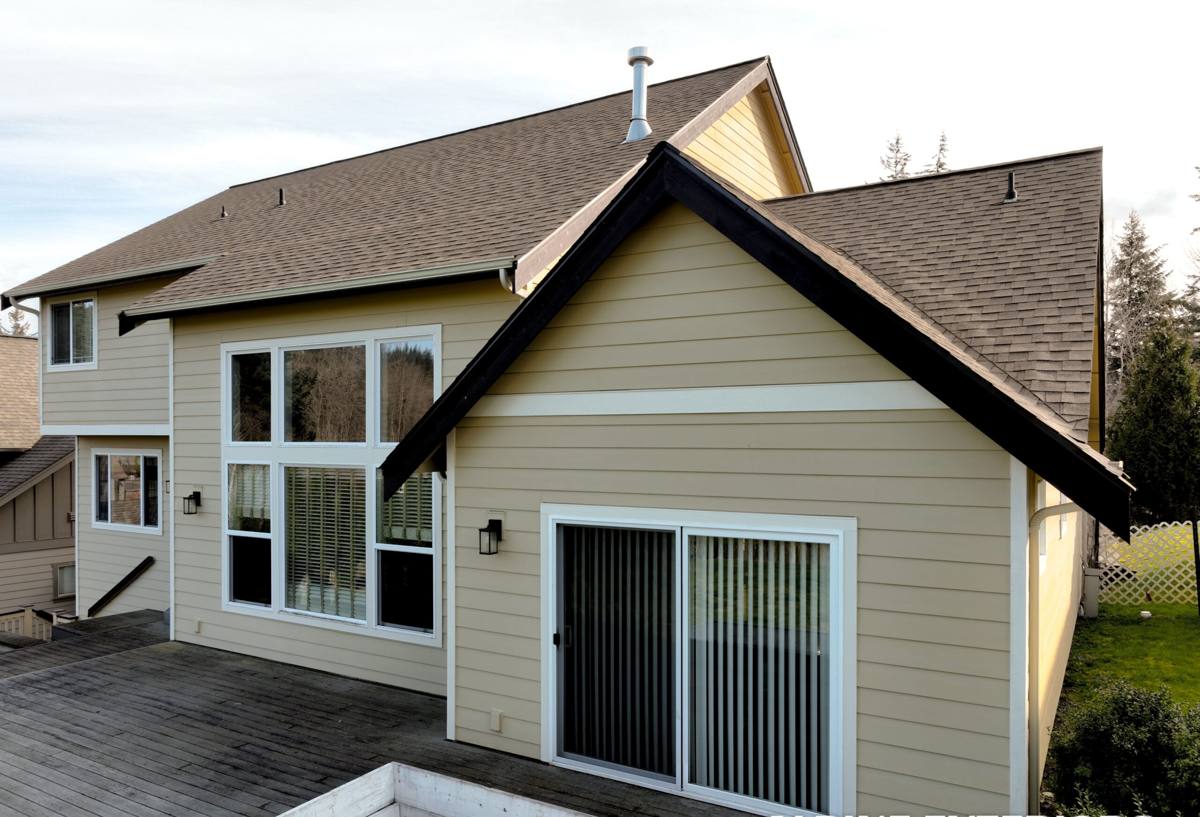
Signs Your Current Windows Are Losing the Battle
Most homeowners don't replace windows because they woke up wanting new windows — they replace them because something told them it was time. In this climate, the tells are pretty consistent:
- Condensation or fogging between the panes of a double-pane window, which means the seal has failed and the gas fill (if there was one) is gone
- Visible moss or black staining building up on the sill or the exterior trim around a window, even after cleaning
- A draft you can feel with your hand near the frame on a windy day, especially on walls that face west or north
- Wood trim or sills that feel soft, or paint that's bubbling and peeling near the window opening
- Windows that are difficult to open, close, or lock — often a sign the frame has swollen, warped, or shifted
- A noticeably higher heating bill in winter compared to homes of similar size nearby
Any one of these on its own might just mean a caulking touch-up. Several of them together, especially moisture and staining, usually mean the window and its surrounding flashing are due for a real look.
Why It Matters More Here Than Elsewhere
In a drier climate, a failed seal or a small gap might just cost you some comfort and a few dollars on the utility bill. In Whatcom County's wet-and-windy pattern, that same small gap is an entry point for moisture that has months of damp weather to work with before the next real drying stretch of summer. That's the local math that makes window condition a bigger deal here than it would be in most parts of the country.
What "Energy-Efficient" Actually Means for This Climate
"Energy-efficient" gets used as a marketing word a lot, so it's worth being specific about what it should mean for a Nooksack-area home. It's not just about the R-value printed on a brochure — it's about how the whole assembly performs against wind-driven rain and sustained damp cold.
The Numbers That Actually Matter
Two ratings tell you almost everything you need to know: U-factor and air infiltration rate. U-factor measures how much heat escapes through the window — lower is better, and for this region we look for U-factor in the 0.27–0.30 range or better on replacement units. Air infiltration measures how much air leaks around the sash when it's closed and locked; a tight window will test well under 0.3 cfm/ft². Solar heat gain coefficient matters less here than in sunnier climates, but it's still worth checking on south- and west-facing units.
Glazing and Gas Fill
Dual-pane, low-E coated glass with an argon gas fill is the standard baseline for this region now, and it's a meaningful step up from the clear dual-pane glass common in windows from the 1990s and early 2000s. Triple-pane is available and does perform better thermally, but for most Nooksack-area homes the added cost doesn't pencil out against a quality dual-pane low-E unit — we'll walk through that trade-off honestly rather than upselling it by default.
Frame and Glass Options Compared
There isn't one "correct" frame material for every home — it depends on your home's age, siding, budget, and how exposed the wall is to wind and rain. Here's how the common options stack up for this climate specifically:
| Frame Type | How It Handles Salt Air & Moisture | Maintenance Load | Typical Fit |
|---|---|---|---|
| Vinyl | Good — won't corrode or rot, seams are the main weak point to watch | Low | Most common replacement choice, good value |
| Fiberglass | Excellent — very stable in wet/dry and hot/cold swings, resists warping | Low | Best long-term option where budget allows |
| Aluminum | Poor thermal performance in this climate; conducts cold and invites condensation | Low, but performance suffers | Generally not recommended for replacements here |
| Wood / Wood-clad | Attractive but vulnerable if cladding or finish is breached by driving rain | High — needs regular inspection and refinishing | Best for homeowners committed to upkeep, historic-style homes |
We install primarily vinyl and fiberglass replacement windows for this reason — both hold up to the salt air and moisture cycle without asking for constant upkeep. We're not against wood-frame windows as a category; we just want homeowners to go in clear-eyed about the maintenance commitment before choosing that route in a climate this wet.
What a Correct Installation Involves
The window unit itself is only part of the job. In this climate, the installation details around the window are what actually determine whether it stays dry and efficient for the next twenty years.
Flashing and Water Management
Every opening needs proper flashing integrated with the wall's water-resistive barrier — flashing tape at the sill and jambs, a sloped sill pan so any water that does get past the glass drains back out instead of pooling, and head flashing that sheds water away from the top of the frame. Skipping or shortcutting this step is the single biggest cause of hidden rot behind window trim, and it's invisible from the outside until the damage is already done.
Sealing and Insulation
The gap between the window frame and the rough opening needs to be insulated — typically with low-expansion foam rather than packed fiberglass, which can settle and leave gaps. Exterior caulking needs to be a proper sealant rated for this climate's temperature swings, applied at the right joints and never used as a substitute for flashing.
Fit and Level
A window that isn't shimmed level and square will bind, won't seal properly against the weatherstripping, and will age poorly. This is a basic step, but it's also the one that gets rushed on a fast, high-volume install.
Our Process, Start to Finish
We keep the process straightforward and make sure you know what's happening at each stage:
- On-site assessment — we look at your existing windows, check for moisture or rot around the openings, and measure accurately rather than estimating
- Honest recommendation — we walk through frame and glass options based on your home's exposure, budget, and what actually makes sense, not the most expensive option on the shelf
- Written estimate — clear pricing with no vague allowances buried in the fine print
- Removal and inspection — old windows come out carefully, and we check the framing underneath for any hidden moisture damage before anything new goes in
- Flashing and installation — proper sill pans, flashing, insulation, and sealant, installed level and square
- Interior and exterior finish — trim and caulking finished cleanly on both sides
- Final walkthrough — we check every window operates smoothly and seals properly before we call the job done
Why a Local Crew Matters for Nooksack Homes
A crew that already works this stretch of Whatcom County knows what to expect before they even pull up. They know which wall orientations catch the worst of the wind-driven rain, they know how long moss season really runs here, and they've seen firsthand what happens to a window that was flashed wrong five years ago. That local knowledge shows up in small decisions throughout the job — how much sealant to use, where to pay extra attention to flashing, which frame materials actually hold up rather than just looking good on a spec sheet.
It also matters for accountability. A local contractor is going to be around next year and the year after if something needs a look, rather than having moved on to the next region over.
Choosing a Contractor: A Practical Checklist
Whoever you hire for window work in this area, these are worth confirming before you sign anything:
- Washington state contractor registration and proof of insurance, provided without you having to ask twice
- A written estimate that spells out frame material, glass package, and U-factor — not just "energy-efficient windows"
- A clear explanation of how they'll handle flashing and sill pans, not just "we'll caulk it up good"
- Willingness to check the rough opening for existing moisture or rot before installing, not just swap the unit and move on
- A real answer on warranty coverage — both the manufacturer's window warranty and their own labor warranty
- References or examples of similar work done in this specific climate, not just generic before-and-afters
Caring for Your New Windows Season to Season
Energy-efficient windows still need a bit of seasonal attention to keep performing the way they should in this climate. Rinse sills and tracks periodically during the wet months to keep moss and debris from building up and holding moisture against the frame. Check exterior caulking once a year, typically before winter, and touch up any spots where it's cracked or pulled away. Keep an eye on weatherstripping around operable sashes — it's a low-cost part to replace and it's the first thing to wear from repeated opening and closing. None of this is heavy maintenance, but skipping it entirely for years at a time is how small issues in this climate turn into bigger ones.
If you're weighing window replacement for a home in the Nooksack or greater Ferndale area, we're glad to take a look and give you a straight, no-pressure estimate — just fill out the form below to get started.