 Ferndale Siding
 Storm Damage Roof Repair for Sumas Homes
Sumas sits out at the far edge of Whatcom County, in the flat, low-lying farmland of the Sumas Prairie right against the Canadian border. It's a different setting than the towns closer to Bellingham Bay, and that position changes what "storm damage" actually means here. Sumas gets less of the direct salt-air exposure that wears on roofs in our waterfront service areas, but it takes a harder hit from wind: cold outflow events funnel down the valley in winter, driving rain comes in sideways rather than falling straight down, and a long moss season keeps roof surfaces damp between storms. When a windstorm moves through, it isn't testing a roof in isolation — it's testing whatever that roof's moss season and driving rain have already been quietly working on all year.
This page is specifically about storm damage roof repair — the work that follows a windstorm, a falling branch, or a sudden leak that shows up after a hard blow through the valley. It's a different job than a routine re-roof or a scheduled inspection: the damage is often sudden, sometimes urgent, and usually needs to be documented properly along the way, not just patched and forgotten. We handle this kind of repair for homes in Sumas regularly, and the approach below is built around what actually happens to a roof out here when the weather turns.
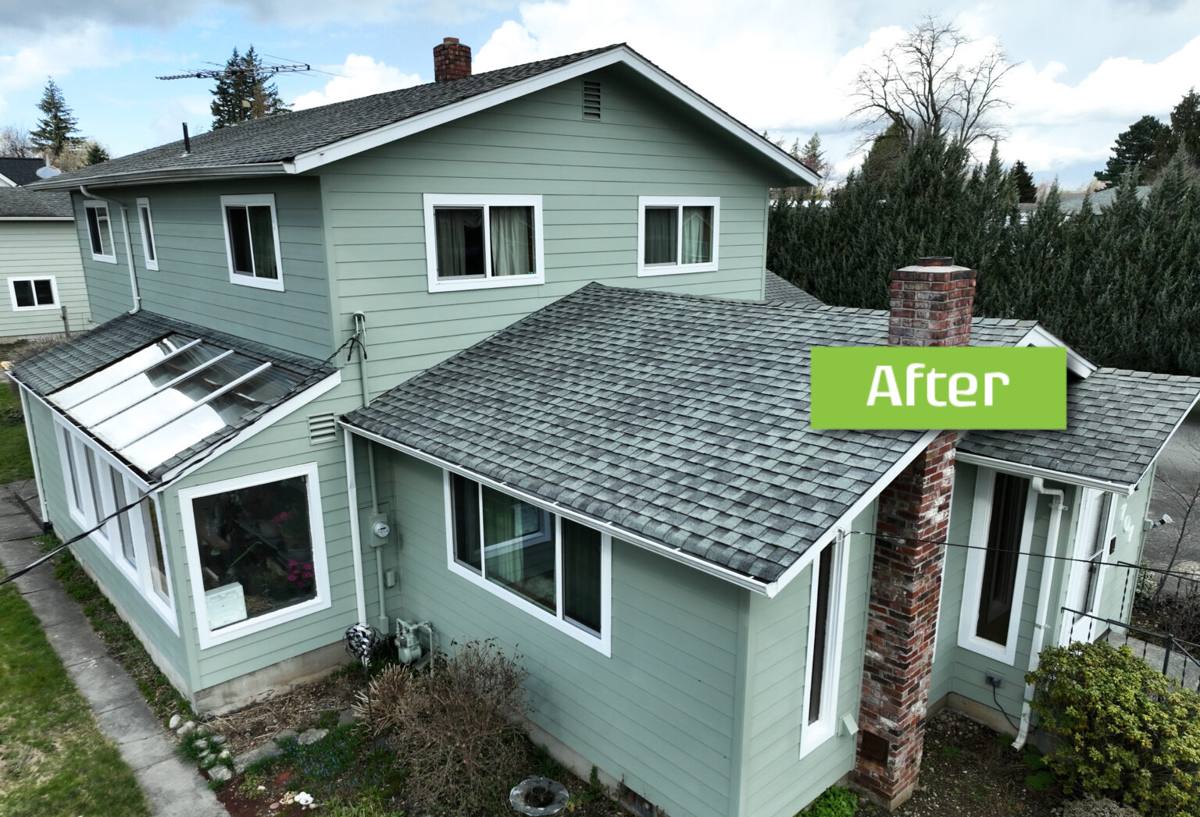
What a Storm Actually Does to a Sumas Roof
Cold Outflow Wind Events
Because of where it sits, at the head of the valley near the border, Sumas gets more of these outflow wind events than towns further west toward the water. They bring sharp temperature drops and real sustained wind load, and that's a different kind of stress on a roof than ordinary Pacific Northwest rain. Wind gets under shingle tabs, breaks the factory seal strip that's supposed to hold them flat, and works loose fasteners that were driven at a slight angle or into a soft spot in the deck. Once a few tabs lift, the next gust has an easier time lifting more.
Wind-Driven Rain Finding Existing Weak Points
A storm rarely creates damage out of nowhere. More often it finds whatever was already marginal — a flashing seam that had started to separate, a pipe boot that had cracked from UV and moss exposure, a valley where granule loss had thinned the surface — and pushes rain through it under real pressure. That's why two roofs that look similar from the ground can come through the same storm very differently: one had nothing left for the wind to exploit, and the other did.
Debris Impact
Sumas Prairie is open farmland, but plenty of properties still sit near mature trees, windbreaks, or shelterbelts planted along field edges. A hard blow can bring down branches or drop debris onto a roof, and even a glancing hit can crack a shingle, dent a vent cap, or knock loose a section of ridge cap without leaving damage that's obvious from the driveway.
Freeze-Thaw After the Storm, Not Just During It
Sumas sees more frequent hard frost than the milder coastal parts of the county, and that matters most in the days right after a storm. Water that got into a roof deck or underlayment during the wind and rain doesn't just sit there — if a cold snap follows, it freezes and expands, and that's often what turns a small point of intrusion into a larger, more expensive repair. This is a big part of why we treat storm response as time-sensitive here rather than something to schedule around at leisure.
Signs Your Sumas Roof Took Storm Damage
Some storm damage is obvious. A lot of it isn't, especially from ground level, which is why it's worth checking carefully after any significant wind event rather than waiting for a leak to show up inside the house.
- Shingles missing, torn, or lifted, especially concentrated on one wind-exposed slope
- A sudden pile of granules at the base of downspouts, rather than the gradual buildup of normal aging
- Flashing around chimneys, vents, or valleys that looks bent, lifted, or pulled away from the surface
- New water staining on an interior ceiling or in the attic that wasn't there before the storm
- Dented, cracked, or displaced vent caps and pipe boots
- Branches, siding fragments, or other debris caught in gutters or lodged on the roof itself
- Shingles or shingle fragments found in the yard after high wind
- A soft or spongy feel underfoot on a section of roof that took a direct hit
Any one of these is worth a call. Storm damage that's caught and addressed quickly is usually a straightforward repair. Left through another wet spell or a follow-up cold snap, it tends to spread into the roof deck and framing underneath.
What a Correct Storm Damage Repair Involves
Stopping the Water First
If a roof has an active leak or exposed decking after a storm, the first job is temporary weatherproofing — a properly secured tarp or covering over the damaged section — before anything else gets scheduled. A tarp isn't a repair, but it buys time and keeps a bad situation from getting worse while the rest of the work gets lined up, which matters in a climate where the next round of rain is rarely far off.
Inspecting the Whole Roof, Not Just the Visible Spot
Wind damage doesn't stop at the section you can see from the ground. A proper storm repair includes checking the full roof — including the leeward slope, which can take its own damage from turbulence even when the wind was blowing from the opposite direction — and checking the decking underneath any compromised section for hidden moisture before new material goes down over it.
Matching Materials Honestly
On a partial repair, we'll match shingle profile and color as closely as the product line allows, but we won't promise a perfect, invisible match on an older roof — sun exposure and moss staining change a roof's appearance over time in ways a brand-new bundle of shingles can't fully replicate. If a close cosmetic match matters more to you than a partial repair, that's a real factor in deciding between a repair and a larger replacement, and we'll talk through it honestly rather than oversell a patch.
Fixing Flashing Properly, Not Just Re-Sealing It
Caulk over a lifted flashing seam is a stopgap, not a repair. Correcting storm-damaged flashing means resetting or replacing the metal so it sheds water the way it was designed to, then sealing it as a secondary measure — not relying on sealant to do a flashing detail's job.
Documenting the Damage
Before repair work covers anything up, we document what we find — photos of the damaged area, the suspected cause, and the scope of what needs to be done. That record is useful for your own files regardless of whether you're filing an insurance claim, and it's essential if you are.
Repair or Replace After a Storm?
Not every storm-damaged roof needs to come off. We look at a handful of factors before recommending either path, and we'll walk you through our reasoning rather than just naming a number.
| Factor | Leans Toward Repair | Leans Toward Replacement |
|---|---|---|
| Extent of damage | Isolated to one section or slope | Spread across multiple slopes or the full roof |
| Roof age | Well within its expected service life | Already near the end of its rated lifespan |
| Decking condition | Dry, solid decking under the damaged area | Soft spots or rot found once the covering is pulled back |
| Repair history | First significant repair on this roof | Several prior patches already on record |
| Material availability | Matching shingle still in production | Discontinued product with no close match |
A newer roof with an isolated wind-lift problem is usually a straightforward repair. An older roof with storm damage on top of existing moss-related wear, or decking that's already showing rot once we look underneath, is more honestly addressed as a full replacement rather than another patch that won't hold through the next storm season.
Working With Your Insurance Company
Many storm-related roof repairs in this area do get submitted as insurance claims, and there are a few things worth knowing going in. We provide clear, dated documentation and a written repair scope you can hand to your adjuster, and we're happy to meet an adjuster on site if that's useful. We are not a public adjuster and won't tell you what your policy covers or negotiate your claim for you — that's between you and your insurer, and anyone who promises to guarantee a specific settlement before your insurer has even looked at the damage isn't being straight with you. What we can promise is an honest, well-documented account of what happened to the roof and what it will actually take to fix it correctly.
Our Storm Damage Repair Process in Sumas
- Call us as soon as you notice damage or a leak — the sooner a compromised roof gets a temporary cover, the less secondary damage it takes on
- We assess whether emergency tarping is needed and get that done as quickly as scheduling allows
- A full inspection of the roof, not just the obviously damaged section, including a check of the decking underneath
- A written scope and estimate that spells out what's damaged, what caused it, and what the repair involves
- Documentation you can use for insurance purposes, whether or not you end up filing a claim
- The repair itself, done with matched materials where available and flashing corrected rather than just caulked over
Cost Factors for Storm Damage Roof Repair in Sumas
| Factor | What It Affects | Why It Matters Here |
|---|---|---|
| Emergency tarping | Whether temporary weatherproofing is needed before the full repair | Ongoing rain and outflow wind can turn a small leak into real damage within days if left uncovered |
| Decking repair | Labor and material cost once the damaged covering is removed | Trapped moisture from a storm followed by a cold snap can rot decking faster than a slow, gradual leak would |
| Material matching | Whether a partial repair or a larger section replacement makes sense | Older roofs with sun and moss staining are harder to match invisibly than newer ones |
| Wind and fastening spec | Fastening pattern and flashing detail on the repaired section | A roof already exposed to outflow wind events benefits from a repair built to the same standard, not a minimal patch |
| Site access | Labor time and equipment needs | Rural Sumas Prairie properties can have longer driveways or different staging needs than an in-town lot |
Exact cost depends on the specific damage and what we find once we're actually on the roof, which is why we inspect in person before giving you a real number rather than a phone estimate.
Why a Crew That Already Works Sumas Matters
A crew that handles storm repairs across this part of Whatcom County regularly knows the difference between damage patterns here and damage patterns on a milder, coastal roof closer to Bellingham Bay. That shows up in practical ways: recognizing that a Sumas roof's leeward slope needs checking just as carefully as the windward one after an outflow event, knowing how quickly trapped moisture can turn to frost damage once a storm passes and temperatures drop, and understanding that a roof with a long moss season behind it is already carrying wear a storm can expose in places a less experienced crew might miss. Sumas sits far enough from the water and close enough to the border that its storm exposure looks a little different from the rest of our service area, and that difference is worth taking seriously rather than treating every storm call the same way.
If a recent windstorm left your Sumas roof with missing shingles, a new leak, or damage you're not sure how to read, we're glad to take a look. Reach out using the form below to schedule a free, no-pressure estimate.