 Ferndale Siding
 Metal Roofing for Lummi Island Homes
Lummi Island sits apart from the rest of Whatcom County in a way that matters for anyone planning a roofing project: it's reachable only by a short county-run ferry crossing from the mainland near Ferndale. That single fact changes more about a roofing job than most homeowners expect, on top of the same weather challenges that shape every exterior project in this part of the county — salt air moving in off the water, driving rain that doesn't fall so much as get pushed sideways, and a moss season that runs longer here than in drier inland stretches of Washington. Metal roofing holds up well against all three of those conditions when it's specified and installed correctly, which is a big part of why we see more of it go on island homes than on comparable mainland properties.
This page focuses specifically on metal roofing for Lummi Island: what the local climate actually demands from a roof system, what separates a correctly installed metal roof from one that will cause problems within a few years, and what the ferry-dependent logistics of an island job mean for scheduling and cost. It's written for someone weighing a metal roof for a Lummi Island home, not as a general introduction to metal roofing.
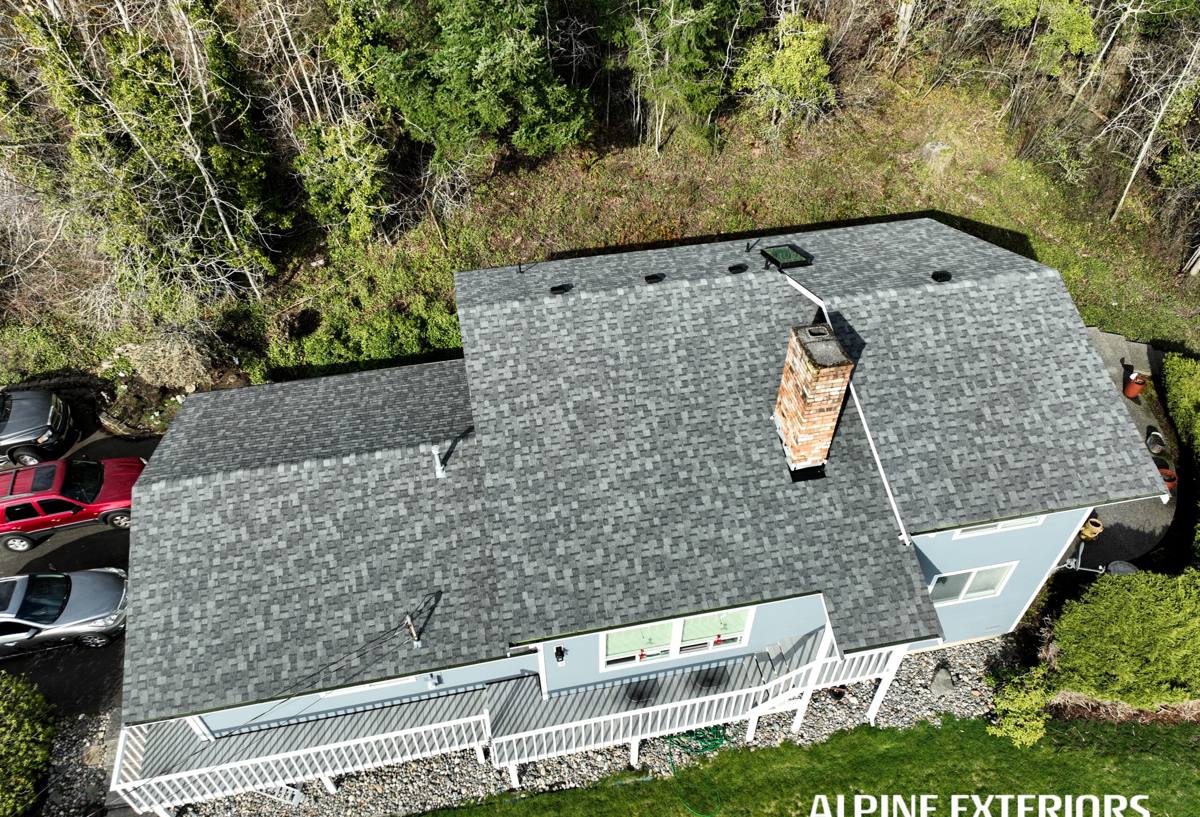
What Salt Air, Driving Rain, and a Long Moss Season Do to a Metal Roof
Salt Air and Fastener Corrosion
An island surrounded by saltwater sees a heavier, more constant dose of salt-laden air than a home set back a few miles inland. On a metal roof, that exposure targets the smallest components first: exposed fasteners, cut edges, and flashing seams. Lower-grade screws and unprotected cut edges will show rust and staining well before the panels themselves show any wear, and once corrosion starts at a fastener, it tends to work outward rather than staying contained. The panel material, the fastener coating, and how cut edges are treated all need to account for this from the start rather than being an afterthought.
Wind-Driven Rain at Laps and Penetrations
Rain that arrives at an angle behaves differently than rain that falls straight down, and a roof system that would perform fine somewhere sheltered can still let water in here because it's being tested from the side, not just from above. On a metal roof, that pressure shows up at panel side-laps, end-laps, and anywhere a pipe, vent, or chimney breaks the roof plane. Panels and trim that are lapped, sealed, and fastened to account for wind-driven rain hold up; ones installed to a minimum, straight-down-rain standard tend to leak first at exactly those transition points.
Moss and Algae in Valleys and Shaded Areas
Metal roofing doesn't give moss the same foothold that a shingle or shake roof does, since there's no rough, absorbent surface for spores to root into. That said, a long moss season still leaves its mark on a metal roof here, mostly as organic debris and algae staining that collects in valleys, behind chimneys, and along shaded north-facing slopes where moisture lingers longest. Left unaddressed, that buildup holds moisture against seams and fasteners for extended stretches, which is exactly the condition that speeds up the corrosion described above.
Why Metal Roofing Is a Strong Fit for This Island's Homes
Metal roofing earns its reputation on properties like these for practical reasons, not just appearance. It sheds wind-driven rain more effectively than a roof that relies on the surface tension of overlapping shingles, it carries a strong wind-uplift rating when it's properly fastened, and a quality panel system with the right coating will outlast an asphalt shingle roof by a wide margin under the same coastal exposure. Many Lummi Island properties are waterfront or near-waterfront homes with clear exposure to open water and wind, which is precisely the setting where a well-installed metal roof shows its advantages most clearly over shingle alternatives.
None of that means every metal roofing product or installation method is equally suited to this exposure. Panel gauge, coating system, fastener type, and installation detail all affect how well a metal roof actually performs here, and that's where the real differences between a good job and a mediocre one show up.
Standing Seam vs. Exposed-Fastener Panels
The two most common metal roofing systems handle this island's climate differently, and the choice between them is worth understanding before getting quotes.
| Feature | Standing Seam | Exposed-Fastener Panel |
|---|---|---|
| Fastening method | Concealed clips under raised seams | Screws driven through the panel face |
| Exposure to salt air and moisture | Fasteners are protected from direct weather | Fastener heads and washers face direct exposure and need periodic inspection |
| Expansion and contraction | Floating clip system allows panels to move without stressing fasteners | Panels are fixed at each screw, which can work fasteners loose over time |
| Typical upfront cost | Higher | Lower |
| Best fit | Waterfront and highly exposed roofs where long-term, low-maintenance performance matters most | Outbuildings, sheds, or budget-driven projects on more sheltered parts of a property |
Our professional standard for primary roofs on Lummi Island homes is standing seam, specifically because concealed fasteners hold up better under sustained salt exposure and don't require the periodic re-torquing that exposed-fastener systems eventually need. Exposed-fastener panels still have a legitimate place on this island, particularly for detached structures or lower-exposure roof sections, and we'll say so plainly when that's the more sensible call for a given building rather than upselling standing seam where it isn't needed.
What a Correct Metal Roof Installation Involves
Tear-Off and Deck Inspection
A full tear-off down to the roof deck is the only reliable way to find rot or hidden moisture damage that's developed under an old roof, and it matters more here than in a drier climate because moisture problems tend to have had more time and more opportunity to take hold. Any soft or damaged decking gets addressed before new material goes down, not sealed over.
Underlayment
Metal roofing needs an underlayment system rated to handle the specific behavior of metal panels, including thermal movement and, in this climate, sustained wind-driven moisture. High-temperature synthetic or self-adhered underlayment at eaves, valleys, and penetrations gives the roof deck a real secondary barrier if water ever gets past the panels themselves.
Fastening and Panel Layout
Panel spacing, clip placement, and fastener pattern have to follow the manufacturer's specification for this wind exposure, not a generic layout. On an island property with open water on one or more sides, that attention to fastening detail is what keeps a roof performing at its rated wind-uplift resistance instead of quietly falling short of it.
Flashing at Valleys, Penetrations, and Wall Transitions
Nearly every metal roof leak we've traced back to its source started at a flashing detail, not in the open panel field. Valleys, chimney and vent penetrations, and roof-to-wall transitions all need flashing that's integrated with the underlayment and panel system, not caulked on afterward as a patch.
Ventilation
Balanced intake and exhaust ventilation keeps the underside of the roof deck dry and reduces condensation risk, which matters under metal roofing just as much as it does under shingles, if not more, given how efficiently metal sheds heat and can encourage condensation on the underside without proper airflow.
The Ferry Factor: Scheduling and Logistics on an Island Job
A metal roofing job on Lummi Island involves a layer of planning that a comparable job on the Ferndale mainland doesn't. Materials, equipment, and crew all have to move across on a ferry with a fixed schedule and limited vehicle capacity, which means panel deliveries, dumpster or debris hauling, and daily crew transport all get planned around ferry sailings rather than around our own preferred timing. Panels for a standing seam roof are also often long, factory-cut lengths, and coordinating that kind of material safely onto a ferry takes advance planning that a mainland job simply doesn't require.
We build that reality into the schedule up front rather than treating it as a surprise delay once the job is underway. That usually means staging more material on-site at the start of a job than we would on the mainland, planning debris removal in fewer, larger loads instead of frequent small ones, and building a little more flexibility into the timeline to account for ferry schedule changes or weather that affects sailings. None of this changes the quality of the finished roof, but it's a real factor in how a Lummi Island project gets priced and scheduled, and it's worth asking any contractor how they plan to handle it before signing a contract.
Cost Factors for a Lummi Island Metal Roof
| Factor | What It Affects | Why It Matters Here |
|---|---|---|
| Standing seam vs. exposed-fastener | Material and labor cost, long-term maintenance | Concealed fasteners cost more upfront but resist this island's salt exposure longer |
| Panel gauge and coating system | Expected lifespan and corrosion resistance | Coastal exposure rewards heavier gauge and marine-rated coatings over base-grade options |
| Tear-off vs. layover | Whether hidden deck damage is found before new roofing goes on | Common on older island homes where moisture damage has had time to develop |
| Ferry logistics and staging | Delivery scheduling, debris hauling, crew transport | Every trip across depends on ferry capacity and sailing times, not just our own schedule |
| Roof complexity and access | Labor time, cutting and flashing detail | Waterfront homes often have more valleys, dormers, or steep pitches to detail correctly |
Because so much of the cost on an island job depends on the specific property and how it's accessed, we walk the roof and the site in person before putting a number in writing rather than estimating from a distance.
Signs Your Lummi Island Roof Needs Attention
- Rust staining or visible corrosion at fastener heads, cut panel edges, or flashing seams
- Panels that have loosened, buzz in the wind, or show visible movement at seams
- Algae streaking or moss and debris buildup collecting in valleys or behind penetrations
- Water staining on interior ceilings or in the attic, especially near valleys or vent penetrations
- Caulking or sealant that's cracked, shrunk, or pulled away at flashing details
- Visible gaps or misalignment where a roof plane meets a chimney, wall, or dormer
Why a Crew That Already Works on Lummi Island Matters
A contractor who's worked roofs on this island already understands the ferry schedule, has a realistic sense of how long material staging and debris hauling actually take here, and has seen firsthand how salt air and wind-driven rain behave on real island homes over time, not just on a spec sheet. That experience shows up in the estimate itself, in how realistic the timeline is, and in the small installation decisions, extra flashing attention at a valley, a heavier fastener spec at an exposed gable, that a crew unfamiliar with island logistics might not think to plan for.
It also matters after the job is finished. A workmanship warranty means little if the company behind it isn't set up to come back out to the island for a follow-up visit without treating it as a major logistical undertaking every time.
- Do they have real, recent experience working roofs on Lummi Island specifically, not just the mainland?
- Does their estimate account for ferry scheduling, material staging, and debris removal explicitly?
- Do they specify panel gauge, coating system, and fastener type in writing, not just "metal roof"?
- Is flashing detail at valleys, penetrations, and wall transitions called out in the bid?
- Do they carry current Washington contractor licensing and insurance?
- Are the manufacturer's material warranty and the contractor's workmanship warranty clearly separated?
If you're weighing a metal roof for a Lummi Island home, whether it's a full replacement, a re-roof after storm damage, or just an honest look at a roof that's showing its age, we're glad to make the trip over and walk it with you. Use the form below to request a free, no-pressure estimate.