 Ferndale Siding
 Point Roberts Puts Siding to the Test
Point Roberts sits on the very tip of the Tsawwassen Peninsula, cut off from the rest of Whatcom County by land — the only road access runs through Canada. That geography matters more than most homeowners realize, because it means the community sits fully exposed to open water on three sides, with none of the buffering that inland Ferndale neighborhoods get from tree cover and distance from the shoreline. Wind off the Strait of Georgia and Boundary Bay carries salt spray well past the waterfront, and it lands on siding day after day, year after year.
Add in the long, wet Pacific Northwest fall and winter, and you've got a climate that actively works against cheap or poorly installed cladding. This page is about one product, in one place: James Hardie fiber cement siding, installed correctly, for homes in Point Roberts. Not a generic rundown of siding options — the specific problems this location creates and what actually solves them.
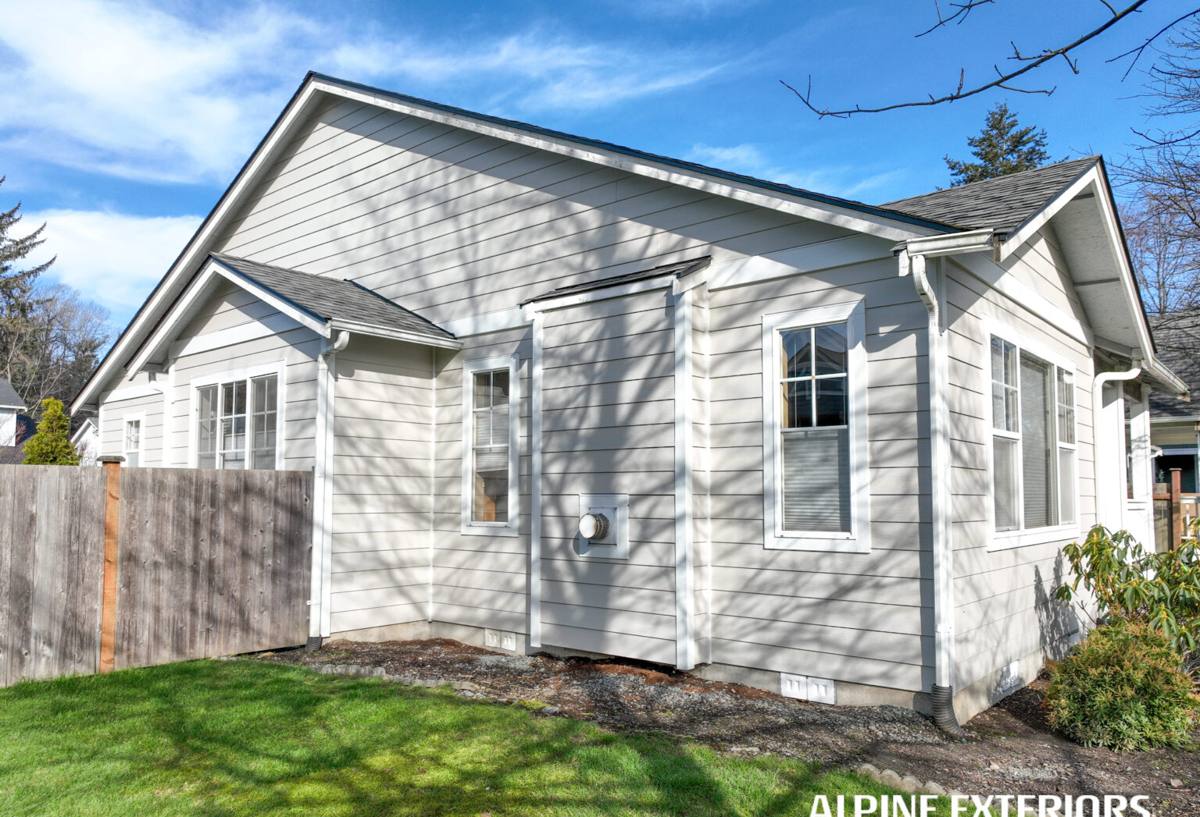
What Salt Air, Driving Rain, and Moss Actually Do to a House
Each of these three stressors attacks siding differently, and a material that resists one doesn't necessarily resist the others.
Salt Air
Airborne salt is corrosive to metal fasteners, trim, and hardware, and it's abrasive to painted or coated surfaces over time. Materials with weak factory finishes chalk, fade, or develop a dull haze faster near the water than they would a few miles inland.
Driving Rain
Wind-driven rain doesn't just fall — it gets pushed sideways and upward, finding its way behind laps, into seams, and around poorly flashed penetrations. Siding that depends on caulk or paint film alone to keep water out will eventually fail at those joints. What matters more is the water-resistive barrier and flashing detail behind the siding, not just the siding itself.
Moss Season
Whatcom County's wet season runs long, and north- and shade-facing walls in Point Roberts stay damp for extended stretches. Any siding material that holds moisture at the surface — or that has seams and textures where organic debris can collect — becomes a moss and mildew magnet. Moss holds moisture against the wall, which compounds every other problem on this list.
Why We Only Install James Hardie Fiber Cement
Fiber cement is cement, sand, and cellulose fiber pressed and cured into a dense, stable board. It doesn't rot, it isn't attractive to insects, and it doesn't expand and contract with moisture the way wood-based products do. James Hardie takes that base material and adds two things that matter specifically in a climate like this: engineered product lines built for regional conditions, and a factory-applied ColorPlus finish that's baked on under controlled conditions rather than field-painted.
| Factor | Vinyl Siding | Wood / Primed Composite | James Hardie Fiber Cement |
|---|---|---|---|
| Salt air / coastal exposure | Chalks and fades; can warp in heat or impact | Finish breaks down faster near salt spray | Factory ColorPlus finish resists fading and chalking |
| Moisture / rot risk | Doesn't rot, but seams leak and trap water behind panels | Highest risk — organic material, prone to rot if finish fails | Non-organic core; won't rot |
| Moss and mildew | Moderate — smooth surface but panel gaps collect debris | High — texture and grain hold moisture | Low — dense surface, proper clearances limit standing moisture |
| Ongoing maintenance | Occasional cleaning; can't easily repaint | Repainting/resealing every few years | Rinse as needed; repainting rarely required with ColorPlus |
| Fire resistance | Melts/ignites at relatively low heat | Combustible | Non-combustible core material |
None of this means other products are junk — vinyl and wood have their place, and homeowners are free to choose them. It's why we've made fiber cement our standard for exposed, moisture-heavy sites like Point Roberts rather than something we offer as one option among several.
What a Correct Installation Involves Here
Fiber cement performs the way it's supposed to only when it's installed to spec. In a high-exposure location, the details behind the boards matter as much as the boards themselves.
Moisture Management Behind the Cladding
Before any siding goes up, the wall needs a continuous water-resistive barrier with properly lapped and sealed seams, correctly integrated flashing at every window, door, and penetration, and a drainage gap where the siding system calls for one. This is the layer that actually stops driving rain from reaching the sheathing — the siding itself is the second line of defense, not the only one.
Fasteners, Clearances, and Joints
James Hardie specifies fastener type, spacing, and placement for a reason — corrosion-resistant fasteners matter in a salt-air environment, and correct nailing prevents the buckling and cracking that comes from panels that can't move as designed. Proper clearance from the ground, roofline, and decks keeps splash-back and standing moisture away from the bottom edge of the siding, which is where failures usually start. Where board ends meet, factory-primed or factory-finished edges and correct sealant practice keep water from wicking into the cut ends.
Factory-Finished Color
ColorPlus finish is cured onto the boards at the factory, which gives it more consistent coverage and better adhesion than field-applied paint. It's touched up with matched product at cut edges and any job-site marks, rather than repainted as a whole system — that's part of why it holds color longer in sun and salt exposure than a site-painted finish typically does.
Our Process for a Point Roberts Project
Working in Point Roberts takes a bit more planning than a job in central Ferndale, mostly around logistics — material deliveries, crew scheduling, and travel time all have to account for the community's unique access situation. Here's how a project typically moves:
- On-site assessment — we look at existing siding condition, sheathing and moisture issues, wall orientation relative to prevailing wind and rain, and any areas already showing moss or water staining.
- Scope and material plan — we confirm the James Hardie product line, profile, and color, and plan removal and disposal of existing siding.
- Tear-off and substrate check — once old siding is off, we inspect sheathing for hidden rot or moisture damage before anything new goes up.
- Weather barrier and flashing — house wrap, flashing, and drainage details get installed and checked before siding starts, since this layer is nearly impossible to fix once boards are on.
- Siding installation — panels or planks go up to manufacturer spec for fastening, clearance, and joint treatment.
- Trim, caulking, and finish work — trim details and any necessary sealant work are finished, followed by a final walk-through.
Cost Factors for Fiber Cement Siding in Point Roberts
Every home is different, so we don't quote a single number without seeing the property, but these are the factors that move the price up or down on most projects:
| Factor | Why It Matters |
|---|---|
| Home size and wall complexity | More square footage, more corners, gables, and dormers all add labor time |
| Existing siding removal | Tear-off and disposal of old material adds cost versus a bare wall |
| Substrate repair | Hidden rot or moisture damage found during tear-off has to be repaired before new siding goes up |
| Product line and profile | Plank width, texture, and color selection affect material cost |
| Trim and detail work | Custom trim, window/door surrounds, and accent details add labor |
| Access and logistics | Site access and delivery logistics for the Point Roberts area factor into scheduling and cost |
Living With Fiber Cement Siding in a Moss-Prone Climate
Fiber cement is low-maintenance, not no-maintenance. A little seasonal attention keeps it performing the way it's built to:
- Rinse salt residue off exterior walls periodically, especially on sides facing open water
- Keep gutters and downspouts clear so water isn't sheeting down the siding face
- Trim back shrubs, hedges, and trees that shade walls and slow drying
- Check shaded, north-facing walls each fall for early moss growth and remove it before it spreads
- Inspect caulking and flashing at windows, doors, and trim annually for cracking or gaps
- Watch for any soft spots or staining near the ground line, which can signal a moisture issue behind the siding
Why It Matters Who Installs It
Fiber cement's reputation for durability depends entirely on correct installation — the wrong nailing pattern, missing clearance, or a gap in the weather barrier can undercut everything the product is designed to do, and those mistakes often don't show up as a leak until years later. A crew that already works in Point Roberts has seen how the local wind, rain, and salt exposure actually behave on real walls here, not just in a manufacturer's general climate guidance. That's the difference between a siding job that's technically finished and one that's actually built for this location.
If you're weighing a siding replacement or repair in Point Roberts, we're happy to take a look and give you a straightforward, no-pressure estimate — use the form below to get started.