 Ferndale Siding
 Windows Take a Different Kind of Beating Out Here
Homes in the Lynden area near Ferndale deal with a specific combination of weather that most window products aren't really designed around. You've got long stretches of driving rain that hits window frames sideways, salt-tinged air drifting in off the water that slowly works on any exposed metal or fastener, and a moss season that runs longer here than almost anywhere else in the state. None of that is dramatic on its own. It's the accumulation, year after year, that separates a window that lasts two decades from one that starts failing in year eight.
Custom windows aren't about luxury upgrades or fancy grille patterns. In this context, "custom" mostly means built and installed to match the actual openings, actual wall assembly, and actual exposure of a specific house — instead of whatever stock size and generic install method is fastest for a crew that doesn't know the area.
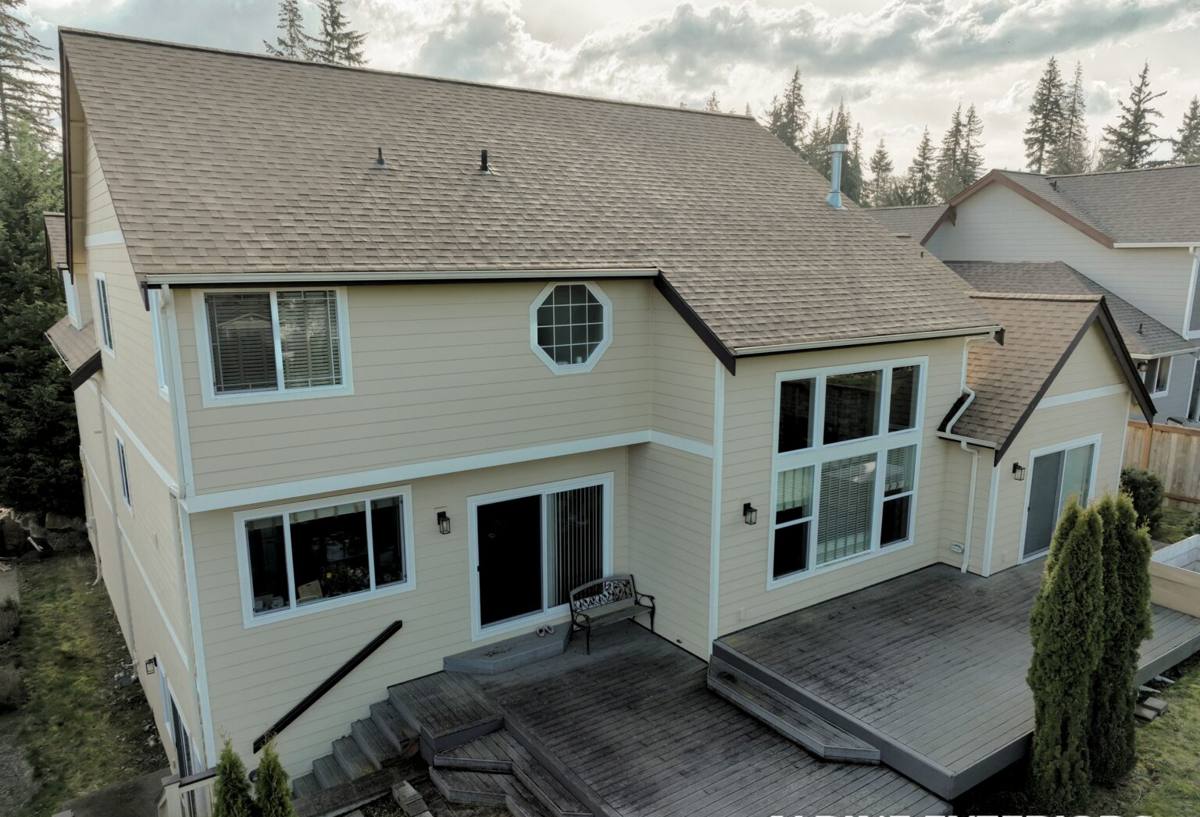
What "Custom" Really Means on a Window Job
Most homes built more than a couple decades ago don't have openings that match today's standard window sizes exactly. Settling, older framing tolerances, and additions or remodels done over the years all shift things slightly. A true custom window job starts with precise measurement of every opening — width, height, and squareness — rather than assuming a catalog size will fit.
Full-Frame Replacement vs. Insert Replacement
There are two honest approaches to replacing a window, and which one is correct depends on the condition of what's already there:
- Insert (pocket) replacement: The new window fits inside the existing frame. Faster and less invasive, but only appropriate when the old frame and the sheathing behind it are still sound and dry.
- Full-frame replacement: The old frame is removed down to the rough opening, exposing the sheathing and framing so it can be inspected and repaired if needed. Slower and more disruptive, but it's the only way to actually fix rot, soft framing, or a bad original flashing job.
Anyone who tells you insert replacement is always fine, or always wrong, isn't being straight with you. It depends on what's behind the trim, and that's something a contractor should actually check rather than assume.
Frame Material: There's No Single Right Answer
Every frame material has a real tradeoff. The table below is a straightforward comparison for homes dealing with the rain and moisture load typical of this part of Whatcom County.
| Frame Material | Moisture Resistance | Maintenance | Typical Cost Tier |
|---|---|---|---|
| Vinyl | Very good — won't rot or corrode | Low — occasional cleaning | Lower to mid |
| Fiberglass | Excellent — dimensionally stable in wet/dry cycles | Low | Mid to higher |
| Wood-clad | Good on the exterior clad face; interior wood needs protection | Higher — interior wood upkeep | Higher |
| Aluminum | Fair — prone to condensation and, near salt air, slow corrosion at fasteners | Moderate | Lower to mid |
Vinyl and fiberglass tend to be the practical choice for most homes in this area because they don't depend on maintained paint or sealant to resist moisture. Wood-clad windows can still be the right call for a specific architectural look, but that decision should be made with the maintenance commitment in mind, not just the showroom appearance. We're not going to tell you a product is "bad" — we'll tell you what it demands of you over the next fifteen years, and let you decide if that fits how you want to maintain your house.
Signs Local Weather Is Winning
Fogging Between the Panes
If you see condensation or a permanent haze between the layers of glass, the seal on that insulated glass unit has failed. It's not repairable — the whole sash or unit needs replacing. Constant rain and temperature swings accelerate this seal fatigue.
Soft or Discolored Trim and Sills
Press a thumb into the sill or the bottom corners of the exterior trim. If it gives at all, or if you see dark staining, moisture has already gotten past the original flashing or caulking. This is the single most common thing we find once we open up an older window opening in this area.
Moss or Green Growth on Frames and Sills
A long moss season means anything that stays damp for extended periods — a horizontal sill, a shaded north-facing wall — becomes a growth surface. Moss holding moisture against wood or old caulking is a slow, steady path to rot, even if the window itself still operates fine.
Drafts and Rising Heating Bills
Warped frames, failed weatherstripping, or a window that was never shimmed level in the first place all show up as drafts. If certain rooms are noticeably colder or your heating costs climb without an obvious reason, the windows are worth checking before assuming it's the furnace.
What a Correct Installation Actually Involves
The window unit itself is often not where problems start — it's the installation detail around it. This is the part that separates a window job that lasts from one that leaks again in three years:
- Proper flashing sequence: Water-resistive barrier and flashing tape installed shingle-style, so water is always directed down and out, never trapped behind the siding.
- Sill pan flashing: A sloped, sealed pan at the bottom of the rough opening so any water that does get past the window has somewhere to go besides the framing.
- Correct sealant, not just more sealant: The right sealant in the right joints — not caulk smeared over everything as a substitute for proper flashing.
- Level, square, properly shimmed installation: A window that isn't shimmed correctly will bind, won't seal against its own weatherstripping, and will stress the frame over time.
- Insulation at the gap, without overpacking: The space between the window frame and rough opening needs to be filled without compressing the frame out of square.
None of this is visible once the trim goes back on, which is exactly why it matters who's doing the work and not just what window brand ends up in the opening.
How We Approach a Lynden-Area Window Project
- On-site assessment: We look at every opening, check for existing moisture damage, and talk through which openings are candidates for insert replacement versus full-frame.
- Precise measurement and ordering: Each window is measured individually — we don't assume uniform sizes across a house, especially on older construction.
- Opening prep: Old units are removed carefully, and any soft framing or sheathing found underneath is flagged and addressed before a new window ever goes in.
- Flashing and installation: Correct sequencing of water-resistive barrier, sill pan, and flashing tape, then a level, properly shimmed install.
- Interior and exterior finish work: Trim, sealant, and insulation are finished to match the surrounding wall, inside and out.
- Final walkthrough: Every window is operated, checked for square operation and a tight seal, before we consider the job done.
What to Ask Any Window Contractor Before You Hire
- Will you inspect behind the existing trim before quoting insert vs. full-frame replacement?
- What's your flashing and sill pan process, specifically — not just "we seal everything"?
- Are you licensed and insured to work in Washington, and can you show current coverage?
- Do you warranty the installation labor separately from the manufacturer's product warranty?
- Have you worked on homes in this area before, and do you know the common issues local construction runs into?
Why It Matters That We Already Work This Area
A crew that regularly works Ferndale and the Lynden area already knows what to expect before pulling the first piece of trim. We know that older homes here commonly have inadequate original flashing, that moss buildup on north-facing walls is a recurring maintenance issue rather than a one-time fix, and that salt-influenced air means fasteners and hardware choices matter more here than they would further inland. That's not something you can learn from a manufacturer's install manual — it comes from doing this work, on these kinds of houses, in this specific climate, repeatedly.
There's also a practical follow-up angle: a local crew is easy to reach if a question comes up six months or two years after the install. That accountability tends to shape how carefully a job gets done in the first place.
Timing a Window Project Around the Local Weather
Window replacement can technically happen most of the year, but scheduling around the wettest stretches reduces the window of time a rough opening sits exposed. We plan projects to minimize how long any opening is open to the weather, and we adjust scheduling around forecasted rain rather than pushing through it — a rushed install during a downpour is exactly how water gets behind a wall before the flashing is even finished.
If you're weighing custom window replacement for a home in the Lynden area, we're happy to take a direct look at your specific openings and give you a straightforward assessment — no pressure, no inflated urgency. Fill out the form below and we'll set up a free estimate.