 Ferndale Siding
 Living With a Blaine Roof: What the Marine Climate Demands
Blaine sits right on the water at the edge of Whatcom County, and that location shapes everything about how a roof ages here. Salt-laden air drifts in off the bay almost daily, driving rain comes in sideways during winter storms, and the shade and dampness that blanket this stretch of the Pacific Northwest keep roofs wet for months at a stretch. None of that is a problem a roof can't handle — but it is a problem that punishes shortcuts. A repair that would hold up fine in a drier inland town can fail within a season or two in Blaine if it skips the details that matter here.
Salt Air and Metal Fatigue
Salt air is corrosive to exposed metal — flashing, fasteners, vent caps, gutter hardware. On a Blaine roof, that means galvanized nails and thin flashing wear out faster than the manufacturer's rated lifespan would suggest. Repairs that reuse compromised metal, or that use the wrong metal for a coastal environment, tend to come back as leaks a few years later.
Driving Rain and Wind-Driven Water
Storms off the water don't just fall straight down — wind pushes rain sideways and up under shingle edges, ridge caps, and flashing laps that would stay dry in calmer weather. A repair has to account for wind-driven water working its way uphill under a shingle, not just water running downhill the way a textbook diagram assumes.
Moss and the Long Wet Season
Whatcom County's wet season runs long, and Blaine's marine layer keeps roofs shaded and damp even on days without rain. That combination is exactly what moss needs to take hold, and once moss gets a foothold under shingle tabs it holds moisture against the roof deck and lifts material as it grows — turning a cosmetic nuisance into a structural one if it's ignored long enough.
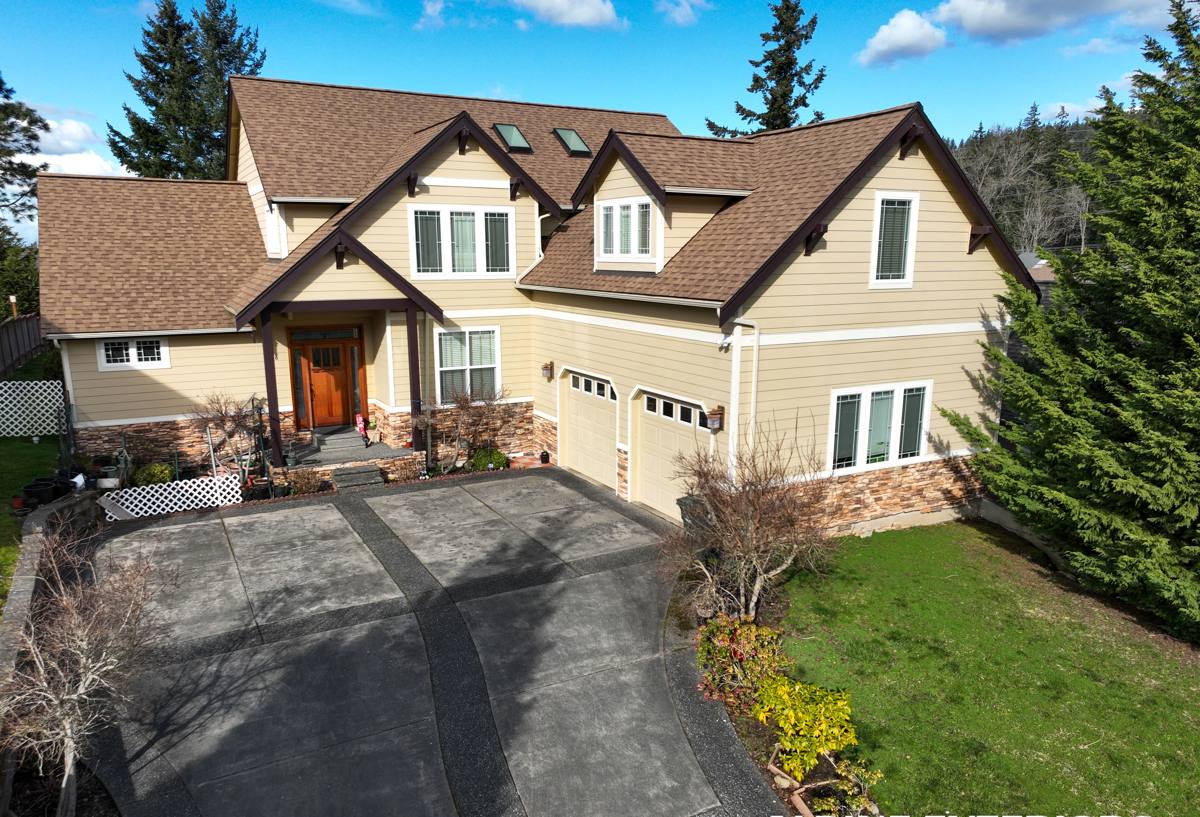
Warning Signs a Blaine Roof Repair Shouldn't Wait
Roof problems in this climate rarely announce themselves with a dramatic leak on day one. Most start small and get expensive by neglect. If you're seeing any of the following, it's worth having a roof looked at before the next storm off the water finds the weak spot for you.
- Granules collecting in gutters or at downspout outlets — a sign shingles are past their protective life
- Dark streaking or thick moss growth, especially on north-facing or shaded slopes
- Curling, cupping, or lifted shingle edges, particularly on the windward side of the roof
- Rusted, loose, or visibly corroded flashing around chimneys, vents, and skylights
- Water stains on interior ceilings or in the attic near exterior walls
- Sagging or soft spots underfoot during a walked roof inspection
- Daylight visible through the roof deck from inside the attic
- Gutters pulling away from the fascia or overflowing during heavy rain
Any one of these on its own might be minor. Several together, or any of them left through a full wet season, usually mean the repair window is closing.
What a Correct Roof Repair Actually Involves
A roof repair done right is not just swapping a shingle or running a bead of sealant over a visible gap. In a climate like Blaine's, a repair that's going to actually last has to address the whole water path, not just the spot where the leak showed up inside the house.
Finding the Real Source
Water travels. A stain on a ceiling is often several feet from where water actually entered the roof system, so the first job is tracing the path back — checking flashing, underlayment, and decking, not just the surface layer, before touching anything.
Flashing First
Most leaks we're called out for in this area trace back to flashing, not shingles — around chimneys, plumbing vents, skylights, and roof-to-wall transitions. Flashing has to be layered correctly with the roofing material so water sheds over every seam, and in a salt-air environment the metal itself has to be a grade that won't corrode out in a few winters.
Matching Underlayment to Exposure
On slopes that catch the brunt of driving rain and wind, a self-adhered, waterproof underlayment at eaves, valleys, and penetrations gives a real second line of defense if wind-driven water gets past the top layer. Skipping this step is one of the most common reasons a repair looks fine for a year and then fails.
Decking Condition
If moss or a slow leak has been sitting on a section of roof for a while, the plywood or plank decking underneath may be soft or delaminating. Patching over soft decking doesn't fix anything — it just hides the problem until it fails somewhere else nearby.
Roofing Materials in Blaine: How They Hold Up
Most homes in Blaine and the surrounding Whatcom County area are roofed in asphalt composition shingle, with a smaller number in cedar shake, metal, or flat/low-slope membrane roofing over additions and porches. Each material behaves differently under salt air, moss pressure, and driving rain, which affects both how we repair it and how often it will need attention.
| Material | Coastal/Moisture Behavior | Repair Considerations |
|---|---|---|
| Asphalt composition shingle | Good overall durability; granule loss accelerates with age and moss | Individual shingles and sections can be replaced cleanly if the deck below is sound |
| Cedar shake/shingle | Absorbs and releases moisture; prone to moss and rot without airflow beneath the shakes | Repairs need matching-thickness cedar and attention to the batten/spacing system, not just a patch |
| Standing seam / metal panel | Sheds water and moss well but seams and fasteners are vulnerable to salt-air corrosion over time | Repairs require matching panel profile and corrosion-resistant fasteners, not generic hardware |
| Low-slope membrane (TPO/EPDM) | Common over porch and addition roofs; seams are the main failure point in driving rain | Seam repair must be done to manufacturer spec — a sealant-only fix rarely holds through a wet season |
We don't push one material as a universal upgrade during a repair call. The right answer is usually repairing what's there correctly, with attention to the coastal factors above — not talking a homeowner into a different roofing system when the existing one just needs proper work.
Our Roof Repair Process, Step by Step
Homeowners in Blaine deserve to know exactly what happens between the first call and the finished repair, so here's how we handle it.
1. Inspection and Diagnosis
We walk the roof, weather permitting, and check the attic from the inside, tracing water paths rather than guessing from ground level. We'll point out what we find in plain terms — including when something looks like it's holding up fine and doesn't need work yet.
2. A Written, Itemized Estimate
You get a clear scope of what's being repaired, the materials involved, and the price — no vague lump-sum guesses. If we find something mid-repair that changes the scope, like soft decking under a shingle section, we stop and talk to you before proceeding.
3. The Repair Itself
We remove and replace only what needs it, matching materials as closely as possible, rebuilding flashing details correctly, and adding waterproof underlayment at vulnerable points where the original installation didn't have it.
4. Cleanup and Debris Removal
Old shingles, moss debris, and any replaced flashing or decking are removed from the property — we don't leave nail scatter in the yard or gutters full of tear-off grit.
5. Final Walkthrough
We show you the completed work and explain what was done and why, so you understand your roof better than you did before we started, not just have a bill.
Moss, Algae, and Salt Spray: The Maintenance Side of Roof Longevity
A good repair buys time, but in Blaine's climate, ongoing maintenance is what actually keeps a roof from needing repair again in a year or two. Moss and algae aren't just cosmetic — moss holds moisture against shingles and lifts tabs as it spreads, while algae staining, mostly cosmetic on its own, is often a sign of the same damp, shaded conditions that let moss take hold.
A few habits go a long way in this climate:
- Keep gutters and downspouts clear so water isn't backing up under the roof edge during heavy rain
- Trim back overhanging branches to cut down on shade and debris that feed moss growth
- Have moss physically removed rather than just power-washed, which can drive granules loose and force water under shingles
- Schedule a roof check after major windstorms, since wind-driven rain is what finds small gaps first
- Keep an eye on zinc or copper strips near the ridge — they slow moss regrowth but don't eliminate the need for periodic physical cleaning
None of this replaces a proper repair when something's actually failed, but it's the difference between a roof that needs occasional attention and one that surprises you with an interior leak during a January storm.
Repair or Replace? How We Help You Decide
Not every roof problem calls for a repair, and not every roof problem calls for full replacement either. We look at a handful of factors together rather than any single one in isolation.
| Factor | Leans Toward Repair | Leans Toward Replacement |
|---|---|---|
| Roof age | Well within the material's expected service life | At or past the manufacturer's expected lifespan |
| Extent of damage | Isolated to one section, slope, or penetration | Widespread across multiple slopes |
| Decking condition | Solid, dry decking beneath the affected area | Soft, delaminated, or rotted decking found in several spots |
| Repair history | First or second repair on this roof | Recurring repairs to the same or nearby areas |
| Underlying material | Matching materials still reasonably available | Discontinued material with no reasonable match |
We'll always give you our honest read on where your roof falls on this table. If a repair is the right call, that's what we'll recommend and price — we don't have an incentive to push a full replacement when a targeted fix will genuinely hold up in Blaine's weather.
Why a Crew That Already Works in Blaine Matters
Roofing knowledge that works in a dry inland climate doesn't automatically transfer to a coastal town like Blaine. A crew that regularly works this part of Whatcom County already knows which flashing details fail first in salt air, which slopes take the worst of the driving rain, and how aggressively moss grows on shaded roofs near the water. That familiarity shows up as fewer surprises during the repair and fewer callbacks after.
It also matters for practical reasons — a local crew can get to your property quickly when a storm has caused active damage, understands the access and seasonal realities of the area, and has a reputation in the community to stand behind, not just a name on an invoice.
If your roof is showing any of the signs above, or you just want a second opinion before the next storm rolls in off the water, we're glad to take a look. Reach out for a free, no-pressure estimate — we'll walk the roof, tell you honestly what it needs, and give you a clear, itemized price before any work begins. The form below is the fastest way to get started.