 Ferndale Siding
 Marietta Homes Face a Tougher Climate Than Most of Whatcom County
Marietta sits close to the water along the Bellingham Bay corridor between Ferndale and Bellingham, and that proximity to open water changes what siding has to survive. Homes here don't just deal with ordinary Pacific Northwest rain — they deal with salt-laden air moving in off the bay, wind-driven rain that hits walls sideways instead of falling straight down, and long stretches of gray, damp weather that keep exterior surfaces wet for days at a time. Add in the shade from mature evergreens common to this part of Whatcom County, and you get one of the more demanding siding environments in the region.
None of that is a reason to worry about your home. It's a reason to be deliberate about what goes on its walls and how it's installed. Siding that's rated fine for a drier inland town can fall short here, and the failures usually show up slowly — a few years in, not on installation day — which is exactly why the material and the workmanship both matter more in Marietta than they would somewhere less exposed.
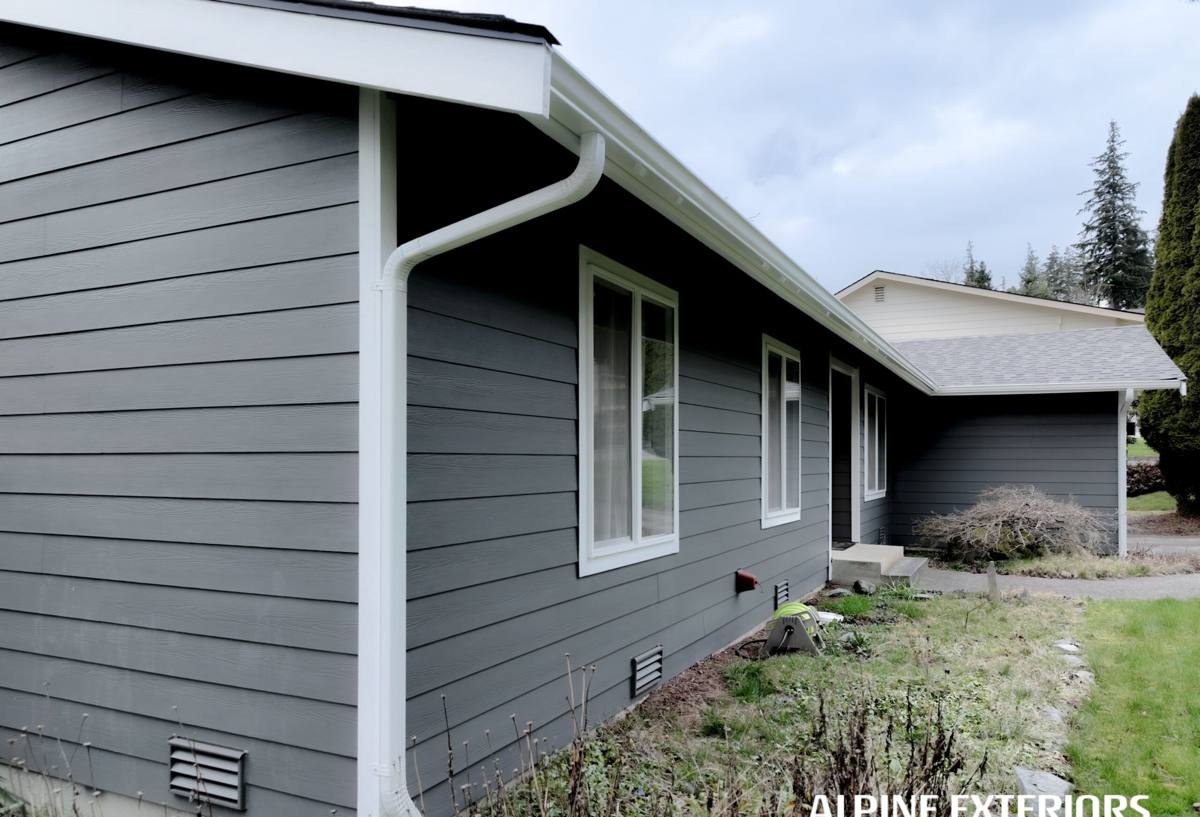
What Salt Air, Driving Rain, and Moss Actually Do to Siding
Salt Air
Airborne salt is corrosive to exposed metal fasteners, trim flashing, and hardware, and it accelerates the breakdown of finishes that aren't formulated to resist it. Paint applied on-site tends to chalk and fade faster in salt-exposed air, and any siding material that relies on a surface coating rather than a baked-in finish will need more frequent attention.
Driving Rain
Wind off the water doesn't just add moisture — it forces rain sideways and upward into laps, seams, and butt joints that would stay dry in calmer conditions. This is where installation detail matters as much as the product itself. Gaps, unsealed seams, and missing flashing turn into slow, hidden moisture intrusion long before anything looks wrong from the ground.
Moss and Sustained Dampness
Whatcom County's moss season isn't a minor cosmetic issue. Shaded, north-facing, and tree-adjacent walls stay damp for extended periods, and moss, algae, and mildew take hold on surfaces that don't dry out or resist organic growth. On wood-based products, sustained dampness under moss growth is how rot gets started — often at butt joints, corners, and anywhere caulking has begun to fail.
Why We Only Install James Hardie Fiber Cement Here
Fiber cement as a category holds up better than wood-based or vinyl siding in this kind of environment, but we've standardized specifically on James Hardie rather than other fiber cement brands, and Marietta's climate is a big part of why.
HZ Product Engineering for This Region
James Hardie manufactures its HZ5 product line specifically for climates like ours — wet, moderate-temperature, high-moisture Pacific Northwest conditions. It's engineered to resist moisture-related damage in exactly the kind of sustained dampness Marietta sees for months of the year, rather than being a general-purpose product used everywhere regardless of climate.
ColorPlus Factory Finish
Instead of relying on a coat of paint applied on the jobsite, Hardie's ColorPlus finish is baked on in a factory process with multiple coats and UV-cured technology. That finish resists fading, chalking, and the kind of salt-air degradation that wears down field-applied paint faster near the water. It also means less repainting over the life of the siding — a real advantage in a climate that's hard on exterior finishes.
Non-Combustible, Dimensionally Stable Material
Fiber cement doesn't expand and contract with moisture the way wood does, and it won't warp, buckle, or delaminate the way lower-grade siding can when it's constantly wet and drying. It's also non-combustible, which matters for long-term durability and insurance considerations regardless of climate.
How Fiber Cement Compares to Other Siding Materials in This Climate
| Material | Salt Air Behavior | Driving Rain Tolerance | Moss/Moisture Resistance |
|---|---|---|---|
| James Hardie Fiber Cement | Factory ColorPlus finish resists corrosion and fading | Engineered lap profiles shed water when properly installed | Non-organic material; won't rot under moss |
| Vinyl Siding | Can become brittle and discolor over time | Prone to water intrusion behind panels at seams | Moss grows on surface film; panels don't rot but trap moisture behind them |
| Primed Wood / Spruce / Cedar | Finish breaks down faster; needs frequent repainting | Absorbs water at joints and end grain | Organic material — most vulnerable to rot under sustained moss and dampness |
| Other Fiber Cement Brands | Varies by manufacturer; often field-painted, not factory-cured | Depends on profile and installation quality | Non-organic, but finish durability varies without a baked-in coating system |
What a Correct Fiber Cement Installation Actually Involves
The material is only half the equation. In a climate like Marietta's, the installation details are what actually keep water out over the next twenty or thirty years. A correct install includes:
- A drainage plane and weather-resistive barrier installed and lapped correctly behind the siding, not just stapled up as an afterthought
- Proper flashing at every window, door, and roofline transition, integrated with the water-resistive barrier rather than caulked as a substitute for it
- Correct fastener placement and spacing per Hardie's installation specifications, using fasteners rated to resist corrosion in coastal-influenced air
- Minimum clearance gaps at the bottom of the siding, around penetrations, and at butt joints so water has somewhere to go instead of wicking into the material
- Factory-primed and sealed cut edges wherever a board is trimmed on site, since exposed cut edges are the most common point of moisture entry
- Caulking only where Hardie's specifications call for it — over-caulking traps moisture just as reliably as under-caulking lets it in
This level of detail is exactly why manufacturer specification matters. James Hardie's installation guidelines exist because they've been refined against real climates like this one, and skipping steps to save time is how a good product ends up with a bad reputation it didn't earn.
Our Process for Marietta Projects
1. On-Site Assessment
We walk the exterior with you, looking at current siding condition, moisture staining, moss buildup patterns, and any areas — typically shaded walls or spots near grade — that are seeing more exposure than the rest of the house.
2. Tear-Off and Substrate Check
Old siding comes off and we inspect the sheathing underneath for hidden rot or water damage before anything new goes up. This step gets skipped by crews trying to move fast, and it's the step most likely to save you from a problem resurfacing a few years later.
3. Weather Barrier and Flashing Installation
We install and lap the weather-resistive barrier and integrate flashing at every penetration and transition point, following a shingle-lap sequence so water is always directed outward and down.
4. James Hardie Installation to Manufacturer Spec
Siding, trim, and fasteners go in following Hardie's published specifications for our climate zone, with attention to gaps, clearances, and fastener corrosion resistance given the salt-air exposure.
5. Final Walkthrough
We review the finished work with you, including care and cleaning guidance specific to a moss-prone, water-adjacent property.
What Affects Cost on a Marietta Siding Project
| Factor | Why It Matters Here |
|---|---|
| Extent of substrate repair | Homes with prior wood or vinyl siding sometimes have hidden moisture damage that needs addressing before new siding goes on |
| Home size and wall complexity | More corners, dormers, and transitions mean more flashing and detail work, which affects labor time |
| Siding profile and trim selection | Lap width, trim style, and accent choices affect material cost and installation time |
| Access and site conditions | Tree cover, tight setbacks, or limited equipment access common to some Marietta lots can affect labor time |
| Full replacement vs. partial repair | A full re-side allows correct barrier and flashing installation throughout; partial repairs are sometimes appropriate but limit long-term protection |
We give straightforward, itemized estimates rather than vague ballpark numbers, because the honest answer to "what will this cost" depends on what we find once the old siding comes off.
Maintaining Fiber Cement Siding in a Salt Air, High-Moss Climate
James Hardie siding is low-maintenance compared to wood, but "low-maintenance" doesn't mean "no maintenance," especially this close to the water. A simple seasonal routine goes a long way:
- Rinse siding periodically to remove salt residue and organic buildup, especially on walls facing the water or shaded by trees
- Check and clear gutters before the fall rains so overflow doesn't run down the wall face
- Inspect caulking annually at trim joints and penetrations, since caulk failure is usually the first sign of a moisture path forming
- Trim back vegetation and tree limbs that keep a wall section shaded and damp longer than the rest of the house
- Watch for moss or algae buildup in shaded corners and address it early rather than letting it establish
Why It Matters That We Already Work in Marietta
A crew that only sees this neighborhood occasionally will treat it like any other job. A crew that works Marietta regularly already knows which walls tend to hold moisture longest, how the salt air behaves differently a few blocks off the water versus further inland, and how the local moss season actually plays out season to season — not from a manual, but from having done the work here before. That local familiarity shows up in small decisions during installation that a generic approach would miss, and it's part of why we standardized on one product system installed to one consistent standard rather than mixing materials and methods project to project.
If you're planning a siding project in Marietta or elsewhere around Ferndale, we're happy to walk your property, look at what your home is actually dealing with, and give you a clear, no-pressure estimate — just fill out the form below to get started.