 Ferndale Siding
 Siding Replacement Built for Kendall's Climate
Kendall is one of the communities we serve out of Ferndale, and homes here take on the same core exposure that shapes exterior work across this part of Whatcom County: salt-tinged air moving in off the water, rain that gets pushed sideways by wind more often than it falls straight down, and a moss season that settles in during the fall and doesn't fully let go until late spring. Siding replacement is one of the few exterior projects that touches every part of that exposure at once — it's the layer standing between the framing of a house and everything the weather here throws at it, for the next several decades. Doing it right the first time matters more in Kendall than it would in a milder, drier climate, because the margin for a shortcut installation to hold up is a lot thinner here.
This page focuses on one thing: full siding replacement for a Kendall home, what it actually involves when it's done correctly, and why the material and installation choices we make are built around the specific conditions this area sees year after year.
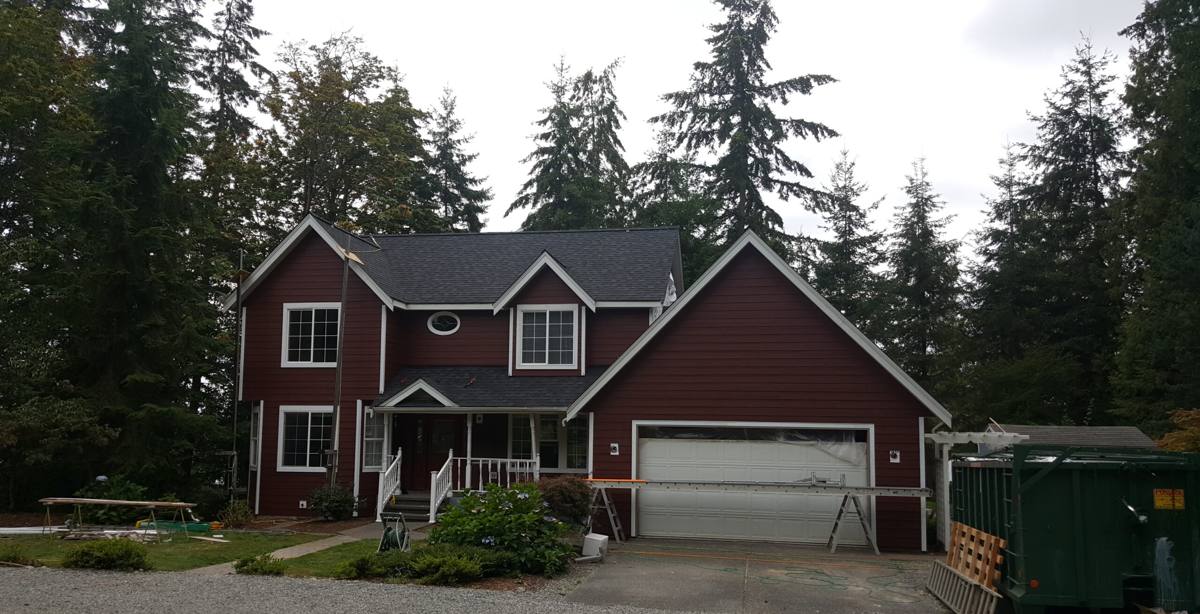
Repair, Partial Replacement, or Full Re-Side?
Not every siding problem calls for a full tear-off, and a straight answer on this upfront saves homeowners money they don't need to spend. The right call usually comes down to how much of the siding is affected and what's happening behind it, not just how the wall looks from the curb.
- A handful of damaged boards, a cracked section from impact, or trim that's failed around one window is usually a repair, not a full replacement.
- Widespread cupping, warping, or soft spots across multiple walls — especially on siding that's approaching or past its expected lifespan — is usually a sign the whole system needs to come off.
- If moisture has been tracking behind the siding for a while, patching the visible damage without opening the wall just hides the problem for another season or two.
- A home with older, non-Hardie siding nearing the end of its service life is often better served by a planned full replacement than by chasing repairs on a product that's already failing.
We'll tell you honestly which category your Kendall home falls into during the inspection, rather than defaulting to whichever answer costs more.
What Kendall's Climate Demands From New Siding
Salt Air
Salt-laden moisture in the air accelerates corrosion in fasteners, flashing, and any hardware that isn't rated for it, and it breaks down lower-grade paints and coatings faster than a drier climate would. Siding and trim chosen without that in mind tend to show it early — rusting nail heads, chalky finishes, and paint that needs redoing well ahead of schedule.
Driving Rain
Wind turns rain into a sideways problem instead of a straight-down one, and that changes what "waterproof siding" actually needs to mean. Wind-driven rain gets forced into lap joints, trim seams, and any gap where flashing isn't doing its job properly. A siding system and installation that would perform fine in a calmer climate can still let water in here, because the water is arriving from angles a simpler installation was never designed to handle.
A Long Moss Season
Between the tree cover common around Kendall and the sustained dampness that runs from fall through spring, moss and mildew have a long window to take hold — especially on shaded, north-facing walls. Beyond looking bad, sustained organic growth holds moisture directly against the wall assembly, which is one of the more common paths to hidden rot behind siding that looks intact from a distance.
Why James Hardie Is the Only Siding We Install
We used to offer a broader range of siding products. We narrowed to one system after watching, repeatedly, which materials actually held up to this kind of sustained Pacific Northwest exposure and which ones quietly didn't.
- Non-combustible core: fiber cement doesn't feed a fire the way wood-based or wood-derived siding can, which matters for household safety and often for insurance underwriting.
- Factory-applied ColorPlus finish: the color is baked on under controlled conditions rather than brushed on in the field, so it resists fading, chalking, and moisture intrusion far longer than site-applied paint.
- Climate-engineered HZ formulation: Hardie's HZ product line is built specifically for regions with heavy, sustained moisture exposure and freeze-thaw cycling — a real match for a Kendall property rather than a generic national spec.
- Dimensional stability: fiber cement doesn't swell, cup, or warp the way engineered wood siding can after repeated wet-season moisture cycles.
- Strong transferable warranty: Hardie backs its products with a real warranty structure, provided installation follows spec — protection a homeowner can actually use, not just a line in a brochure.
We don't install LP SmartSide, vinyl siding, Cemplank, Allura, primed spruce, or cedar. Each of those has a place in the broader market, and plenty of homes carry them without incident. But between the salt air, the wind-driven rain, and how long the moss season runs here, we made a professional call that standardizing on one system we trust completely beats offering a cheaper option that quietly shifts maintenance risk onto the homeowner a few years down the road.
What a Correct Siding Replacement Job Involves
The material is only half the equation. The other half is installation detail, and it's where most of the real difference between a siding job that lasts and one that doesn't actually shows up.
Tear-Off and Sheathing Inspection
A full tear-off to the sheathing is the only way to find hidden rot, soft spots, or moisture damage that's been developing behind the old siding, often invisible until the old material comes off. Installing new siding directly over old siding or damaged sheathing just buries whatever problems are already there.
Weather-Resistive Barrier and Flashing
A properly installed house wrap or weather-resistive barrier, combined with correctly integrated flashing at windows, doors, and any wall penetrations, is what actually keeps wind-driven rain out of the wall assembly. Siding is the visible layer, but the barrier and flashing behind it are doing most of the real waterproofing work.
Fastening and Clearances
Correct nail placement, count, and spacing — to manufacturer specification rather than a shortcut pattern — is what keeps siding from loosening or lifting under wind load. Proper clearance from grade, roofline, and decks also matters more here than in a drier climate, since inadequate clearance is a direct path for splashback and standing moisture to reach the bottom edge of the siding.
Joints, Trim, and Caulking
Lapped and properly sealed joints hold up far longer than boards that are simply butted together and caulked as an afterthought. Trim details around windows, corners, and transitions are where a lot of water intrusion actually starts, and they deserve the same attention as the field of the wall, not less.
Comparing Siding Materials for a Kendall Home
| Material | Moisture Behavior | Maintenance | Typical Lifespan |
|---|---|---|---|
| Vinyl | Doesn't absorb water, but can warp or crack under UV and temperature swings; seams are a weak point for wind-driven rain | Low, but can't be repainted if it fades | 20-30 years, shorter in high-wind exposure |
| Engineered Wood (LP SmartSide) | Vulnerable to swelling and edge deterioration if moisture reaches the substrate through a coating failure | Moderate to high — coating and caulking need regular upkeep | 20-30 years with consistent maintenance |
| Cedar | Absorbs and releases moisture naturally, which drives cupping, checking, and rot without disciplined upkeep | High — refinishing and sealing on a regular cycle | Variable, heavily maintenance-dependent |
| James Hardie Fiber Cement | Doesn't absorb moisture into its core; factory finish resists salt and UV | Low — occasional washing, no repainting cycle in most cases | 30+ years when installed to spec |
Every option in that table has real-world owners who are satisfied with it. The differences show up over time, and in a climate that stays wet for a large part of the year, that time horizon is exactly where fiber cement's advantages matter most.
Cost Factors in a Kendall Siding Replacement
| Factor | What It Affects |
|---|---|
| Tear-off vs. overlay | Whether hidden sheathing or framing damage gets found and repaired before new siding goes on |
| Sheathing and framing repair | Extent of moisture damage discovered once old siding comes off |
| House wrap and flashing scope | How thoroughly the weather-resistive barrier is integrated around windows, doors, and penetrations |
| Siding profile and trim detail | Lap size, trim complexity, and corner treatment affect both material and labor |
| Home size and wall complexity | Square footage, number of stories, and how many corners, gables, and transitions the crew has to work around |
| Site access | Staging space, driveway access, and equipment needs |
An itemized written estimate that breaks these out tells you far more than a single lump-sum figure, and it's worth asking any contractor to walk through what's actually included before comparing bids.
How Our Process Works
- In-person inspection: we walk the exterior of the home in person and look at the siding, trim, flashing, and any visible signs of moisture damage.
- Written estimate: a clear, itemized bid covering tear-off, sheathing repair allowance, house wrap, flashing, siding, and trim — no vague single-line pricing.
- Scheduling around weather: we build reasonable flexibility into the timeline, since wet-season delays are a normal part of exterior work in this region.
- Tear-off and sheathing repair: old siding comes off completely, and any damaged sheathing or framing found underneath gets addressed before anything new goes up.
- Weather barrier, flashing, and siding installation: each layer goes on to manufacturer specification, with extra attention at windows, corners, and any wall penetrations.
- Final walkthrough and cleanup: we review the completed exterior with you and do a full site cleanup before calling the job done.
Why Hiring a Crew That Already Works in Kendall Matters
A crew that regularly works siding jobs in and around Kendall has already seen how salt air corrodes underspecified fasteners, how wind-driven rain finds its way through a poorly lapped joint, and which wall orientations hold moss the longest through the wet season. That's practical knowledge that shows up in the small decisions made throughout a job — decisions a crew unfamiliar with this specific climate might not think to make at all. It also matters after the job is finished: a workmanship warranty is only as good as the company standing behind it, and a contractor with an ongoing local presence is the one you can actually reach a few years later if a question comes up.
A Practical Checklist Before You Choose a Siding Contractor
- Do they perform a full tear-off with sheathing inspection, not just an overlay?
- Does the estimate specify house wrap and flashing scope, not just "new siding"?
- Is trim, corner, and joint detail explicitly addressed in the bid?
- Do they carry current WA contractor licensing, liability insurance, and workers' compensation?
- Can they point to recent, real local work in or near Kendall?
- Does the bid separate manufacturer warranty coverage from their own workmanship warranty?
If your Kendall home needs new siding — or you'd just like an honest opinion on whether you're looking at a repair or a full replacement — we're glad to take a look. Use the form below to schedule a free, no-pressure estimate.