 Ferndale Siding
 Building New in Kendall? The Windows Have to Work With the Weather, Not Against It
Kendall sits up against the foothills east of Ferndale, in a stretch of Whatcom County where new home construction has picked up steadily over the last several years. Whether you're framing a custom build on acreage or finishing out a new spec home, the window package you choose and how it's installed will shape how that house performs for the next 30-plus years. New-construction windows aren't just a bigger version of a replacement window — they're installed differently, sealed differently, and need to be planned into the wall assembly from the framing stage forward.
That matters more here than in a lot of places. Kendall gets the same marine air and long wet season as the rest of Whatcom County, plus more exposure to wind-driven rain in open, less-sheltered lots than you'd see in denser parts of Ferndale proper. A window install that would pass fine in a dry climate can leak, fog, or rot out its sill within a few years if it's not detailed for this one.
New Construction vs. Replacement — Why the Distinction Matters
A true new-construction window has a nailing fin (also called a nail flange) around the perimeter of the frame, designed to be fastened directly to the sheathing before siding goes on. This lets us integrate the window fully into the weather-resistive barrier (WRB) and flashing system — lapped correctly, shingle-style, so water sheds outward and down no matter how hard it's blowing. Replacement or "pocket" windows, by contrast, install into an existing frame and rely on the old flashing being sound. If you're building new, insisting on a proper new-construction window and install — rather than a retrofit shortcut — is one of the cheapest ways to avoid a callback years down the road.
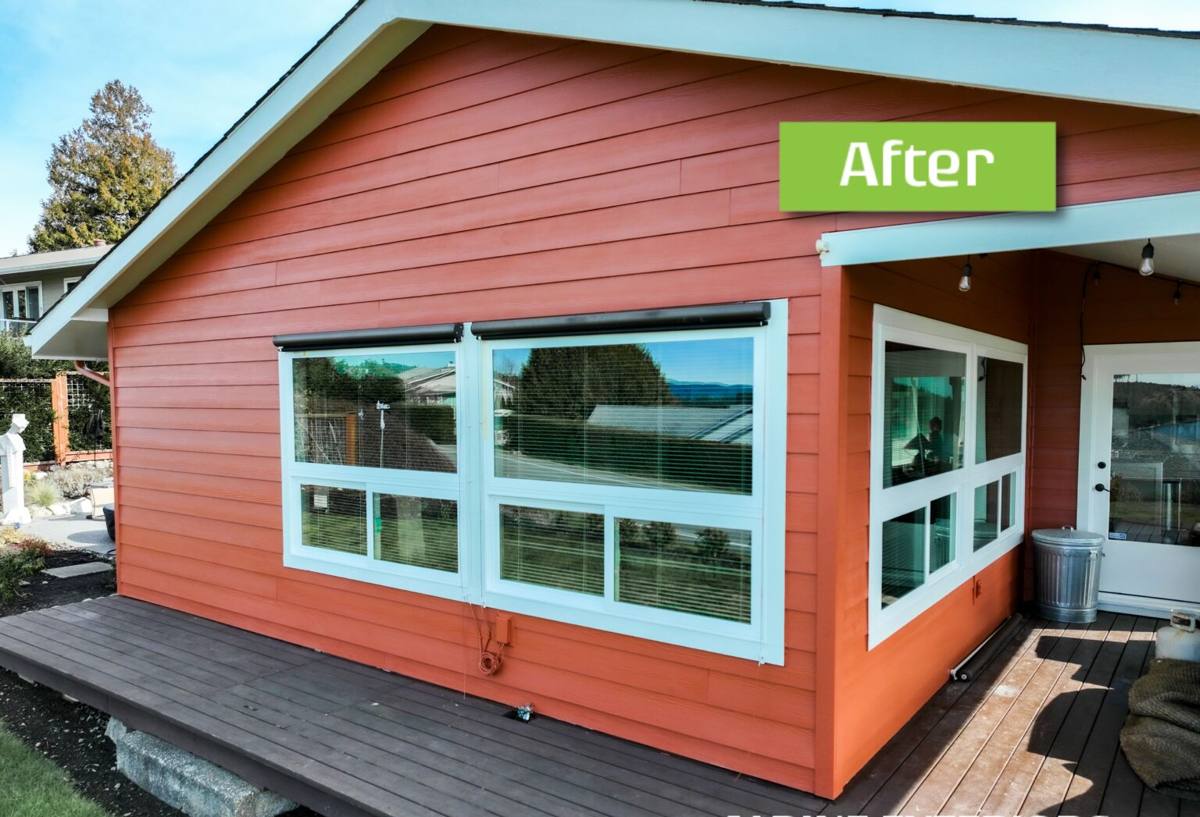
What Kendall's Climate Actually Does to a Window Opening
We don't need to exaggerate the weather here — the numbers speak for themselves. Whatcom County sees a genuinely long wet season, and Kendall's more open, less urban lots often catch wind and driving rain with less buffer from trees or neighboring structures than tighter Ferndale lots do. Add proximity to the Strait and Bellingham Bay air moving inland, and you get a steady diet of salt-tinged moisture that finds its way into any gap in the building envelope.
- Driving rain: Wind-driven rain doesn't just fall on a window — it gets pushed sideways and upward into any unsealed lap or fastener hole, which is why flashing sequence matters more than caulk quality.
- Salt air corrosion: Fasteners, hinges, and hardware exposed to salt-laden coastal air corrode faster than inland-rated products are designed for; hardware and fastener selection matters here.
- Moss and organic growth: Long stretches of damp, shaded conditions let moss and algae establish on sills, trim, and anything that stays wet — which traps moisture against the window frame if it's not detailed to shed water cleanly.
- Freeze-thaw swings: Whatcom County gets enough cold snaps that trapped moisture behind a poorly sealed frame can freeze, expand, and work a seal loose over a winter or two.
None of this is exotic problem-solving — it's standard Pacific Northwest building science. But it only works if it's actually done at every opening, not just the ones that are easy to reach.
What a Correct New-Construction Window Install Actually Involves
A window opening is a system, not a single product. Getting it right means every layer does its job and hands off to the next one correctly.
Sill Pan and Sloped Sill
Before the window ever goes in, the rough opening sill should have a sloped sill pan — either a manufactured pan flashing or a properly built-up and sloped sub-sill — so that any water that does get past the window has somewhere to go besides the framing. This is the single most-skipped step we see corrected on other builders' work, and it's the one most responsible for hidden rot.
WRB and Flashing Integration
The weather-resistive barrier (housewrap or equivalent) has to be cut and lapped at the opening so that the window's nailing fin, the sill pan, and the WRB all shingle correctly — each layer overlapping the one below it, top to bottom, so water always drains outward rather than behind the next layer. Side and head flashing get taped or flashed in sequence, never in a way that traps water at the top of the opening.
Fastening and Shimming
Nailing fins get fastened per the manufacturer's schedule — skipping fasteners to save time is a common shortcut that shows up later as a window that racks out of square or won't latch properly. The frame itself needs to be shimmed plumb, level, and square in the opening before it's fastened, or the sash will bind, the weatherstripping won't seat evenly, and air/water infiltration follows.
Interior and Exterior Sealing
Low-expansion foam or backer rod and sealant around the perimeter (not spray foam alone) closes the air gap without bowing the frame. Exterior trim and caulking are the last line of defense, not the first — they should never be relied on to make up for a flashing sequence that was skipped.
Choosing a Frame Material for Kendall's Exposure
Frame material choice matters more in a wet, salt-influenced climate than it does inland. Here's how the common options compare for a new build in this area:
| Frame Material | Moisture Behavior | Maintenance | Notes for This Area |
|---|---|---|---|
| Vinyl | Won't rot; some expansion/contraction with temperature swings | Low — occasional cleaning | Good value, widely used in new Whatcom County builds; verify UV and impact rating on the specific line |
| Fiberglass | Excellent — very stable, minimal expansion, holds paint/finish well | Low | Strong choice for driving-rain exposure and larger openings; higher upfront cost |
| Wood / Wood-Clad | Attractive but vulnerable if cladding or finish is breached | Higher — finish upkeep, especially exterior wood elements | We frame the trade-off honestly: beautiful interior look, but exterior wood needs consistent upkeep in this moisture load |
| Aluminum | Durable but thermally conductive; can condense in cold snaps | Low to moderate | More common in commercial applications; less common for residential new-construction here |
There's no universally "best" material — it's a trade-off between upfront cost, maintenance appetite, and how much upkeep the homeowner actually wants to do over the years. We'll walk through what fits your build rather than pushing one line because it's what we happen to stock.
Our Process for New-Construction Window Installs in Kendall
- Rough opening review: We check every opening against the window schedule before install day — square, plumb, correct dimensions — and flag framing issues before they become window problems.
- Sill pan and flashing prep: Sloped sill pans go in first, followed by WRB integration at each opening, sequenced so every layer laps correctly.
- Window setting: Units are shimmed plumb, level, and square, then fastened per the manufacturer's schedule — not a shortened version of it.
- Head and side flashing: Completed and inspected before siding closes the opening up — this is the step you can't fix later without removing siding.
- Interior air seal: Perimeter gaps sealed with appropriate low-expansion foam or backer rod and sealant, checked for square and smooth operation.
- Final check: Every window operates, latches, and seals correctly before we call the opening done.
Mistakes We Commonly Find in Other New-Construction Work
When we're brought in to finish, fix, or inspect someone else's rough openings around Kendall and greater Ferndale, the same handful of issues show up again and again:
- No sloped sill pan — water sits flat against bare framing instead of draining out
- WRB and flashing lapped backward or out of sequence, so water gets funneled behind the layer instead of over it
- Missing fasteners on the nailing fin to save time, leaving the frame under-secured
- Caulk used as the primary water seal instead of proper flashing — caulk fails; flashing shouldn't have to rely on it
- Windows shimmed out of square, causing hardware to bind or fail to latch within the first year or two
- Trim installed tight to the frame with no room for the assembly to shed water outward
Cost Factors for New-Construction Window Projects
Every new build is different, so we won't quote a number without seeing the plans and openings — but the main variables that move the price are consistent from job to job:
| Factor | How It Affects Cost |
|---|---|
| Number and size of openings | More openings and larger units mean more material and labor per opening |
| Frame material | Fiberglass and higher-end wood-clad units cost more upfront than standard vinyl |
| Glass package | Upgraded low-E coatings, gas fills, or impact-rated glass add cost but improve performance and durability |
| Site access and story height | Second-story or hard-to-access openings take longer and may need additional staging |
| Custom shapes or sizes | Non-standard shapes (arched, oversized, specialty) cost more than stock sizes |
| Timing with framing schedule | Coordinating install tightly with the framing crew avoids delays that add cost on both ends |
Generally, expect new-construction window costs to range from several hundred to a few thousand dollars per opening installed, depending on the factors above — a full house package varies widely based on window count and specification. We'll give you an itemized number once we've reviewed your plans.
Why a Local Ferndale Crew Matters for a Kendall Build
New-construction window work isn't a one-and-done trade — it has to coordinate with framers, the WRB installer, and the siding crew, often on a tight schedule. A crew that already works Whatcom County builds knows the inspection expectations locally, has relationships with the framers and builders active in this area, and isn't learning our climate on your project. We've seen what happens to window openings here that were detailed for a drier region's building code — and we build every opening assuming Kendall's rain, wind, and salt air, not around it.
Being local also means we're a short drive away if a warranty question or a settling issue comes up after the build is finished — not a call center number attached to a crew that worked the area once and moved on.
Get a Straight Answer on Your Kendall New-Construction Window Package
If you're framing a new build in Kendall or anywhere around Ferndale, we're happy to look at your plans, walk the openings, and give you a clear, itemized estimate — no pressure, no upsell script. Use the form below to request a free estimate and we'll get back to you with next steps.