 Ferndale Siding
 Birch Bay's Waterfront Climate and What It Does to Siding
Birch Bay sits right on the water, and that changes what a house needs from its exterior. Homes here take on a mix of conditions that inland Whatcom County properties don't deal with nearly as much: salt-laden air coming off the bay, driving rain pushed sideways by wind, and long stretches of the year where north-facing and shaded walls stay damp enough to grow moss. None of that is unusual for western Washington, but it's more concentrated at the waterfront than it is a few miles inland in Ferndale proper.
Siding on a Birch Bay home is doing real work every day. It's the first line of defense against wind-driven moisture finding its way behind trim and around windows, and it's constantly exposed to airborne salt that can accelerate wear on the wrong materials. A product and installation approach that holds up fine in a drier, more sheltered part of the county can fall short here. That's the starting point for any siding decision on this stretch of coastline.
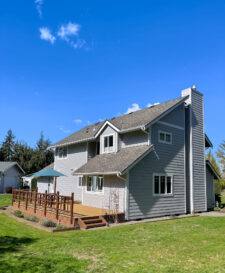
Why Fiber Cement Fits This Location
Salt Air and Material Stability
Salt air is hard on anything that relies on paint film alone for protection, and it's especially hard on materials that expand, contract, or degrade when exposed to airborne moisture and salt over years of exposure. Fiber cement is dense and dimensionally stable — it doesn't warp, and it doesn't rely on an unprotected substrate underneath a thin coating to keep it looking right. That stability matters more on a bay-front lot than it does a few blocks from the water.
Driving Rain and Wind
Storms off the water don't just drop rain straight down — wind pushes it sideways, driving it into laps, joints, and anywhere a gap exists. Fiber cement siding, installed with the correct laps, clearances, and flashing, sheds that kind of wind-driven rain rather than trapping it. The material itself is also non-combustible, which is a separate benefit but one worth mentioning for homes near dry brush or windy conditions later in the summer.
The Long Moss Season
Whatcom County's moss season runs long — shaded, north-facing, and tree-covered walls in Birch Bay can stay damp for months at a stretch. Moss and algae growth on siding isn't just cosmetic; sustained dampness against a wall surface is exactly the condition that causes problems for moisture-sensitive products over time. Fiber cement handles sustained dampness far better than wood-based or wood-fiber siding, because it isn't made from an organic substrate that moss and algae can feed on or that trapped moisture can break down.
What We Install: James Hardie Fiber Cement
We install James Hardie fiber cement siding exclusively — no vinyl, no LP SmartSide, no Cemplank, no Allura, no primed wood. That's a deliberate standard, not a brand preference. James Hardie engineers specific product lines for different climate zones, and the HZ5 line is built for regions with more moisture exposure, which fits Birch Bay's conditions better than a generic all-climate product. The factory-applied ColorPlus finish is baked on under controlled conditions rather than field-painted, which gives it more consistent coverage and better resistance to fading and moisture intrusion at the surface than a job-site paint job can match.
James Hardie also backs its siding with a strong transferable limited warranty, which matters if the home changes hands — a real consideration for a lot of properties in a desirable waterfront community like Birch Bay. We stand behind our installation work separately, but having a manufacturer warranty that actually transfers gives homeowners a second layer of protection.
What a Correct Installation Involves on the Waterfront
Fiber cement siding is only as good as the installation behind it. In a location like Birch Bay, a handful of details matter more than they would on a sheltered inland lot, and skipping them is where most siding failures actually start — not with the material itself.
Clearances and Drainage
Siding needs proper clearance from grade, roof lines, decks, and hard surfaces so water has somewhere to go instead of wicking up into the bottom edge of the panel. A drainable house wrap and rainscreen gap behind the siding lets any moisture that does get past the surface dry out instead of sitting against the wall assembly — a detail that matters more in a high-moisture coastal environment than almost anywhere else in the county.
Flashing and Sealed Penetrations
Every window, door, vent, and utility penetration is a potential entry point for wind-driven rain. Correct flashing — installed in the right order, lapped the right direction, and integrated with the house wrap rather than just caulked over the top — is what actually keeps water out. Caulk is a backup, not the primary defense; if flashing is done right, caulk failure years down the road doesn't turn into a wall problem.
Fastening for Wind Exposure
Waterfront properties see more sustained wind than sheltered inland lots. Fastener type, spacing, and placement need to match Hardie's specifications for the exposure level, not just a standard nailing pattern. Under-fastened or incorrectly placed fasteners are a common cause of siding that loosens, cracks at the fastener head, or performs poorly in a windstorm — problems that show up years after a rushed install, not on day one.
Our Process for a Birch Bay Project
- On-site assessment — we look at wall orientation, existing moisture damage, drainage patterns, and how exposed each elevation is to wind and salt air off the bay.
- Prep and moisture check — old siding comes off, sheathing gets inspected for hidden rot or damage before anything new goes up, and any problems get addressed rather than covered over.
- Water-resistive barrier and rainscreen — a drainable house wrap and gap system go on correctly, matched to the wall assembly, before any siding panel is installed.
- Hardie panel installation — installed to manufacturer spec for clearances, fastening, and flashing, with attention to every window, door, and penetration.
- Final walkthrough — we go over the finished job with the homeowner and confirm everything meets both Hardie's installation standard and our own.
What Affects the Cost of a Fiber Cement Job in Birch Bay
Every home is different, so we quote after an actual on-site assessment. In general, these are the factors that move the price up or down:
| Factor | How It Affects Cost |
|---|---|
| Home size and wall complexity | More square footage, more corners, and more trim detail add material and labor time |
| Condition of existing sheathing | Hidden rot or moisture damage found during tear-off adds repair work before new siding goes on |
| Wall exposure and elevation | Bay-facing and wind-exposed walls may call for more careful flashing and fastening detail |
| Siding profile and accessories | Lap width, trim style, and any specialty accessories affect material cost |
| Access and site conditions | Waterfront lots with limited access, slopes, or landscaping can add labor time |
Caring for Fiber Cement Siding in a Salt Air, Moss-Prone Climate
Fiber cement is low-maintenance compared to wood, but "low-maintenance" doesn't mean "no maintenance," especially at the waterfront. A yearly rinse-down with a garden hose removes salt residue and airborne grime before it builds up on the surface. Shaded and north-facing walls should get checked for moss and algae growth going into the wetter months — catching it early with a gentle wash is far easier than dealing with established growth. Keep gutters clear and downspouts directed away from the wall base, since standing water at the bottom edge of siding is the most common cause of long-term problems regardless of material. ColorPlus finished siding doesn't need repainting on the same schedule as field-painted siding, but it's still worth a visual check each year for caulk lines that need attention around windows and trim.
Why Local Experience in Birch Bay Matters
A crew that already works in Birch Bay knows what to expect before they show up — how much more exposure a bay-facing wall gets compared to a sheltered one, what moss growth patterns look like on shaded elevations after a wet Whatcom County winter, and how wind off the water changes fastening and flashing decisions. That's not something you can substitute with a generic siding crew working from a standard spec sheet built for a drier climate. Local experience also means fewer surprises during tear-off — we've seen how these homes age in this specific environment, so we know where to look for hidden moisture damage before it becomes an expensive surprise mid-project.
How to Tell a Siding Job Was Done Right
Whether you're evaluating our estimate or someone else's, here's what a correct fiber cement installation should include:
- A drainable house wrap and rainscreen gap behind the siding, not siding installed directly against sheathing
- Proper clearance between the bottom of the siding and grade, decks, or roof lines
- Flashing integrated with the house wrap at every window, door, and penetration — not just caulk
- Fastener spacing and placement matched to Hardie's spec for the home's wind exposure
- Sheathing inspected and repaired before new siding goes over it, not covered up
- A written scope that specifies the actual Hardie product line and profile being installed
If you're considering fiber cement siding for a home in Birch Bay, we'd be glad to take a look and walk you through what your property specifically needs. Reach out for a free, no-pressure estimate using the form below.