 Ferndale Siding
 Why Windows Take a Beating on Sandy Point
Sandy Point sits right up against the water in Whatcom County, and that location is exactly what makes window selection and installation different here than it is a few miles inland in Ferndale proper. Homes on or near the beach face a steady diet of salt-laden air, wind-driven rain coming almost horizontally off the water during winter storms, and a long, damp moss season that keeps wood and vinyl surfaces wet for weeks at a time. None of that is dramatic on its own, but it adds up year after year, and windows are one of the first places the damage shows.
Salt air is corrosive to hardware — screws, hinges, balance mechanisms, and cheaper aluminum components can pit and seize years before they would in a drier, inland location. Driving rain finds any gap in flashing or caulking and pushes water sideways and even slightly upward under pressure, which is a very different load than the straight-down rain most window installation details are built around. And moss and algae thrive in the shade and moisture along north-facing walls and low sills, holding water against wood trim and frames long after a storm has passed.
None of this means windows can't hold up at Sandy Point — plenty do, for decades. It means the material, the glass package, and especially the installation details have to be chosen with this specific exposure in mind, not treated like a generic replacement job.
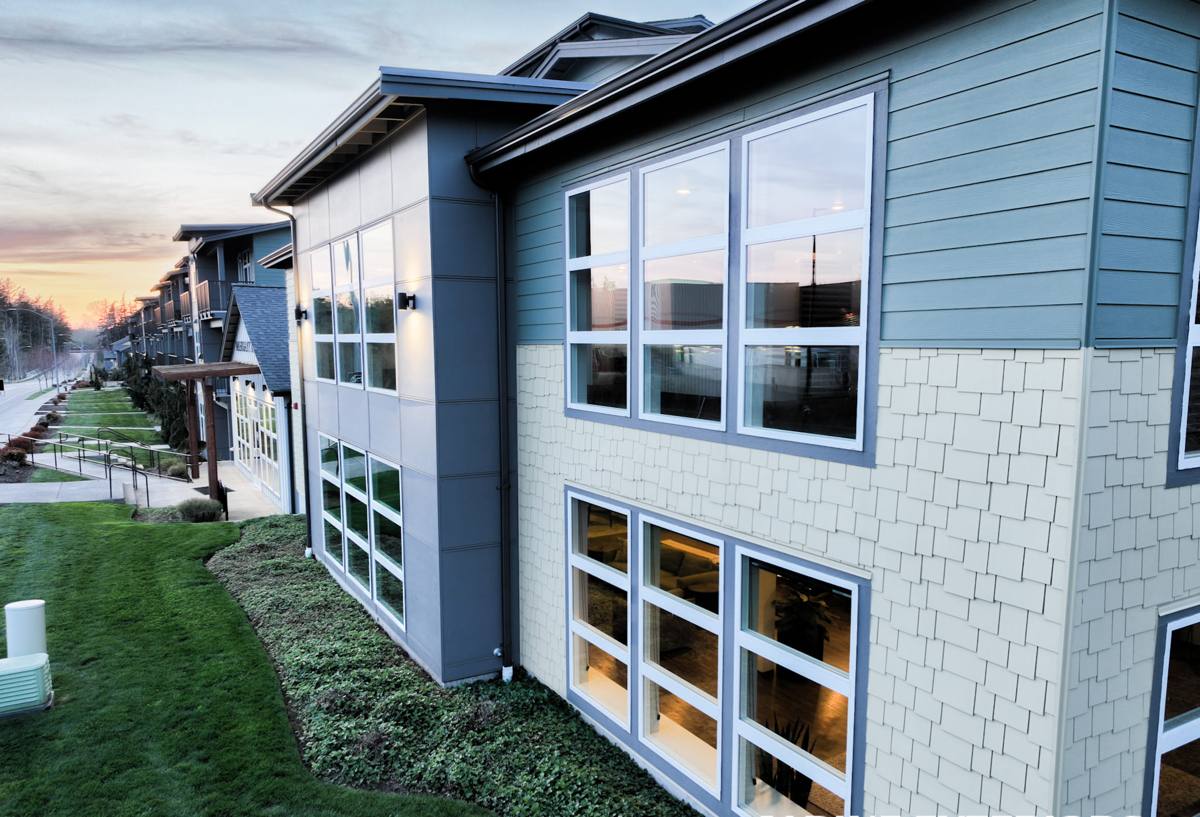
What "Correct" Looks Like for a Waterfront Job
Frame Material
For a beachfront or near-beachfront property, we lean toward materials and finishes that don't depend on paint or a factory coating standing up to salt spray indefinitely. Fiberglass and quality vinyl both handle salt air well because they don't rust and don't rely on a surface coating to resist corrosion the way bare aluminum does. Wood windows can absolutely work here, but only with a properly maintained exterior cladding or clad-wood construction — bare or poorly maintained painted wood is the first thing salt air and moss go after.
Glass and Weatherstripping
Wind-driven rain exposure calls for a window rated for higher water penetration resistance, not just the baseline code minimum. We also pay attention to weatherstripping quality — dual or triple-fin seals hold up better against sustained wind pressure than a single thin gasket, and that's the difference between a window that stays dry in a February storm and one that weeps at the sill.
Hardware
Locks, hinges, balances, and screws should be marine-grade or at minimum a corrosion-resistant alloy, not standard steel with a light coating. This is a small line-item cost difference and a large difference in how the window operates five or ten years from now.
Material Comparison for Salt-Air Exposure
| Material | Salt Air Behavior | Maintenance | Typical Fit for Sandy Point |
|---|---|---|---|
| Vinyl (quality grade) | Won't corrode; UV-stable finishes hold color | Occasional rinse to clear salt residue | Strong value option, good for most homes |
| Fiberglass | Excellent — dimensionally stable, no rust | Low; wipe down periodically | Best long-term option for direct waterfront exposure |
| Wood, clad exterior | Good if cladding is intact and sealed | Moderate — inspect seals/joints yearly | Works well when interior wood look is a priority |
| Wood, painted exterior | Vulnerable without diligent upkeep | High — repaint and reseal regularly | Requires real maintenance commitment this close to the water |
| Aluminum | Prone to pitting/corrosion over time in salt air | Moderate to high | Not our first recommendation for direct beachfront homes |
We're not telling homeowners that any of these materials is a bad product in general — aluminum and painted wood both perform fine in a lot of settings. Our recommendation for Sandy Point specifically is shaped by the corrosion and maintenance burden that salt air and constant moisture put on a home sitting this close to the water.
How We Handle the Job
- On-site assessment. We look at sun and wind exposure on each elevation, current signs of water intrusion or wood rot, and how the existing flashing and trim are holding up — waterfront homes rarely have identical exposure on all four sides.
- Precise measuring. Older Sandy Point homes, especially converted seasonal cottages, often have openings that have shifted slightly or were never perfectly square to begin with. We measure each opening individually rather than assuming uniformity.
- Flashing and weather barrier first. Before a new window ever goes in, we address the flashing, housewrap integration, and sill pan so water is directed out and away from the framing — this step matters more here than almost anywhere else in Ferndale.
- Installation and sealing. Windows are set, shimmed level and square, and sealed with sealants rated for exterior, marine-adjacent exposure — not a generic caulk that will chalk and crack within a couple seasons.
- Final check and cleanup. We test operation, confirm weather-tight seals, and walk the job with the homeowner before we consider it done.
Signs Windows Are Losing the Battle With the Elements
If you own an older home at Sandy Point, here's what tends to show up first when windows are struggling with the exposure:
- Fogging or moisture between double-pane glass — a sign the seal has failed
- Soft or discolored wood at the sill or lower corners of the frame
- Moss or dark green growth on the exterior trim, especially on north- or west-facing walls
- Windows that stick, won't stay open, or have stiff, gritty-feeling locks and cranks
- Visible daylight or a draft at the frame edge during a windstorm
- Salt residue or a chalky white film that keeps returning shortly after cleaning
Any one of these on its own might just mean a cleaning or minor repair. Several at once, especially on a home that's fifteen-plus years old, usually means it's worth having someone look at whether repair or replacement makes more sense.
Wind, Rain Pressure, and Comfort
Beyond keeping water out, windows facing open water at Sandy Point take a real wind load that inland Ferndale homes don't see in the same way. A window that isn't rated or installed for that pressure can flex slightly under strong gusts, which over time stresses seals and hardware faster than normal wear would. Choosing a window with an appropriate design pressure rating for a coastal-exposed elevation, and making sure it's anchored correctly to the framing, is as much a comfort and durability issue as it is a water-intrusion issue — a window that flexes in the wind also lets more cold air and noise through.
What to Check Before You Choose a Window or a Contractor
- Does the contractor ask about your home's specific exposure (which direction it faces, how close to the water) before recommending a product?
- Are they recommending corrosion-resistant hardware, not just standard hardware, for a waterfront property?
- Do they explain their flashing and sill pan approach, or just talk about the window itself?
- Can they speak to how the product they're proposing has held up in similar Whatcom County coastal settings?
- Is the warranty structure clear on what's covered for seal failure, hardware corrosion, and labor?
Why Local, Sandy Point-Familiar Experience Matters
A crew that regularly works this stretch of Whatcom County already knows which elevations at Sandy Point tend to take the worst of the winter storms, how moss establishes itself on shaded trim, and which installation shortcuts simply don't hold up against driving rain off the water. That's a different starting point than a general contractor pricing a window job the same way they would for a home twenty miles inland. It shows up in the details — the flashing sequence, the hardware spec, the sealant choice — that don't get noticed until years later when they either held up or didn't.
We also understand that a lot of homes at Sandy Point were originally built as seasonal beach cottages and have since been upgraded for year-round living. That history matters for window selection — older framing, different insulation assumptions, and openings that may not be standard sizes all factor into getting the job right the first time.
Get a Straight Answer for Your Home
If you're dealing with foggy glass, drafty frames, or windows that are just tired of fighting the salt air and rain at Sandy Point, we're glad to come take a look. We'll give you an honest read on repair versus replacement, walk through material options that make sense for your home's exposure, and put together a free, no-pressure estimate — no upsell, just what your house actually needs.