 Ferndale Siding
 Decks Built for the Way Cordata Actually Weathers
A deck in the Cordata area near Ferndale has a harder job than a deck almost anywhere inland. It sits under a marine layer that carries salt off Bellingham Bay and the Strait, it takes on driving, wind-blown rain for months at a stretch, and it spends a good chunk of the year shaded and damp enough to grow moss on anything that isn't actively shedding water. None of that is a reason to skip a deck. It's a reason to build one differently than a catalog plan from a drier climate assumes you will.
We build and repair custom decks for homes in this part of Whatcom County, and the decisions that matter most on this page aren't cosmetic — they're about what happens to the structure and the surface over five, ten, and twenty winters of Pacific Northwest weather.
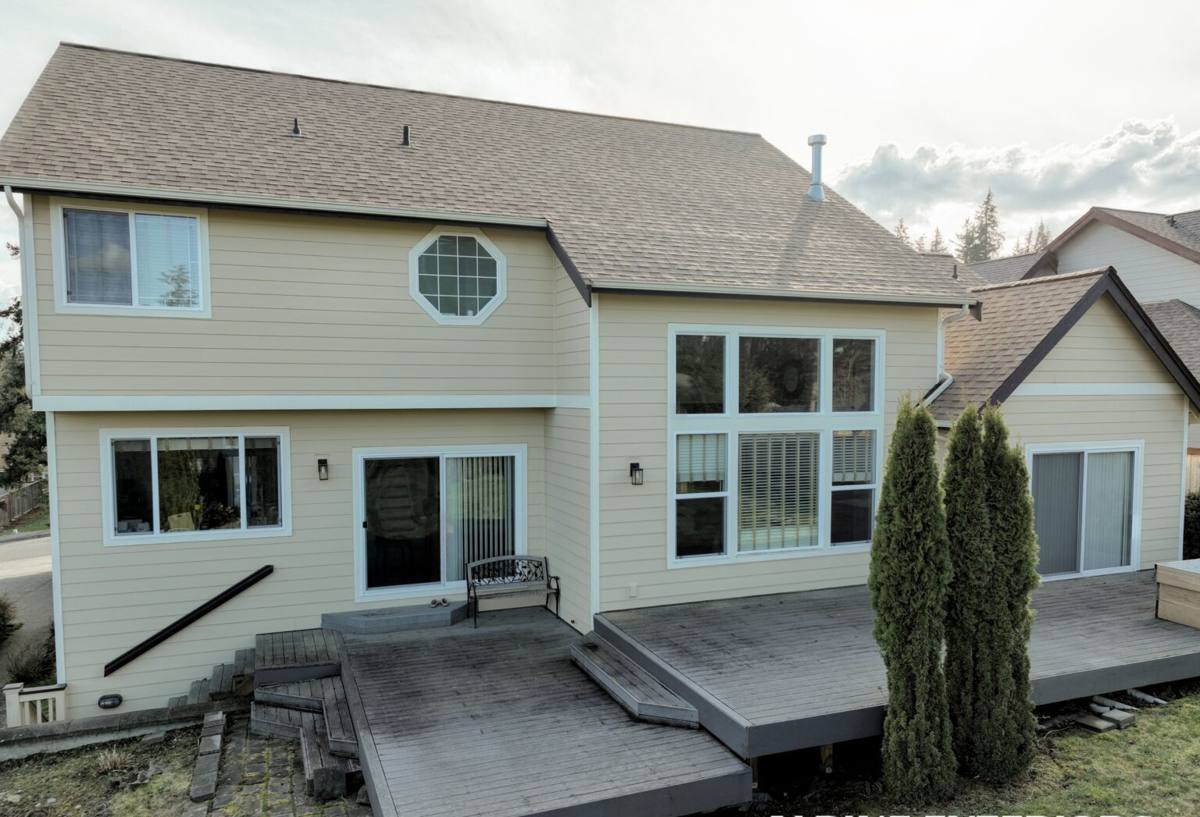
What Whatcom County Weather Actually Does to a Deck
Salt Air
Proximity to the water means airborne salt settles on every exterior surface, including decks that aren't visibly "at the coast." Salt accelerates corrosion on exposed metal — fasteners, brackets, railing hardware — and that corrosion is often invisible until a connection has already weakened. It also speeds up the breakdown of unsealed or poorly sealed wood fibers.
Driving Rain
Rain here doesn't fall straight down for long. Wind pushes it sideways into ledger connections, under poorly lapped flashing, and into any gap where end grain is exposed. A deck built with techniques from a low-rain region tends to fail first at the ledger board and at fastener penetrations, because those details assume rain arrives from directly overhead.
Moss Season
Shade, moisture, and mild temperatures add up to a long window — realistically much of the year — where moss, algae, and mildew can establish on any decking surface that stays damp between rains. Beyond looking bad, a mossy deck surface is genuinely slick and holds moisture against the board longer than a clean one, which shortens the life of the material underneath.
Choosing the Right Decking Material for This Climate
There's no single "best" decking material — there's a best fit for your budget, your maintenance appetite, and how much sun or shade your particular lot gets. Here's how the common options actually perform under Whatcom County conditions:
| Material | How it handles the wet season | Maintenance reality | Typical lifespan here |
|---|---|---|---|
| Pressure-treated wood | Resists rot chemically but still swells, checks, and grays; needs a real drainage gap underneath | Annual cleaning and re-sealing to control moss and splintering | 10-15 years before major repair |
| Cedar | Naturally rot-resistant and handsome, but softer and more prone to surface checking in constant damp | Regular oiling or staining; moss shows quickly on shaded runs | 15-20 years with upkeep |
| Capped composite | Shrugs off moisture absorption almost entirely; won't rot or splinter | Occasional wash to keep moss/algae from gripping the surface texture | 25-30+ years, backed by manufacturer warranty |
| Uncapped composite | Better than wood but the exposed core can still wick moisture at cut ends over time | More cleaning than capped composite to prevent surface staining | 15-25 years |
For homes in Cordata with a lot of tree cover or a north-facing deck that rarely dries out, we usually steer clients toward capped composite or well-detailed cedar. For a sunnier, more exposed site, pressure-treated wood with a disciplined maintenance schedule is still a reasonable, budget-friendly call. We'll walk your specific site conditions with you rather than defaulting to one product.
Structural Details That Matter More Here Than Elsewhere
The visible decking board is the least of what determines how long a deck lasts in this climate. The structure underneath is where most failures actually start.
Ledger Flashing
Where the deck attaches to the house is the single most common failure point we see on older decks in this region. Proper flashing — metal, correctly lapped with the house's water-resistive barrier, not just caulked — keeps driving rain from tracking behind the siding and rotting the rim joist from the inside out, where you can't see it until it's serious.
Joist Protection
Joist tape or a comparable membrane over the top of every joist keeps standing water from soaking into end grain and fastener holes, which is exactly where rot starts under a deck board. This is a small material cost that pays for itself many times over in a climate with this much sustained moisture.
Drainage and Airflow Below
Decks built low to grade, or without gaps for airflow underneath, hold humidity against the framing year-round. We grade and detail the substructure so water has somewhere to go and air has a way to move, instead of pooling under the deck all winter.
Footings
Whatcom County's clay-heavy, frequently saturated soils move more than people expect. Footings poured to the correct frost depth and bearing width keep posts from heaving or settling unevenly over a few wet winters — a problem that shows up as a suddenly bouncy or uneven deck a couple of years after a rushed build.
Our Deck-Building Process
- On-site assessment. We look at your yard's drainage, sun/shade exposure, existing structure (if this is a rebuild), and how the deck will actually be used before recommending anything.
- Design and material selection. We talk through layout, railing style, and decking material against your budget and how much upkeep you want to take on long-term.
- Permitting. Most elevated decks in Whatcom County require a building permit; we handle the paperwork and inspections so you don't have to chase it down.
- Demolition or site prep. Old decking, damaged framing, and any hidden rot get removed and assessed before new construction starts — not covered up.
- Framing with climate-appropriate detailing. Ledger flashing, joist protection, proper post spacing, and correctly sized footings go in before a single deck board is laid.
- Decking, railings, and hardware install. Fasteners and connectors are selected for the coastal environment, not generic hardware-store defaults.
- Final walkthrough. We go over care and maintenance specific to the material you chose, so the deck actually reaches its expected lifespan.
Railings, Fasteners, and Hardware for a Salt-Air Environment
Hardware is where a lot of otherwise well-built decks quietly fail early in this region. Standard galvanized fasteners can corrode faster than the wood or composite around them when they're exposed to salt-laden air, staining the decking and losing holding strength at the same time. We use stainless steel or coated fasteners rated for coastal exposure on structural connections and railing hardware, and we make sure fastener types are compatible with the decking material — some composites require specific fastener systems to keep the manufacturer's warranty valid.
Railing posts are another common weak point. A post that isn't properly through-bolted to blocking in the framing can develop play over time, especially once moisture works into the connection. We build railings to hold up under regular use, not just to pass a first inspection.
Maintenance Reality: Keeping a Deck Looking Good Here
Every deck material needs some upkeep in this climate — the differences are in how much and how often. A realistic annual routine looks like this:
- Sweep debris (needles, leaves, seed pods) off the deck regularly so it doesn't trap moisture against the boards
- Wash the surface at least once a year — more often on shaded sections — to knock back moss and algae before it establishes
- Check and clear gaps between boards so water keeps draining instead of pooling
- Inspect railing connections and stair stringers annually for movement or soft spots
- Re-oil or re-stain wood decking on the schedule the product actually needs, not just when it looks faded
- Look underneath the deck once a year for standing water, debris buildup, or early signs of rot on framing
Skipping this list doesn't cause sudden failure — it causes the slow kind, where a deck that should have lasted two decades needs major repair at year eight.
Why Hire a Crew That Already Works in Cordata
A deck built from a design that works fine in a dry climate, or by a crew unfamiliar with what Whatcom County winters actually do to a structure, tends to show its problems in year three or four rather than year twenty. Working regularly in this area means we already know which details matter here — ledger flashing that actually sheds driving rain, fastener choices that hold up to salt air, footing depths suited to local soil and frost conditions, and material recommendations based on how much shade and moss pressure your specific lot gets, not a generic national average.
It also means we're not guessing at permitting requirements or inspection expectations for the area — we've been through that process on homes near yours.
Get a Straightforward Estimate
If you're planning a new deck or replacing one that's showing its age, we're happy to come take a look, talk through material options for your specific site, and give you a clear, no-pressure estimate. Use the form below to get started.