 Ferndale Siding
 Birch Bay sits directly on the water in northern Whatcom County, and that location puts more stress on a roof than almost anywhere else in the region. Homes here take a steady dose of salt-laden marine air, wind-driven rain that gets pushed sideways under laps and flashing instead of falling straight down, and a moss season that can run most of the year on shaded, north-facing slopes. Metal roofing has become a popular answer to that combination for good reason — it sheds water better than a shingle surface and shrugs off moss more easily. But a metal roof only delivers on that promise when it's specified and installed correctly for this exact exposure. This page covers what that actually means for a Birch Bay home, not metal roofing in general.
What Birch Bay's Climate Actually Demands From a Roof
Three conditions drive almost every metal roofing problem we see out here, and they don't act in isolation — they compound each other over the life of a roof.
Salt Air and Fastener Corrosion
Direct waterfront exposure means more airborne salt than most of Whatcom County deals with. Salt accelerates corrosion at every metal-to-metal contact point on a roof — fasteners, flashing, cut panel edges, and any spot where two dissimilar metals touch and set off galvanic corrosion. A fastener or flashing spec that holds up fine a few miles inland can start streaking rust within a handful of years right on the bay if it wasn't rated for direct marine exposure. This is the detail that separates a metal roof that looks good for decades from one that develops ugly rust staining and eventual leaks at every screw head.
Wind-Driven Rain at the Seams
Rain off the water rarely falls straight down. Wind pushes it sideways and even upward under panel laps, exposed fasteners, and flashing details that would stay dry in a calmer, more sheltered location. A panel system and flashing detail built to a minimum standard is more likely to leak at valleys, ridge caps, and roof-to-wall transitions than one specified with this kind of wind exposure in mind from the start.
A Long Moss Season
Mild temperatures, shade, and near-constant moisture add up to a moss and mildew season that runs long across this part of the county. Metal's smooth, non-porous surface resists moss far better than a shingle roof's granular texture, which is one of the real advantages of the material here. But metal isn't moss-proof — needles, leaves, and dust still collect in valleys, at panel laps, and behind snow guards, and that debris gives moss a foothold if it's never cleared. Shaded, north-facing planes and anything running under tree cover still need attention even on a metal roof.
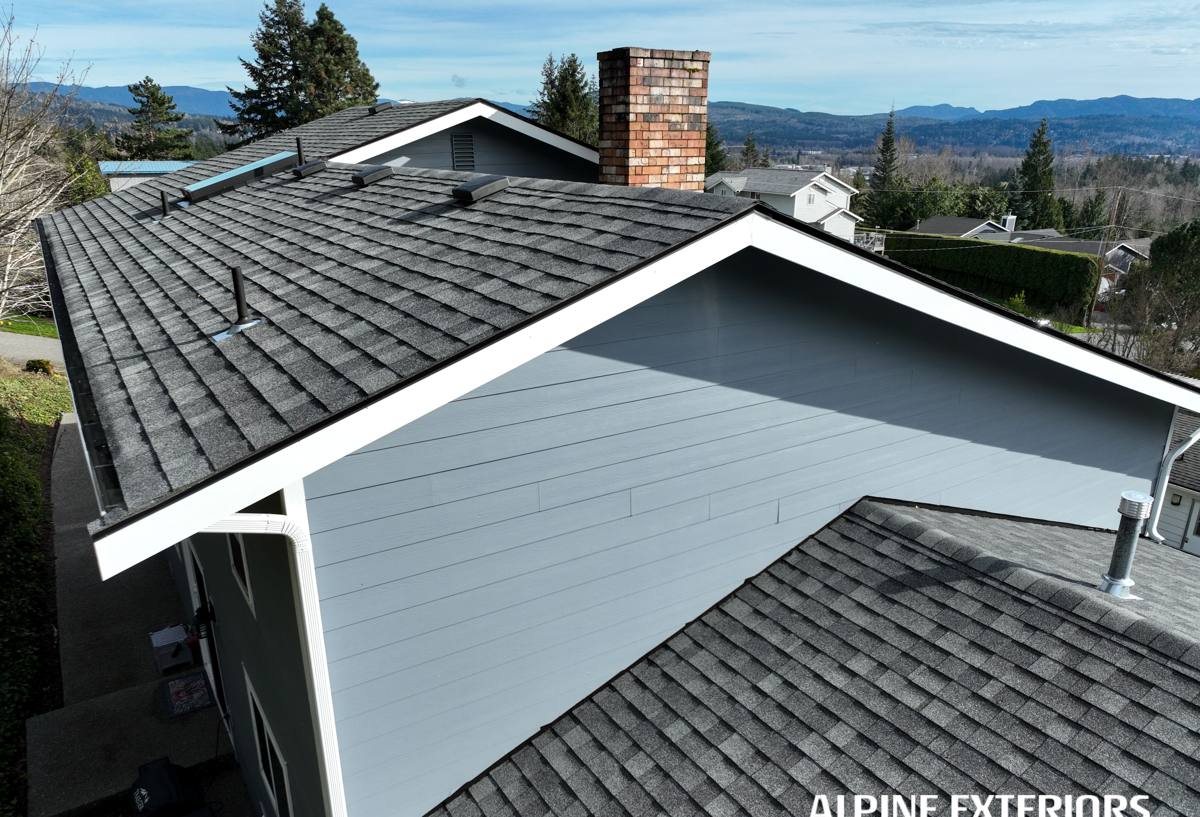
Choosing a Panel System: Standing Seam vs. Exposed Fastener
Not all metal roofing is built the same way, and the panel profile matters as much as the metal itself when the roof sits this close to the water.
| Panel Type | How Water Sheds | Fastener Exposure | Fit for Birch Bay |
|---|---|---|---|
| Standing seam (mechanically seamed) | Concealed clips under raised, interlocking seams — no fasteners penetrate the panel face | None on the exposed surface | Best match for direct waterfront exposure and a long ownership horizon |
| Exposed fastener panel | Screws penetrate the panel face directly, each sealed with a rubber washer | Dozens to hundreds per roof, each a future corrosion and seal point | Lower upfront cost; workable on secondary structures or tighter budgets with a maintenance commitment |
Standing seam costs more to install because the seaming process and clip system take more labor and specialized tooling, but it removes the single biggest long-term maintenance item an exposed fastener roof carries: hundreds of rubber washers that harden, crack, and need replacing over the roof's life. On a home taking direct salt exposure, that maintenance gap tends to matter more than it would a few miles inland.
Finish and Coating: Why the Paint System Matters as Much as the Metal
The substrate — steel or aluminum — is only half of what determines how a metal roof holds up in salt air. The applied finish does a lot of the actual corrosion and fade resistance work. Heavier PVDF-based finishes (commonly sold under the Kynar name) hold color and resist chalking longer under sustained UV and salt exposure than lighter, lower-cost polyester finishes. That difference shows up over ten or fifteen years, not in the first season, which is exactly why it's easy to underweight when comparing bids on price alone.
Aluminum panels are also worth a real look for a property sitting directly on the bay. Aluminum doesn't rust the way steel can if a coating is ever breached, since the metal itself resists corrosion rather than relying entirely on the finish. It typically costs more per square than steel, and the trade-off is a decision we walk through with each homeowner based on budget and how long they plan to own the home — not a one-size answer.
Fasteners, Flashing, and Underlayment: Where Metal Roofs Actually Fail
The panel itself is rarely the point of failure on a metal roof. Problems show up in the details around it — the same way they do on any roofing system, just with different consequences given the material.
Underlayment still matters under metal, even though the panel is far less porous than a shingle. A high-temperature synthetic underlayment across the field, with self-adhered membrane at eaves, valleys, and other vulnerable points, gives the deck a second line of defense if wind-driven rain ever works past a lap or fastener. Fastener installation is its own skill on a metal roof: over-driven screws crush the rubber washer and lose their seal almost immediately, while under-driven screws leave a gap that works loose and leaks under wind load. Flashing at every penetration, valley, and roof-to-wall transition needs to be fabricated and lapped correctly for this specific wind-driven exposure, since that's where the majority of metal roof leaks actually originate rather than in the field of the panel.
Signs a Birch Bay Metal Roof Needs Attention
- Rust streaking at fastener heads, cut panel edges, or exposed screws
- Panels, ridge caps, or trim that have loosened or lifted after a windstorm
- Moss or debris building up in valleys, at panel laps, or around snow guards
- Water staining on interior ceilings near penetrations or roof-to-wall transitions
- Chalking, fading, or color mismatch across the roof plane, which often points to a lower-grade repair patch
What Drives the Cost of a Metal Roof in Birch Bay
Metal roofing costs meaningfully more upfront than asphalt shingles, and the gap between two metal roofing bids is rarely arbitrary — it usually traces back to real differences in panel system, material, and labor scope.
| Cost Factor | What It Affects | Why It Matters in Birch Bay |
|---|---|---|
| Panel profile | Material and labor cost, seaming method | Standing seam handles wind-driven rain best but takes more labor to install correctly |
| Substrate and gauge | Corrosion resistance, dent resistance | Aluminum resists salt corrosion inherently; heavier gauge steel holds up better to wind-driven debris |
| Finish and coating grade | Long-term fade and corrosion resistance | Heavier PVDF-based coatings hold color and rust resistance longer under direct salt exposure |
| Tear-off vs. install over existing | Deck access and inspection, disposal cost | Tear-off lets the crew find and replace any rotted decking hidden under an older roof, common on older bay-area homes |
| Roof complexity | Labor time, custom flashing fabrication | Homes with more valleys, dormers, or penetrations need more hand-fabricated flashing, which adds labor |
| Snow guards and ice-and-water shield | Added material and labor | Snow load here is light compared to mountain areas, but sudden cold snaps can still cause ice damming at eaves |
When two metal roofing bids differ significantly, ask what's actually specified — panel profile, gauge, finish grade, and fastener or clip hardware — rather than comparing a single total number. A bid that just says "metal roof" without those specifics is hard to compare honestly against one that spells them out.
Our Installation Process
- On-site assessment. We inspect the existing roof, deck condition, and the home's specific sun, shade, and wind exposure, and take measurements for an accurate estimate.
- Panel and finish selection. We go over panel profile, gauge, substrate, and coating options that fit the home's exposure and the homeowner's budget, with honest trade-offs explained for each.
- Written scope of work. The bid spells out panel profile, gauge, finish, fastener and flashing hardware, and underlayment — not just a total price.
- Tear-off and deck inspection. Existing roofing comes off so we can check the deck for rot or prior water damage before anything new goes down.
- Underlayment and flashing. Installed with corrosion-resistant components sized for this specific wind and salt exposure.
- Panel installation. Correct fastener spacing, torque, and seaming, done to the manufacturer's spec rather than a generic install pattern.
- Final walkthrough. A cleanup and magnetic sweep for stray fasteners and metal shavings before the job is considered done.
Why a Local Crew With Metal Roofing Experience Matters
Metal roofing installed wrong in a marine climate can look perfectly fine for a year or two before galvanic corrosion, an under-sealed fastener, or a poorly lapped flashing detail shows up as a leak or a line of rust streaks down the panel. A crew that's actually installed and repaired metal roofs on this stretch of coastline already knows which fastener, flashing, and coating combinations hold up out here and which ones don't — that's not something a contractor who mostly works drier, inland roofs picks up on a single job.
A Simple Checklist Before Hiring for Metal Roofing in Birch Bay
- Ask what panel profile, gauge, and finish they're specifying, and why it fits a waterfront property specifically
- Confirm fastener, clip, and flashing hardware are rated for direct salt exposure, not a generic inland spec
- Ask how they detail valleys and roof-to-wall transitions for wind-driven rain
- Confirm current Washington contractor licensing and active liability insurance
- Get panel profile, gauge, and finish spelled out in the written bid — not just "metal roof" as a single line item
If you're weighing a metal roof for a Birch Bay home, we're happy to walk the roof with you, talk through panel and finish options honestly, and put together a written estimate you can compare against anything else you've received. Reach out below for a free, no-pressure estimate.