 Ferndale Siding
 Why Birch Bay's Location Puts Extra Stress on Siding
Birch Bay sits right on the water, and that location is exactly what makes it such a demanding spot for exterior siding. Homes here take on a combination most inland Whatcom County properties never see at the same intensity: salt-laden air blowing off the water, wind-driven rain that hits walls sideways instead of falling straight down, and long stretches of shade and dampness that keep moss and algae established on north- and west-facing walls for much of the year. Any one of those on its own is manageable. Together, over years, they wear down siding, fasteners, and paint faster than the same materials would fail a few miles inland.
This page is about one job specifically: installing James Hardie fiber cement siding correctly on a Birch Bay home. Not a generic overview of siding, and not a sales pitch for Hardie in the abstract — what the Birch Bay environment actually does to a wall assembly, what a correct installation has to account for, and how our crew approaches the work differently because of where the house sits.
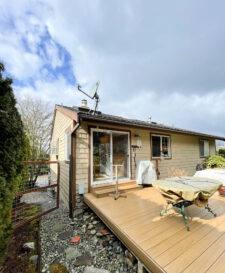
What Salt Air, Rain, and Moss Actually Do to a Wall System
Salt air and exposed metal
Airborne salt accelerates corrosion on anything metal that's exposed to it — fasteners, flashing, trim screws. On a wall that's built and fastened correctly, this is a manageable maintenance factor. On a wall where the wrong fasteners were used, or flashing was skipped to save time, salt exposure turns a small oversight into a moisture path a few years sooner than it would show up elsewhere.
Wind-driven rain and water intrusion
Straight-down rain mostly runs off a wall. Wind-driven rain gets pushed sideways and upward, into laps, seams, and any gap around windows, doors, and trim that wasn't sealed and flashed properly. Waterfront exposure in Birch Bay means walls facing the water take this kind of rain more often and harder than a sheltered lot would. Every seam and penetration on those elevations needs to be treated as a place water will actively be pushed against, not just a place water might land.
Moss, shade, and trapped moisture
Whatcom County's long wet season is tough on any exterior in shaded spots, and Birch Bay's tree cover and marine humidity extend the window where moss and algae can get established on siding, trim, and the lower courses near grade. Moss itself doesn't rot fiber cement, but it holds moisture against the wall surface for longer stretches, which matters most at seams, fastener heads, and anywhere caulk or paint has started to fail.
Why We Standardize on James Hardie for This Kind of Exposure
We install James Hardie fiber cement siding exclusively — not vinyl, not LP SmartSide, not cedar or primed spruce. For a marine-exposed property like a Birch Bay home, the reasons matter more than they would somewhere drier and more sheltered:
- Non-combustible material that doesn't rely on a factory or field-applied coating to resist moisture the way wood-based products do.
- ColorPlus factory-applied finish, baked on and warranted, which holds up to UV and salt exposure longer than field-applied paint — meaning fewer repaint cycles on a house that's already taking more weather than average.
- HZ5 climate-engineered formulation, Hardie's product line built specifically for wetter, cooler regions like the Pacific Northwest, as opposed to the HZ10 formulation sold in hot, dry climates.
- A strong transferable warranty that assumes correct installation — which is why we're as careful about the install as we are about the product choice.
None of this means other products are junk. It means that for the specific combination of salt air, wind-driven rain, and moss exposure a Birch Bay home deals with, we're not willing to put our name on a lower-durability option and hope it holds up. We'd rather turn down work than install something we don't think will perform here long-term.
What a Correct Installation Looks Like in This Climate
James Hardie siding performs the way it's rated to only when it goes on correctly. On a standard inland home, a few small shortcuts might not show up for a long time. On a Birch Bay waterfront elevation, they show up faster. The details we hold to on every job here:
Flashing and water management first
Every window, door, and butt joint gets proper flashing and house-wrap integration before a single piece of siding goes up. This is the single biggest factor in whether wind-driven rain stays outside the wall assembly or finds its way behind it.
Correct clearance and gaps
Hardie specifies minimum clearances from grade, roof lines, decks, and other transitions, along with expansion gaps at every butt joint. Skipping these to make a wall look tighter is one of the more common shortcuts we see on homes we're asked to re-side — and it's exactly the kind of detail that fails first in a wet, salt-heavy environment.
Fastening pattern and fastener choice
Fasteners need to be corrosion-resistant and driven per Hardie's specification — proper depth, proper spacing, into framing or backing that can actually hold them. Overdriven or underdriven nails are a common source of premature siding failure, and they're avoidable with a crew that isn't rushing.
Caulking discipline
Where caulk is called for — and where it isn't — matters. Over-caulking traps moisture in gaps that were designed to drain and vent; under-caulking leaves entry points for wind-driven rain. Following Hardie's actual specification, rather than a generic "seal everything" habit, is what makes the difference on a wall this exposed.
Our Process on a Birch Bay Hardie Project
- On-site assessment — we look at wall exposure, existing moisture damage, trim condition, and which elevations take the worst of the wind and rain off the water.
- Product and color selection — matching the right Hardie panel or lap profile and ColorPlus finish to the home, with realistic expectations about how the color will read against marine light and shade.
- Prep and tear-off — removing existing siding, checking sheathing and framing for hidden moisture damage before covering it back up, and correcting anything found rather than siding over it.
- Installation to spec — flashing, clearances, fastening, and caulking done to Hardie's published requirements, not shortcuts.
- Final inspection and cleanup — walking the whole exterior, checking every seam and penetration, before we call the job done.
Maintenance: What Owning Hardie Siding in Birch Bay Actually Looks Like
Correctly installed James Hardie siding is low-maintenance, not no-maintenance, and that's especially true this close to the water. A realistic yearly routine:
- Rinse salt residue off the exterior periodically, especially on water-facing walls, with a garden hose or soft wash — no pressure washer aimed directly at seams or fastener heads.
- Check shaded and north-facing sections for moss or algae buildup and treat it before it spreads, rather than letting it sit through another wet season.
- Inspect caulk lines at trim, windows, and butt joints annually for cracking or separation, and have any gaps re-sealed before the next wet season.
- Keep gutters and downspouts clear so water isn't sheeting down the wall face longer or more often than it needs to.
- Trim back vegetation that keeps a section of wall shaded and damp longer than the rest of the house.
What Drives Cost on a Birch Bay Siding Project
Every home is priced individually after a walk-through, but the factors that move the number up or down are consistent:
| Cost Factor | Why It Matters |
|---|---|
| Tear-off vs. overlay | Removing old siding and checking sheathing costs more up front but is often necessary where moisture damage is suspected. |
| Home size and wall complexity | More corners, gables, and trim detail mean more cutting, flashing, and labor time. |
| Existing moisture damage | Rot or hidden water damage found during tear-off has to be repaired before new siding goes on — this is discovered, not always predictable in advance. |
| Product line and profile | Lap siding, panel systems, and trim accessories vary in material cost and installation time. |
| Site access | Waterfront lots with limited staging space or steep grades can add labor time versus a straightforward inland lot. |
| Color and finish selection | Standard ColorPlus colors versus custom or specialty finishes affect material lead time and cost. |
Checklist: What to Look for in a Birch Bay Siding Crew
Because of the exposure this location deals with, the margin for a rushed or generic installation is smaller here than inland. Before hiring anyone for Hardie siding on a Birch Bay home, it's worth asking:
- Do they install to James Hardie's published fastening, clearance, and flashing specifications — and can they explain those specs, not just claim to follow them?
- Are they factory-trained or certified on Hardie products specifically?
- Will they check sheathing and framing for hidden moisture damage during tear-off, rather than siding directly over whatever is underneath?
- Do they have experience with waterfront or near-water exposure specifically, not just siding in general?
- What does their workmanship warranty cover, separate from Hardie's own product and finish warranties?
- Will they give you a straight answer about why they do or don't recommend a given product for your specific exposure?
Why Local Experience in Birch Bay Matters
A crew that only sees Birch Bay's conditions occasionally tends to install the same way they would anywhere else — because they haven't watched what happens three or five years later when salt air, driving rain, and moss season get skipped over in the install. A crew that regularly works this stretch of Whatcom County treats flashing, clearances, and fastening as non-negotiable because they've seen what happens on the homes where those details were rushed. That's the difference we bring to a Birch Bay project: not a different product, but a level of attention matched to what this specific location actually demands.
If you're considering new siding for a Birch Bay home, we're happy to take a look and walk you through what we'd recommend and why — no pressure, no obligation. Use the form below to request a free estimate.