 Ferndale Siding
 Building New in Marietta: Windows Are Part of the Framing Decision
If you're building new in Marietta, the windows aren't a finishing touch you pick out of a catalog after the walls are up. They're a structural and weatherproofing decision that has to be made while the house is still open — before the weather-resistive barrier goes on, before siding goes up, and before anyone can see whether the flashing was done right. Get it wrong at this stage and you've built a leak path into the house that won't show up for years. Get it right, and the windows become one of the least-thought-about parts of the house for the next few decades.
Marietta sits in a stretch of Whatcom County that gets more direct exposure to marine weather than homes further inland around Ferndale proper. That means the windows going into a new build here need to be selected and installed with the local climate in mind from day one, not treated as a generic spec pulled from a builder's standard package.
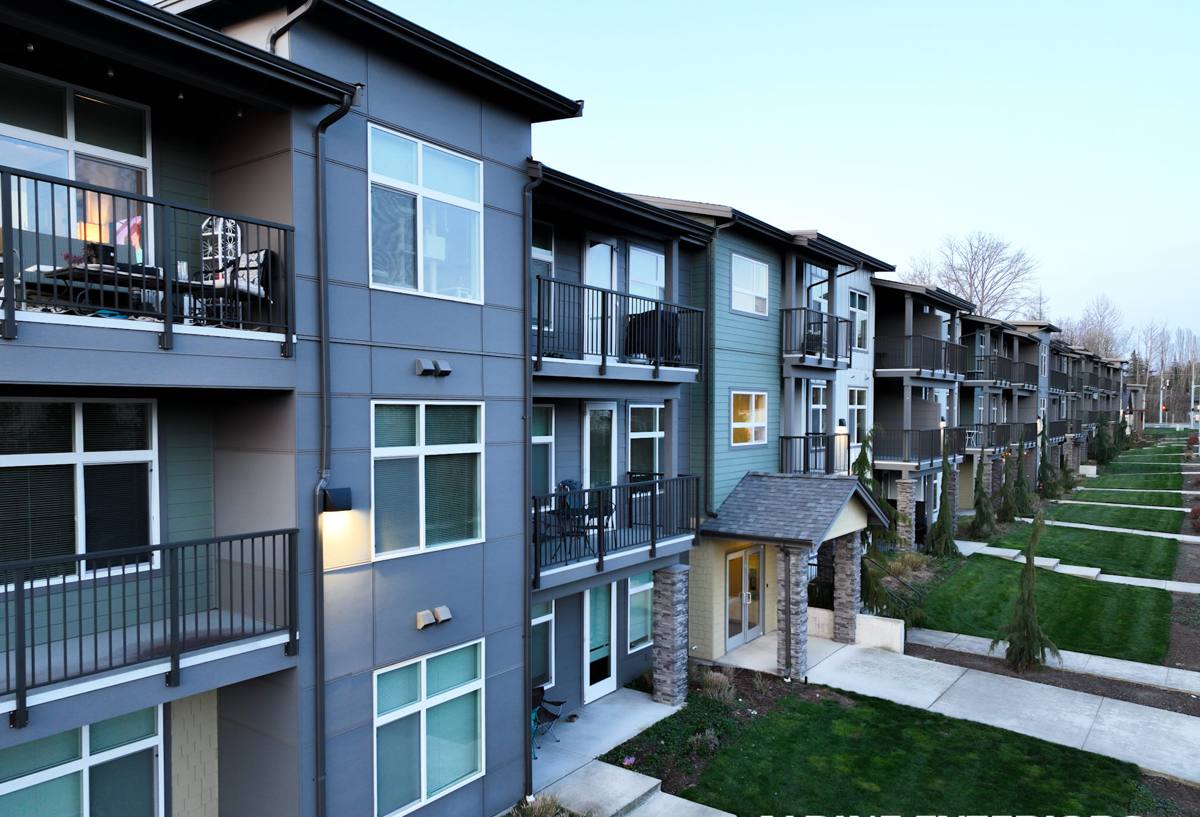
What Whatcom County's Climate Does to a Window Over Time
Three things drive most of the window problems we see in this part of the county, and all three are relevant to a new build, not just an older one being replaced.
Salt Air and Marine Exposure
Homes closer to the water pick up airborne salt that settles on glass, frames, and hardware. Over years, that salt film accelerates corrosion on unprotected fasteners and lower-grade hardware, and it etches into glass coatings that aren't rated for coastal exposure. It doesn't ruin a window overnight, but it shortens the life of cheap components fast.
Driving Rain
Storms coming off the water don't just fall straight down — wind pushes rain sideways and up under trim, sills, and anything with a gap. A window that would be fine in a sheltered inland yard can leak in Marietta simply because the wind-driven rain finds a path that a calm-weather install never gets tested against. This is the single biggest reason new-construction flashing detail matters more here than in a lot of other parts of the state.
The Long Moss Season
Whatcom County's mild, wet stretch runs long — moss and algae get a genuine head start and don't let up until well into spring. On a house, that shows up as green growth on north-facing trim, sills, and anywhere water sits instead of draining. A new-construction window with a poorly sloped sill or a caulk-only seal (instead of a proper weep path) gives moss somewhere to take hold right at the frame, which traps moisture against the window instead of letting it shed.
New-Construction Windows vs. Replacement Windows
This distinction matters more than most homeowners realize, and it's worth understanding before you talk to anyone about a build. "New-construction" and "replacement" aren't marketing terms — they're two different physical products installed two completely different ways.
| Feature | New-Construction Window | Replacement Window |
|---|---|---|
| Frame design | Nailing flange around perimeter | Flangeless, sized to fit existing frame |
| When it's installed | During framing, before WRB and siding | After the fact, into an existing opening |
| Flashing integration | Flange integrates directly with house wrap and flashing tape | Relies on the existing opening's condition and sealant |
| Best fit for this project | Correct choice for a true new build | Wrong product for new construction — used for retrofits into an intact wall |
For a genuine new build in Marietta, the nailing-flange, new-construction unit is the right product. It lets us build the weatherproofing into the wall assembly itself rather than trying to seal around a window that's already boxed in by finished siding. Trying to force a replacement-style window into new framing — or vice versa — is one of the more common corner-cutting moves we see on jobs that get handed off between crews mid-build.
What a Correct New-Construction Install Involves
The window itself is only part of the job. The install sequence is what actually determines whether the opening stays dry for the next 30 years.
Flashing Sequence
Before the window ever goes in, the rough opening needs a sill pan to catch and direct any water that gets past the window back out, not into the wall. The weather-resistive barrier gets cut and integrated with flashing tape in a specific order — sill first, then jambs, then head — so every layer sheds water down and out, never trapping it behind the next layer. On a house exposed to Marietta's wind-driven rain, skipping or reversing this order is exactly how a wall starts leaking two or three winters in.
Fastening and Shimming
New-construction windows get shimmed square and plumb in the opening before the nailing flange is fastened off — not the other way around. A window fastened before it's properly shimmed can bow, which throws off the reveal, binds the sash, and stresses the seals around the glass. We check every unit for square, level, and plumb before it's fastened, then fasten through the flange per the manufacturer's schedule, not just "enough nails to hold it."
Sealants and Weep Paths
Caulk is not a substitute for correct flashing — it's the last line of defense, not the first. We seal where the manufacturer specifies and leave the weep path at the sill open so any water that does get in can drain back out instead of pooling. A fully caulked perimeter with no weep path is a classic way to trap moisture right where moss and rot get started.
Choosing the Right Frame Material for a Marietta New Build
Frame material affects how a window handles moisture, salt exposure, and temperature swings over the long run. There's no single "best" material for every project — it depends on budget, the home's design, and how much upkeep the owner wants to take on.
| Frame Material | How It Handles This Climate | Trade-Offs |
|---|---|---|
| Vinyl | Won't corrode from salt air; handles moisture well | Lower up-front cost; can be less rigid in very large sizes |
| Fiberglass | Very stable in temperature swings; strong moisture and corrosion resistance | Higher cost than vinyl; fewer color options in some lines |
| Wood-clad | Warm appearance; exterior cladding protects the wood from weather | Any breach in the cladding exposes wood to moisture — needs careful sealing and periodic inspection |
| Aluminum | Strong and slim sightlines | Conducts heat and cold; needs a thermal break and marine-grade hardware near the water |
For most new builds in Marietta, we steer owners toward vinyl or fiberglass for the bulk of the house because both shrug off salt air and driving rain with minimal maintenance. Wood-clad units still show up where the design calls for it, but we're upfront that they demand more attention to the cladding seal in this climate than they would somewhere drier.
Our Installation Process
Every new-construction window job follows the same sequence, whether it's one window or a whole house of them.
- Verify rough openings against the approved window schedule before a single unit arrives on site.
- Install sill pan flashing and integrate it with the weather-resistive barrier.
- Set each window, check for square, level, and plumb, and shim as needed.
- Fasten through the nailing flange per manufacturer spec.
- Complete head and jamb flashing integration with the WRB.
- Seal per manufacturer instructions while preserving the weep path at the sill.
- Walk every opening a second time before siding crews close it in — this is the last point anything can be corrected without tearing into finished work.
That last step is one we don't skip, even when it slows the schedule down. Once siding goes on, a flashing mistake is hidden for years — right up until it isn't.
Mistakes We Watch For on New Builds
Most window leaks on new construction trace back to a short list of repeatable errors. We check for these on every job, including ones where another crew already framed the openings.
- Missing or incorrectly lapped sill pan flashing
- Flashing tape applied out of sequence (head before jamb, or jamb before sill)
- Windows fastened before being properly shimmed and squared
- Weep paths sealed shut with excess caulk
- Wrong window type used for the opening — replacement-style units forced into new framing
- Rough openings cut oversized or undersized relative to the window schedule
- No second check of flashing before siding closes the wall in
Why a Crew That Already Works in Marietta Matters
A window install that would hold up fine in a sheltered, inland yard can fail in a few years on a lot that takes direct wind-driven rain off the water. Crews who haven't worked this specific stretch of Whatcom County don't always adjust their flashing detail, sealant choice, or sill slope for that reality — they install to a generic standard and move on.
Working in and around Ferndale and Marietta regularly means we're not guessing at how this microclimate behaves. We know which orientations on a lot take the worst of the driving rain, where moss tends to establish first on a new house, and which details are worth the extra half hour on install day because we've seen what happens when they're skipped. That's the difference between a window install that's technically correct on paper and one that's actually built for where it sits.
Cost Factors and Caring for New Windows Through the Seasons
Costs on a new-construction window package vary by project, and we'd rather walk a specific job than quote a number that doesn't mean much out of context. That said, a few factors consistently move the price up or down.
| Factor | Effect on Cost |
|---|---|
| Frame material (vinyl vs. fiberglass vs. wood-clad) | Fiberglass and wood-clad run higher than vinyl for the same size |
| Window size and quantity | Larger openings and higher counts scale cost directly |
| Glass package (standard vs. upgraded low-E, coastal-rated coatings) | Upgraded coatings add cost but pay off in a marine climate |
| Special shapes or operable configurations | Custom shapes and multi-panel units cost more than standard operable sash |
| Site access and timing within the build schedule | Coordinating install ahead of siding closes in the wall correctly, but tight schedules can add cost pressure |
Once the windows are in, upkeep in this climate is straightforward if it's done on a schedule. A short annual routine keeps new windows performing the way they should for the long haul:
- Rinse salt film off glass and frames a couple of times a year, especially after storm season
- Check weep paths at the sill to make sure they're clear and not clogged with debris or moss
- Look at exterior sealant joints each fall for cracking or gaps before winter rains set in
- Wipe down sills and trim where moss tends to establish, particularly on north-facing walls
- Test that operable sash still open, close, and lock smoothly as the house settles in its first year
None of this is heavy maintenance — it's the kind of routine check that catches a small problem before it becomes a wall repair.
If you're framing a new home or addition in Marietta and want the windows handled by a crew that already knows this stretch of Whatcom County, we're happy to walk the site and put together a free, no-pressure estimate. There's a form below — reach out and we'll go from there.