 Ferndale Siding
 Siding Installation Built for Lynden's Weather, Not Just Its Look
Lynden homeowners deal with a specific combination of weather that a lot of siding products simply weren't designed for. You've got salt-laden air moving in off the Strait of Georgia and Bellingham Bay, long stretches of driving rain that can last for days at a time, and a moss season that seems to start earlier and run longer every year. Add in the humidity that settles over the Nooksack valley farmland, and you have an environment that finds every weak point in a siding installation — the caulk joints that were never meant to be the primary water barrier, the fastener that missed the stud, the butt joint that wasn't flashed.
We're a Ferndale-based crew, and we've worked Lynden and the surrounding Whatcom County communities long enough to know that siding installation here isn't a one-size-fits-all job. A siding system that performs fine in a drier inland climate can fail early here — not because the product is bad, but because it wasn't matched to the conditions or wasn't installed with this climate in mind. This page is about what a correct siding installation looks like for a Lynden home, and why we install exactly one product system to get there.
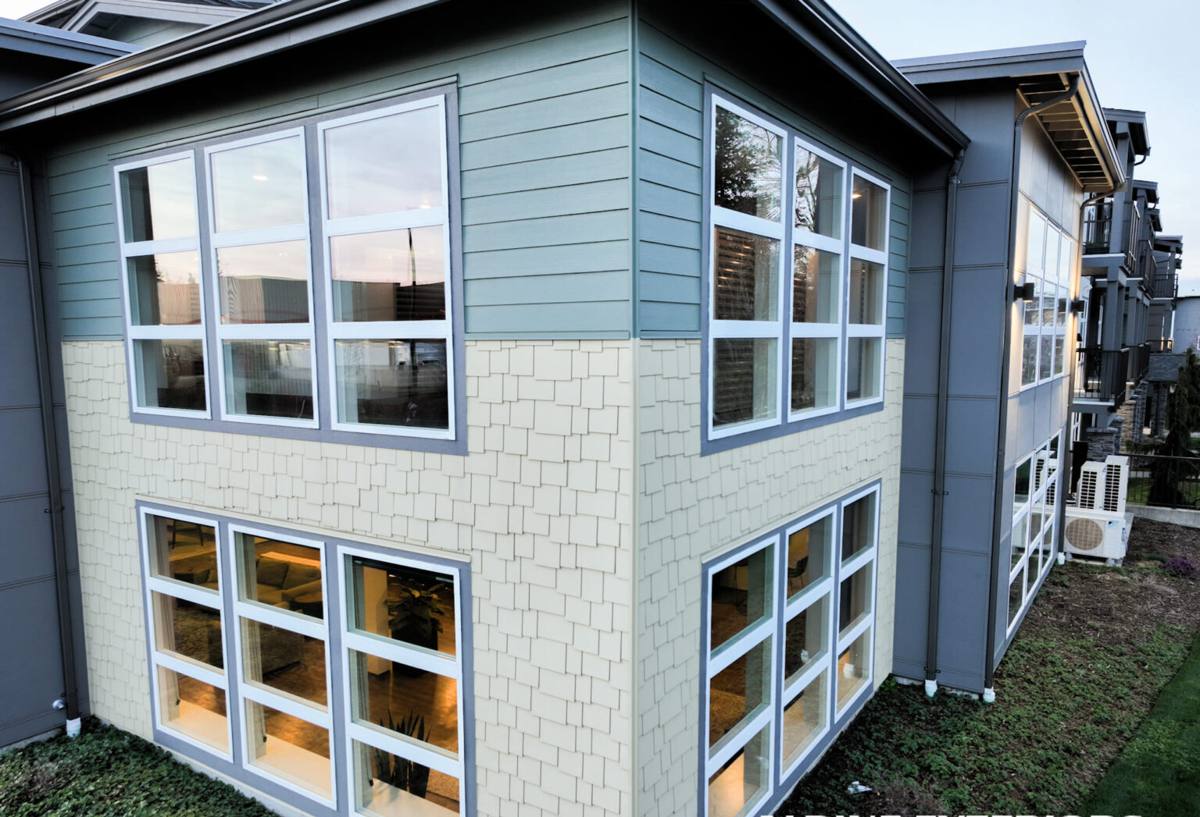
What Whatcom County Weather Actually Does to Siding
It helps to understand the specific failure modes before talking about the fix. In this part of Washington, siding doesn't usually fail all at once — it fails slowly, at the seams and the transitions, in ways that aren't obvious from the ground.
Moisture Intrusion at Joints and Penetrations
Driving rain doesn't just fall straight down — wind pushes it sideways and up under laps, around window trim, and into any gap that wasn't properly flashed. Once water gets behind the siding, it doesn't dry out quickly in our climate. That's when you get rot in the sheathing, staining, and eventually siding that separates from the wall.
Moss and Organic Growth
Shaded north-facing walls, tree cover, and consistent moisture create ideal conditions for moss, algae, and mildew to take hold on siding surfaces. Some materials resist this better than others. Wood-based products in particular can hold moisture at the surface long enough for growth to get established, which accelerates surface breakdown over time.
Salt Air and Coastal Exposure
Even a few miles inland, salt-laden moisture in the air can accelerate corrosion on fasteners and hardware, and it degrades some paint and coating systems faster than a standard inland climate would. Siding and trim need finishes and fastening systems that are built to handle that exposure, not just cosmetic paint.
What a Correct Siding Installation Actually Involves
The siding itself only does part of the job. Most of the failures we get called out to inspect trace back to installation shortcuts, not the product. A correct installation includes:
- A continuous, properly lapped weather-resistive barrier behind the siding — not just wrap that's stapled up and left with gaps at seams
- Correct flashing at every window, door, and roof-to-wall transition, installed in the right sequence so water sheds outward, not inward
- Proper fastening into structural framing, at the manufacturer's specified pattern and spacing — not just enough nails to hold the board up
- Correct clearance between the bottom of the siding and grade, decks, patios, and roof lines, so splash-back and standing moisture can't wick into the material
- Caulking used as a secondary defense at specific joints, never as the primary barrier against water intrusion
- Factory-finished or properly field-finished cut edges, since an unsealed cut edge is one of the most common places moisture gets in
Skip any one of these steps and you can end up with a siding system that looks fine for a year or two and then starts failing from the inside out, well before the material itself was supposed to wear out.
Why We Install James Hardie Fiber Cement — and Nothing Else
We made a decision a while back to install one siding system: James Hardie fiber cement. Not vinyl, not LP SmartSide, not cedar, not primed spruce, not other fiber cement brands. That's not a marketing angle — it's because of how each of those products tends to perform under exactly the conditions Lynden and the rest of Whatcom County deal with every year.
Non-Combustible and Dimensionally Stable
Fiber cement doesn't expand and contract with moisture and temperature the way wood-based products do, and it doesn't soften or warp when it stays wet for extended periods — which matters a lot during our wet season. It's also non-combustible, which is a real consideration for long-term home protection.
Climate-Engineered Product Lines
James Hardie makes region-specific HZ formulations engineered for different climate zones, including wetter, moisture-heavy regions like the Pacific Northwest. That's a meaningful difference from a generic siding board — the product is formulated with our actual weather in mind.
ColorPlus Factory Finish
Rather than relying on field-applied paint, Hardie's ColorPlus finish is baked on in a controlled factory process, which gives more consistent coverage and better resistance to fading and moisture than most site-applied paint jobs. Touch-up product is formulated to match, so repairs down the road blend in properly.
A Warranty Structure Backed by the Manufacturer
Hardie's product warranty is transferable and backed directly by the manufacturer, which matters if you ever sell the home. It's a stronger position than warranties tied to smaller regional brands or products with thinner track records in wet climates.
None of this means other products are junk — plenty of them have a place. It means that for the specific job of standing up to Whatcom County's rain, moss, and salt air over the long haul, fiber cement engineered for this climate, installed correctly, is the standard we're willing to put our name on.
Signs Your Current Siding Is Already Losing the Battle
If you're in the Lynden area and wondering whether it's time to look at replacement, these are the signs worth taking seriously:
| What You See | What It Usually Means |
|---|---|
| Persistent moss or dark streaking that returns after cleaning | Surface is holding moisture longer than it should, or drainage behind the siding is compromised |
| Soft or spongy spots when pressed | Moisture has reached the substrate — often more extensive than what's visible |
| Cracked, peeling, or chalking paint on wood or composite siding | Finish has failed and the material underneath is now exposed to weather |
| Visible gaps, warping, or bowing boards | Material is reacting to repeated wet/dry cycles — a sign of a product mismatched to this climate |
| Rust streaks near fasteners | Hardware is corroding, often accelerated by coastal air exposure |
How Our Process Works
For a Lynden siding installation, our process is straightforward and doesn't skip the steps that actually protect the home:
- On-site assessment — we look at existing siding, sheathing condition, drainage patterns, and any problem areas specific to your home's exposure
- Removal and substrate check — old siding comes off and we inspect the sheathing underneath for hidden rot or moisture damage before covering anything back up
- Weather barrier and flashing — a continuous, properly lapped barrier goes on, with flashing detailed at every window, door, and transition
- Hardie installation to manufacturer spec — correct fastening pattern, clearances, and joint treatment throughout
- Trim and finish detailing — corners, trim boards, and touch-up finishing so the job reads clean and performs as a system, not just individual boards
- Final walkthrough — we go over the finished work with you before calling the job done
What Affects Cost on a Lynden Siding Job
| Factor | Why It Matters |
|---|---|
| Home size and wall complexity | More corners, gables, and dormers mean more cutting, flashing, and labor time |
| Condition of existing sheathing | Hidden moisture damage found during removal adds repair work before new siding can go on |
| Siding profile and trim details | Lap width, board-and-batten, and trim complexity all affect material and labor |
| ColorPlus finish selection | Factory-finished color options vary in cost compared to primed-for-paint boards |
| Access and site conditions | Tight lots, landscaping, or multi-story sections can add time and equipment needs |
We don't quote exact numbers without seeing the home, but these are the real drivers behind any estimate you'll get — from us or anyone else.
Why It Matters That Your Crew Already Works This Area
A crew that regularly works Lynden and greater Whatcom County has already seen how local conditions play out over years, not just during installation. That means recognizing which wall orientations tend to hold moisture, understanding how moss and algae behave on different exposures, and knowing that a detail that's optional in a drier climate isn't optional here. It also means being available for warranty follow-up and maintenance questions without you having to track down an out-of-area contractor. Being based in Ferndale, we're not driving in from across the state for a single job and then disappearing — this is the region we work in day to day.
Simple Maintenance That Extends the Life of Correctly Installed Siding
- Rinse siding annually, especially shaded or north-facing walls prone to moss
- Keep gutters clear so overflow doesn't run down the siding face repeatedly
- Trim back vegetation and tree limbs that keep sections of wall shaded and damp
- Inspect caulking at trim and penetrations every year or two and touch up as needed
- Address any impact damage or cracked boards promptly rather than waiting
Correctly installed James Hardie siding is genuinely low-maintenance compared to wood-based alternatives, but "low-maintenance" isn't "no-maintenance" — a little attention each year goes a long way in this climate.
Get a Straight Answer on Your Siding
If you're weighing a siding replacement in Lynden or anywhere else in the Ferndale area, we're happy to take a look and give you an honest read on what your home actually needs — no pressure, no inflated scare tactics. Fill out the form below to schedule a free estimate.