 Ferndale Siding
 Deck Building for Lummi Nation's Waterfront Climate
Homes around Lummi Nation sit close to the water, and that changes what a deck needs to survive. Between the salt-laden air coming off Bellingham Bay and the Strait of Georgia, the long stretches of driving rain that roll through Whatcom County every fall and winter, and a moss season that can last from October through April, an outdoor deck here is under more pressure than one built inland. A deck that would hold up fine in a drier part of the state can start showing problems within a few years out here if it wasn't built with this specific environment in mind.
This page is about deck building specifically for Lummi Nation properties — what the local climate does to decks over time, what a correctly built deck involves in this setting, and how we approach the job when we're building or replacing a deck for a homeowner in this area.
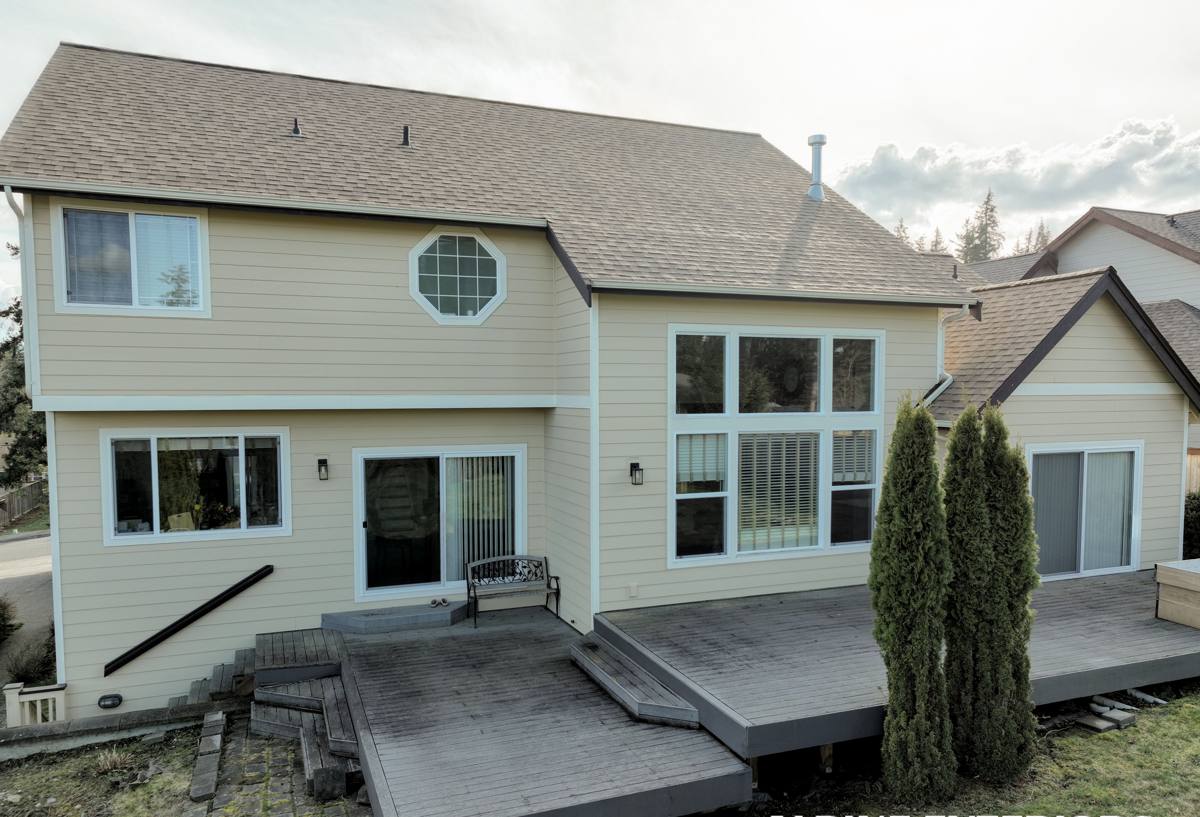
What Salt Air and Marine Moisture Actually Do to a Deck
Salt air isn't just a coastal cliché — it's a real, ongoing chemical process. Airborne salt accelerates corrosion on anything metal, and it settles into wood grain and finishes over time, which changes how a deck ages compared to one built further from the water.
Hardware and Fasteners
The single biggest mistake we see on older decks near the water is fasteners and connectors that were never rated for a marine or coastal environment. Standard hot-dip galvanized hardware can start corroding faster than expected when it's exposed to salt air year-round, especially at joints where moisture sits. Screws that streak and stain the decking around them, joist hangers that rust and weaken, and bolts that seize up are all signs of hardware that wasn't matched to the environment it's living in.
Wood Movement and Finish Breakdown
Wood expands and contracts with moisture regardless of location, but the combination of salt air and near-constant humidity here speeds up the cycle. Finishes break down faster, grain can raise and roughen sooner than the manufacturer's timeline suggests, and any spot where water can sit — a low board, a poorly sealed cut end — becomes a weak point faster than it would in a drier climate.
Rain Volume and Drainage: Where Whatcom County Decks Actually Fail
It's rarely the decking boards themselves that fail first. It's what's underneath and around them. Whatcom County gets sustained, driving rain for months at a stretch, and a deck that doesn't manage that water correctly will develop problems in the framing long before the surface looks bad.
Ledger Board Attachment
The ledger board — where the deck attaches to the house — is the single most common source of hidden rot on decks in this region. If flashing wasn't installed correctly, or if the ledger was fastened directly against siding without proper waterproofing, water works its way behind the board and into the house's structure over months and years. This is often invisible until the deck starts to feel spongy or pull away from the house.
Joist and Beam Protection
Framing lumber that isn't properly rated or protected for ground contact and sustained moisture will rot from the inside before the surface shows it. Joist tape, correctly rated fasteners, and lumber graded for the exposure it's actually going to face matter more here than in a lot of the country.
Post Footings
Saturated soil around footings, common in a wet winter, can lead to movement if footings weren't set deep enough or with the right drainage around them. A deck that shifts slightly every winter and settles back in spring is a sign the footings weren't sized or placed correctly for the ground conditions.
Choosing Decking Material for This Environment
There's no single "right" material for every home, but each option carries real trade-offs once you factor in salt air, rain volume, and moss. We walk homeowners through this honestly rather than pushing whatever is easiest to install.
| Material | How It Handles This Climate | Maintenance Burden |
|---|---|---|
| Pressure-treated lumber | Affordable and structurally solid if properly installed and finished; needs consistent re-sealing to resist the rain volume here | Higher — annual inspection and periodic refinishing |
| Cedar | Naturally rot-resistant and handles moisture well, but salt air and UV will gray and weather it faster without upkeep | Moderate to high — periodic cleaning and sealing |
| Composite decking | Resists moisture absorption and won't rot; some early-generation composites held moss and algae more than expected in damp climates | Lower — occasional cleaning, no sealing |
| PVC/capped composite | Fully moisture-sealed surface, best resistance to salt air staining and algae growth of the manufactured options | Lowest — periodic washing |
Our standard is to match the material to the specific spot on the property — how exposed it is to wind-driven rain, how much shade and moisture it holds, and how much upkeep the homeowner actually wants to commit to. We don't default to whichever product is easiest for us to install; we tell you the honest maintenance trade-off for each option before you decide.
Moss, Algae, and the Long Wet Season
A moss season that runs half the year is one of the more underestimated factors in deck longevity here. Moss and algae hold moisture against the surface of a deck board, which slows drying time after every rain and creates a surface that's both slippery and quietly damaging over time.
Two things matter most for keeping moss from taking over a deck long-term:
- Airflow and sun exposure — decks built in constant shade with poor airflow underneath will always fight moss harder than ones with better exposure, so layout and orientation matter at the design stage, not just after the fact
- Surface texture and material choice — some wood grains and composite textures hold spores and moisture more than smoother, denser surfaces
- Gap spacing between boards — correct spacing lets water drain through instead of pooling on the surface, which directly affects how fast moss and algae can establish
No deck material is moss-proof in this climate. The goal is building one that dries out fast enough between rain events that moss and algae never get a real foothold, and that's a function of design and installation, not just the product label.
Permitting and Jurisdiction Near Lummi Nation
Building on or near Lummi Nation land can involve permitting and jurisdictional requirements that differ from a standard Whatcom County building permit, depending on exactly where the property sits and how it's classified. We don't guess on this — before any project starts, we confirm with the homeowner what jurisdiction and permitting process actually applies to that specific property, and we build to whatever code and inspection requirements are in force there. If you're not sure which rules apply to your property, that's a conversation worth having before design work starts, not after.
How We Approach a Deck Build Here
Every deck we build in this area follows the same core process, adjusted for the specific site conditions — exposure to wind and rain, existing drainage, soil conditions, and how the structure ties into the house.
- Site assessment — we look at sun exposure, prevailing wind and rain direction, drainage patterns, and soil before recommending anything
- Design and material selection — matched to how exposed the deck will be and how much maintenance the homeowner wants long-term
- Ledger and flashing — done correctly the first time, since this is the most common point of hidden failure
- Framing with rated hardware — fasteners and connectors chosen for coastal and marine-adjacent exposure, not just whatever is standard stock
- Footings sized for local soil and moisture conditions — set to resist the movement that comes with saturated winter ground
- Final grading and drainage check — confirming water moves away from the structure, not toward it
A few things we always check before calling a deck finished:
- Ledger flashing is fully sealed and integrated with the house's existing water management, not just caulked over
- All structural hardware is rated for the exposure the deck will actually see, not generic interior-grade stock
- Board spacing allows proper drainage and airflow underneath
- Footings are set below frost depth and account for local soil drainage
- Any area with reduced sun exposure has been flagged to the homeowner as a higher-maintenance zone for moss and algae
Why Local Experience on Lummi Nation Projects Matters
A crew that mostly builds decks in drier, inland parts of the state will default to methods that are perfectly fine there and undersized here. The difference shows up two to five years in — not on day one — when hardware starts corroding, a ledger board starts leaking, or moss takes over a section that never gets enough sun. Building correctly for salt air, sustained rain, and a long moss season isn't a different skill set, but it does require treating those conditions as the default, not an afterthought. That's the standard we hold every deck build in this area to, whether it's a full replacement or new construction.
If you're planning a new deck or need to replace one that's showing its age, we're happy to take a look and give you a straightforward, no-pressure estimate. Use the form below to get in touch and we'll go from there.