 Ferndale Siding
 Roof Repair Built for Kendall's Climate
Kendall sits inland from Ferndale in Whatcom County, but it shares the same weather pattern that wears down roofs across this part of Washington: long stretches of damp, overcast weather, driving rain that comes in sideways during fall and winter storms, and a moss season that can run eight months or longer. Add in the salt-tinged air that moves inland off the Strait of Georgia and Bellingham Bay, and you've got a combination that ages roofing material faster than most homeowners expect. A roof that would last decades in a dry climate can develop real problems here in half that time if it isn't maintained and repaired correctly.
We do roof repair work throughout the Ferndale area, including Kendall, and we've seen the same failure patterns come up again and again on local homes. This page walks through what those problems look like, what a correct repair actually involves, and how to tell a real fix from a patch job that will fail again in a year or two.
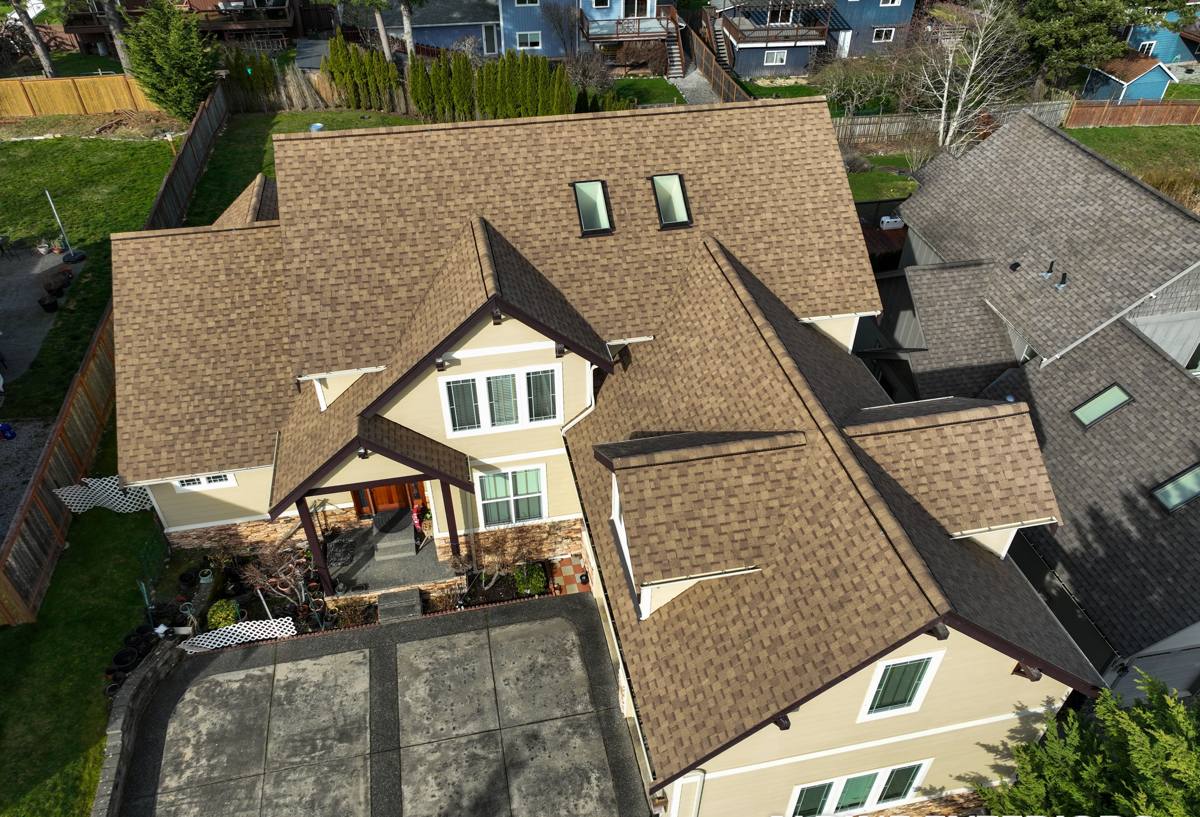
Why Kendall Roofs Take Extra Punishment
Moss and Moisture
Moss doesn't just look bad — it holds moisture against the roof surface long after the rest of the roof has dried out. On asphalt shingles, that trapped moisture accelerates granule loss and lets algae and moss roots work their way under shingle edges, lifting them and breaking the seal that keeps water out. On older wood shake or shingle roofs, moss can trap enough moisture to promote rot in the wood itself. Kendall's tree cover and shaded rooflines make moss growth worse than it is on more open, sun-exposed lots, so roofs here often need more frequent moss treatment and inspection than the regional average.
Driving Rain and Wind-Driven Water
Straight-down rain is easy for a roof to shed. Driving rain — the kind that comes in at an angle during a winter storm — is what actually finds the weak points. It pushes water up under shingle tabs, through poorly sealed flashing, and into any gap around a vent pipe, chimney, or skylight. A roof can look fine from the ground and still have several spots where wind-driven rain is getting past the surface layer and into the roof deck underneath.
Salt Air and Metal Fatigue
Salt-laden air doesn't stop at the coastline — it travels inland with prevailing winds and settles on exposed metal. Flashing, fasteners, gutter hardware, and any exposed metal roofing components are the first things to show it, usually as pitting, rust streaks, or premature corrosion. Once flashing starts to corrode, it stops doing its job of keeping water out of the seams and transitions where the roof is most vulnerable — around chimneys, valleys, and wall intersections.
Common Repair Calls We See in This Area
- Lifted or missing shingles after a windstorm, often concentrated on one exposed slope
- Soft or spongy spots on the roof deck from long-term moisture intrusion
- Moss buildup along shaded valleys and north-facing slopes
- Rusted or failing flashing around chimneys, skylights, and vent pipes
- Interior ceiling stains that trace back to a small, hard-to-spot leak point
- Gutter and downspout backups that push water under the roof edge
- Granule loss and thinning on older asphalt shingle roofs
What a Correct Repair Actually Involves
A lot of "roof repair" in this region amounts to a quick patch — a dab of sealant over a visible gap, or a shingle nailed back down without addressing what caused it to lift in the first place. That kind of fix might buy a season, but it rarely lasts through a full Whatcom County winter. Our approach starts with figuring out why the failure happened, not just where it's showing.
1. Find the Real Source
Leaks are notorious for showing up far from where the water actually enters. Water can travel along a rafter or along the underside of the deck before dripping somewhere inside the house. We trace the path back to the actual entry point — a lifted shingle, a cracked pipe boot, failed flashing — rather than treating the symptom.
2. Address the Roof Deck, Not Just the Surface
If water has been getting in for a while, the plywood or OSB deck underneath may be soft, delaminated, or rotted. Patching shingles over a compromised deck doesn't hold — the new material has nothing solid to seal to. Any section of deck that's been weakened needs to be cut out and replaced before new roofing goes down.
3. Match Materials and Technique to What's There
Repairs need to tie into the existing roofing system correctly — proper shingle overlap, correct nailing pattern, compatible flashing metal, and underlayment that ties into the surrounding field rather than just sitting on top of it. A repair that doesn't integrate properly with the existing roof often creates a new leak point right at its own edge.
4. Treat the Cause, Not Just the Damage
If moss caused the failure, we address the moss — not just the shingle it damaged. If poor attic ventilation is driving condensation that's rotting the deck from underneath, that gets flagged too. A repair that ignores the underlying cause is a repair you'll be paying for again.
Repair vs. Replacement: How We Help You Decide
| Factor | Repair Usually Makes Sense | Replacement Is Often Better |
|---|---|---|
| Age of roof | Under 15–20 years, otherwise sound | Nearing or past expected service life |
| Extent of damage | Isolated to one area or a few spots | Widespread across multiple slopes |
| Deck condition | Solid, dry, structurally sound | Soft, rotted, or repeatedly rebuilt |
| Shingle condition elsewhere | Still flexible, granules intact | Brittle, curling, heavy granule loss overall |
| Repair history | First or second repair on this roof | Repeated repairs to the same areas |
We won't push a full replacement when a solid repair will genuinely hold. But we also won't recommend a patch on a roof that's clearly past the point where repairs make financial sense — that's just delaying a bigger bill and risking interior damage in the meantime.
Flashing and Ventilation: The Parts Homeowners Miss
Most roof leaks in this climate trace back to flashing or ventilation rather than the shingles themselves. Flashing is the metal that seals transitions — where a roof meets a chimney, a wall, a valley, or a vent pipe. It's a small part of the total roof area but responsible for a disproportionate share of leaks, especially once salt air and years of freeze-thaw cycling start to corrode it. Ventilation matters just as much: a poorly ventilated attic traps warm, moist air against the underside of the roof deck, which leads to condensation, rot, and shortened shingle life from the inside out — sometimes even when the outside of the roof looks fine. Any thorough repair should include a look at both, not just the visible shingle damage.
Our Process for Kendall Roof Repair
- Inspection. We get on the roof (or use a close visual inspection when access or conditions don't allow it) and check the deck, flashing, ventilation, and shingle condition — not just the spot you called about.
- Honest assessment. We tell you what we found, what's causing it, and whether a repair will actually hold or whether you're better off putting that money toward a longer-term fix.
- Clear scope and pricing. You get a written explanation of the work before we start — no surprise add-ons once we're up there.
- The repair itself. We match materials to your existing roof, replace any compromised decking, and correctly integrate new flashing and underlayment with the surrounding roof system.
- Follow-up. We check our own work after the next significant rain when it's practical, and we stand behind the repair.
What to Check Before You Call Anyone
- Interior stains on ceilings or upper walls, especially after a storm
- Visible moss buildup, particularly on shaded or north-facing slopes
- Shingles that look lifted, cracked, or missing from the ground
- Rust streaks running down from flashing or vent pipes
- Sagging or uneven roof lines, which can point to deck damage underneath
- Granules collecting in gutters or at the base of downspouts
If you see any of these, it's worth having it looked at before the next big rain rather than after.
Why a Crew That Already Works Kendall Matters
Roofing crews that work Whatcom County regularly know how local roofs actually fail — which slopes hold moss longest, how far salt air travels inland in this area, and which flashing details tend to give out first under our particular mix of wind, rain, and damp shade. That local pattern recognition speeds up diagnosis and helps avoid repairs that look fine on paper but don't hold up to another Ferndale-area winter. It also means we're a known, reachable crew if a repair ever needs a follow-up visit, rather than an outfit that did one job and moved on to the next county.
If you're dealing with a leak, storm damage, or a roof that just needs an honest once-over, we'd be glad to take a look. Reach out for a free, no-pressure estimate using the form below — we'll tell you straight what we find and what it would take to fix it right.