 Ferndale Siding
 Why Lynden Homes Need Siding Built for This Climate
Lynden sits inland from the coast but still lives inside Whatcom County's marine-influenced weather pattern: long stretches of driving rain from fall through spring, humidity that never fully lets up, and a moss season that can run half the year on shaded or north-facing walls. Add the salt-tinged air that rolls in off Bellingham Bay and the Strait of Georgia, and you have a combination that is genuinely hard on exterior building materials. Siding here isn't just a cosmetic choice. It's the single largest surface protecting a home's framing, sheathing, and insulation from moisture intrusion, and it has to do that job through dozens of freeze-thaw cycles and hundreds of soak-and-dry cycles every year.
This page is specifically about installing James Hardie fiber cement siding on homes in the Lynden area. We're not going to cover every siding product on the market or every neighborhood we work in — just what Lynden homes need, what correct Hardie installation looks like here, and why the details matter more in this climate than in a drier one.
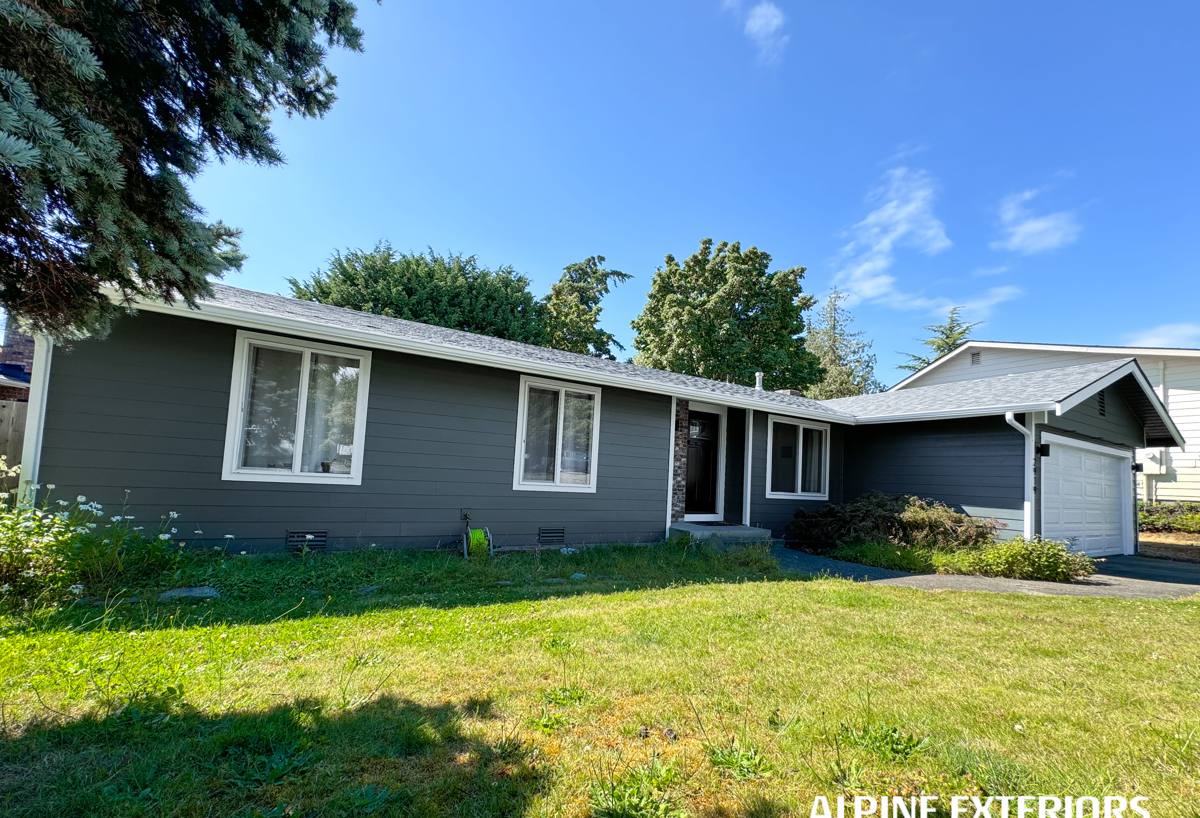
What Salt Air, Driving Rain, and Moss Season Actually Do to Siding
Salt-Influenced Air
Even well inland from the water, airborne salt combines with moisture to accelerate corrosion on fasteners, flashing, and any exposed metal trim. Siding systems that rely on unprotected steel nails or cheap flashing tend to show rust streaking and fastener failure years before the siding panel itself would otherwise need replacement. The panel can be fine while the hardware holding it up is not.
Driving Rain
Whatcom County storms frequently come with wind, which means rain doesn't just fall — it drives sideways into wall assemblies, seams, and butt joints. A siding system with weak water-shedding detailing at laps, corners, and penetrations will let water track behind the cladding over time, even if the face of the siding looks dry. That's the kind of damage you don't see until a wall is opened up.
Moss and Sustained Moisture
Shaded elevations, tree cover, and long gray stretches without direct sun create ideal conditions for moss, algae, and mildew growth on exterior surfaces. Moss doesn't just look bad — it holds moisture directly against the siding face for extended periods, which is exactly the condition that causes swelling, delamination, and paint failure in materials that aren't engineered to handle it.
Why We Install Only James Hardie Siding in Lynden
We made a deliberate decision as a company: James Hardie fiber cement is the only siding product we install, anywhere, including here in Lynden. We don't offer vinyl, LP SmartSide, cedar, primed spruce, or other fiber cement brands. That's not a marketing angle — it's because we've weighed the real trade-offs of those products against what Whatcom County's climate demands, and Hardie is what we're willing to put our name behind.
Fiber cement is non-combustible, which matters as wildfire smoke and dry-season fire risk have become a more regular part of Pacific Northwest summers even in traditionally wet regions. It doesn't rot, doesn't attract insects, and doesn't absorb water the way wood-based products can. James Hardie specifically engineers regional product formulations (their HZ5 line is built for climates like ours) and backs the product with a factory-applied ColorPlus finish and a strong transferable warranty — meaning the coverage can follow the home to a new owner, which matters if you ever sell.
None of that means Hardie is maintenance-free or foolproof. It means that when it's installed correctly, it holds up to exactly the conditions Lynden throws at a house year after year — and when it's installed poorly, it can fail just like anything else. That's why installation quality is really the center of this whole page.
The HZ5 Product Line: Why the "Climate Zone" Detail Matters
James Hardie makes different formulations of its fiber cement for different climate zones across the country, based on freeze-thaw exposure and moisture patterns. Whatcom County falls into a zone where the HZ5 formulation is the appropriate choice — engineered for regions with more moisture cycling and cooler, wetter winters compared to the HZ10 formulation used in hot, dry climates. Installing the wrong regional formulation, or installing generic fiber cement without regard to climate zone, is one of the more common corners cut by crews unfamiliar with Pacific Northwest requirements. We install to the climate-correct specification as a baseline, not an upsell.
What a Correct James Hardie Installation Involves
The siding panel itself is only part of the system. Most siding failures we're called out to inspect on older homes trace back to installation details, not the material. A correct install in this climate means:
- Proper water-resistive barrier and rainscreen or drainage plane behind the siding, so any moisture that does get past the face has a path to drain and dry out
- Correct flashing at every window, door, and penetration — installed in the right sequence so water sheds outward and down, never inward
- Stainless steel or hot-dip galvanized fasteners rated for coastal-influenced air, not standard fasteners that will corrode faster here than in a drier inland climate
- Manufacturer-specified nailing patterns and clearances, including gaps at butt joints and minimum clearance from grade, roof lines, and decks
- Correct caulking and sealant only where Hardie's specifications call for it — over-caulking can trap moisture just as badly as under-caulking
- Factory-primed cut edges sealed on site, since a raw cut edge is the most vulnerable point on any fiber cement panel
Every one of these details is in James Hardie's published installation manual. The material performs to its rating only when the installation matches the spec — that's true of any building product, but the consequences of skipping steps show up faster in a climate that's wet as much of the year as this one is.
Our Installation Process for Lynden Homes
We follow the same disciplined sequence on every Lynden project, adjusted for the home's specific exposure (how much wall area faces prevailing wind and rain, how much shade and moss risk exists on north and east elevations, and the condition of the sheathing underneath).
| Stage | What Happens | Why It Matters in This Climate |
|---|---|---|
| Assessment | Inspect existing siding, sheathing, and moisture history; identify shaded/moss-prone elevations | Catches hidden rot or moisture damage before it's covered up again |
| Prep & tear-off | Remove old siding, repair or replace damaged sheathing | Whatcom County's rain means damaged sheathing is common on older homes |
| Weather barrier | Install water-resistive barrier and drainage plane | Gives driving rain a way to drain instead of pooling behind the wall |
| Flashing & trim | Flash all windows, doors, and penetrations before siding goes on | Prevents wind-driven rain from tracking behind openings |
| Hardie installation | Install HZ5-rated panels or lap siding per manufacturer spec, with corrosion-resistant fasteners | Matches the product to the climate zone and protects against salt-air corrosion |
| Finish & seal | Seal cut edges, apply specified caulking, final trim | Closes the last vulnerable points against moisture entry |
| Final walkthrough | Owner walkthrough and documentation of warranty coverage | Confirms the installation qualifies for full Hardie warranty terms |
What Affects the Cost of a Lynden Siding Project
Every home is different, so we won't quote a number without seeing the house, but these are the factors that most often move the price up or down on Hardie projects in this area:
| Factor | Effect on Cost |
|---|---|
| Sheathing condition underneath old siding | Hidden rot or moisture damage adds repair scope once uncovered |
| Home size and number of stories | More wall area and access complexity (staging, ladders) increases labor |
| Siding profile (lap vs. panel vs. shingle-style) | More detailed profiles and trim work take longer to install correctly |
| Number of windows, doors, and penetrations | Each one requires individual flashing work |
| Color and finish choice | Factory ColorPlus finishes vs. field-painted options affect material cost |
| Existing moss/moisture damage | Shaded, moss-heavy elevations may need extra prep or minor structural repair |
Why It Matters to Hire a Crew That Already Works in Lynden
Building codes, typical construction age, and exposure conditions vary block to block, let alone region to region. A crew that regularly works in Lynden and the surrounding Whatcom County area already knows which elevations tend to have moss problems, what kind of sheathing and moisture issues show up on homes of a certain age in this area, and how local wind and rain patterns actually behave against a wall — not just what a manual says in the abstract. That local pattern recognition shows up in small decisions during a project: where to add extra flashing attention, which elevations need closer inspection before covering them up, and how to sequence work around this region's rain windows so the weather barrier isn't left exposed longer than it should be.
It also matters for warranty support. James Hardie's transferable warranty is only as good as the installation behind it, and a local crew that's still around years later is far more useful than a name-only warranty with no one to call.
Signs an Older Home's Siding Needs Attention
If your Lynden home has original siding from decades past, a few warning signs are worth a look before problems get expensive:
- Persistent moss or algae growth that returns quickly after cleaning
- Soft spots, bubbling paint, or visible warping, especially on north-facing or shaded walls
- Rust streaking below nail heads or trim pieces
- Gaps opening up at butt joints, corners, or around window trim
- A musty smell or visible staining on interior walls that back up to exterior siding
None of these guarantee a full replacement is needed, but they're worth having looked at before they turn into sheathing or framing repairs.
Ready to Talk About Your Home
If you're weighing a siding project on a Lynden home, we're happy to take a look, walk you through what we see, and put together a straightforward estimate — no pressure, no obligation. Use the form below to get started.