 Ferndale Siding
 Custer's Climate Is Harder on Siding Than Most Homeowners Realize
Custer sits in the northwest corner of Whatcom County, close enough to the water that salt-laden air is a daily fact of life for anything on the exterior of a house. Combine that with the long, wet Pacific Northwest winters and the shoulder seasons that never seem to fully dry out, and you have a climate that quietly works against ordinary siding materials year after year. It's rarely one dramatic storm that causes the damage — it's the slow, cumulative effect of moisture, salt, and shade doing their work on a wall that never gets a real chance to dry out.
Homes around Custer also tend to sit closer to tree lines, fields, and open exposure than homes in denser parts of Ferndale proper, which means more wind-driven rain hitting siding at an angle, and more shaded north and east walls that stay damp longer after every storm. If you've owned a home out here for more than a few years, you've probably already noticed how differently the north side of the house ages compared to the side that gets afternoon sun.
The Three Forces at Work
- Salt air: Airborne salt accelerates corrosion of fasteners, trim, and any metal flashing, and it can degrade paint films faster than inland exposure.
- Driving rain: Wind-driven rain doesn't just wet the surface of siding — it tests every seam, joint, and piece of flashing on the wall, finding any weak point in the water management system.
- Moss and organic growth: Long, cool, damp seasons let moss, algae, and lichen colonize shaded siding, trapping moisture against the surface for months at a time.
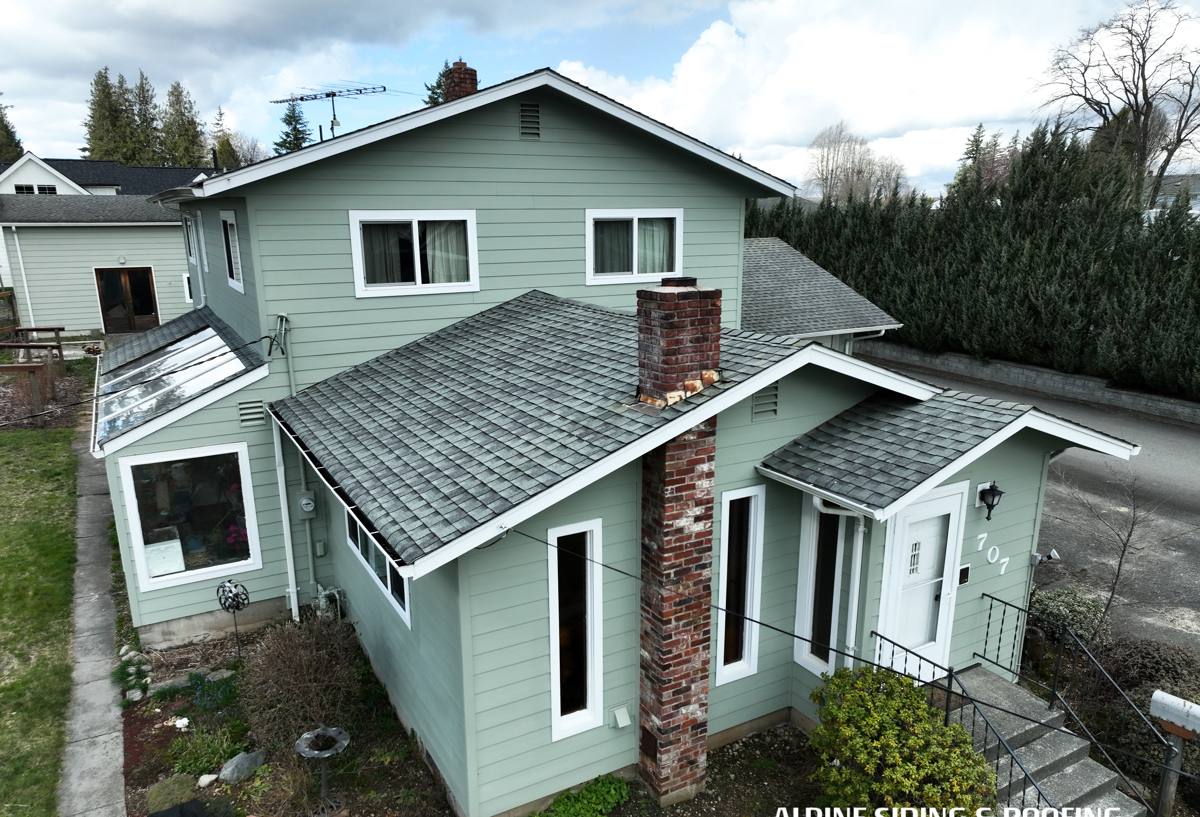
Signs a Custer Home Needs Siding Replacement, Not Just a Repair
Not every siding problem means a full replacement. But there's a point where patching stops making sense — where the underlying material has taken on enough moisture damage, or the water management behind the siding has failed enough times, that repair is just delaying a bigger repair. Knowing the difference saves homeowners money and prevents damage to the wall assembly behind the siding.
- Soft, spongy, or crumbling spots when you press on the siding, especially near the bottom of walls or under windows
- Persistent moss or algae staining that returns within a season or two of cleaning
- Visible warping, buckling, or gaps between siding pieces
- Paint that's failing in patches rather than uniformly — often a sign of moisture pushing out from behind the board
- Rot or soft wood at corner boards, window trim, or anywhere siding meets a roofline
- Rising energy bills paired with drafts, which can point to a failing weather barrier behind old siding
- Interior signs — peeling paint, musty smell, or discoloration on interior walls that share an exterior wall
If you're seeing more than one or two of these, it's worth having someone look at the wall assembly itself, not just the surface material.
Why We Install Only James Hardie Fiber Cement
We made a decision as a company to install James Hardie fiber cement siding exclusively, and we don't apologize for it or pretend it's the only reasonable choice on the market — it's simply the standard we hold ourselves to. Vinyl, LP SmartSide, primed wood, and other fiber cement brands each have their own trade-offs, and in a climate like Whatcom County's, those trade-offs matter more than they would somewhere drier and milder.
Fiber cement is non-combustible, doesn't rely on a wood substrate that can absorb and hold moisture, and holds paint and factory finishes far longer than most alternatives in a wet, salt-exposed environment. James Hardie specifically engineers regional product lines (their HZ5 formulation is built for climates like ours) and backs installations with a strong, transferable warranty when the work is done to their specification. That last part — installed to spec — is doing a lot of work in that sentence, and it's a big part of what separates a siding job that lasts decades from one that fails early.
What a Correct Siding Replacement Actually Involves
Siding replacement is not just removing old boards and nailing up new ones. The siding itself is only the visible layer — the real work, and the part that determines whether a job lasts 10 years or 40, happens underneath it.
Tear-Off and Wall Inspection
Once old siding comes off, we inspect the sheathing and framing underneath for rot, soft spots, or prior water damage. In a climate like Custer's, it's common to find some degree of moisture damage behind older siding, particularly around windows, at the base of walls, and on shaded elevations. Any compromised sheathing or framing gets addressed before new siding goes up — covering damaged wood with new siding just traps the problem.
Weather-Resistive Barrier and Flashing
A correctly installed weather barrier, properly lapped and taped, combined with correctly integrated flashing at every window, door, and roofline intersection, is what actually keeps water out of the wall. Siding sheds most water, but it's not the primary waterproofing layer — the barrier and flashing system behind it is. This is where driving rain either gets managed or gets in.
Installation to Manufacturer Spec
James Hardie siding has specific requirements for fastener type and spacing, gapping at butt joints, clearance from grade, roofline, and decks, and caulking practices. Skipping or shortcutting these details is the single most common reason fiber cement siding underperforms — it's rarely the product itself, it's the installation. Following spec is also what keeps the manufacturer's warranty intact.
Finish Work and Detailing
Trim, corner boards, caulking at joints, and touch-up painting on cut edges finish the job and protect the cut ends of the board, which is where fiber cement is most vulnerable to moisture intrusion if left unsealed.
Our Process, Start to Finish
- Free on-site estimate: We look at your specific walls, exposure, and existing siding condition, and give you a straightforward assessment — no pressure, no inflated scope.
- Detailed proposal: Product line, color, trim details, and cost broken out clearly, so you know exactly what you're paying for.
- Tear-off and inspection: Old siding removed, sheathing and framing inspected and repaired as needed.
- Weather barrier and flashing installation: The part of the job that does the real waterproofing work.
- Hardie siding installation to spec: Correct fasteners, gapping, and clearances throughout.
- Finish work: Trim, caulking, and touch-up.
- Final walkthrough: We go over the finished work with you before calling the job done.
Cost Factors for Custer Siding Replacement
Every home is different, and we won't quote a number without seeing the walls, but a few factors consistently move the price up or down on jobs in this area.
| Factor | Why It Matters |
|---|---|
| Extent of hidden moisture damage | Rot or compromised sheathing found during tear-off adds repair scope before new siding can go up |
| Home size and wall complexity | More corners, dormers, and roofline intersections mean more flashing and labor |
| Siding profile and trim selection | Lap width, trim board size, and finish detail level affect material and labor cost |
| Existing siding removal | Multiple layers of old siding or difficult removal (e.g., over old masonry-look products) adds time |
| Access and site conditions | Steep grades, limited access, or tall walls affect scaffolding and staging needs |
James Hardie Product Lines That Fit This Climate
James Hardie makes several siding profiles, and the right one depends on the look you want and the specific exposure of your home.
| Product | Best For |
|---|---|
| HardiePlank lap siding | The classic, most common choice — traditional horizontal lap look, wide range of colors |
| HardiePanel vertical siding | Board-and-batten or modern vertical looks, often paired with lap siding as an accent |
| HardieShingle | Staggered or straight-edge shingle look for accent areas or full-facade coastal styling |
| HardieTrim | Corner boards, window and door trim, fascia — finishes the job and protects edges |
For our region, we specify Hardie's HZ5 formulation, engineered for climates with significant moisture exposure, which describes Whatcom County well. ColorPlus factory-applied finishes are also worth serious consideration for homes out here — a factory-baked finish holds up to sun, salt air, and repeated wet-dry cycles better than field-applied paint, and it comes with its own finish warranty.
Why It Matters to Hire a Crew That Already Works in Custer
Siding installation isn't identical everywhere. A crew that mostly works in drier inland climates may not think twice about flashing details or clearance heights that matter a great deal here. A crew familiar with Custer and the surrounding parts of Whatcom County already knows which walls tend to take the worst weather, where moss and moisture problems typically show up first, and how to detail a job so it holds up to salt air and driving rain rather than just looking good on installation day.
Local experience also means faster, more accurate estimates — we're not guessing at how this climate treats a wall, we're seeing it on houses near yours on a regular basis.
Maintaining Your New Siding
Correctly installed James Hardie siding is low-maintenance, but "low-maintenance" isn't "no-maintenance," especially in a climate that grows moss on anything that sits still.
- Rinse siding annually, focusing on shaded, north-facing, and tree-covered walls where moss and algae take hold first
- Keep gutters clear so overflow doesn't run down the face of the siding
- Trim back vegetation and tree limbs that keep walls shaded and damp
- Inspect caulking at trim and joints every year or two and re-caulk if it's cracked or pulling away
- Address any paint or finish damage promptly, since exposed cut edges are the most vulnerable point on fiber cement siding
If your Custer home's siding is showing signs of wear, moisture damage, or persistent moss, we're happy to take a look and give you an honest, no-pressure assessment. Fill out the form below for a free estimate.