 Ferndale Siding
 Decking That Has to Survive Birch Bay, Not Just Look Good on Day One
Birch Bay sits right on the water, and that changes what a deck has to put up with compared to a yard a few miles inland. Salt-laden air off the bay works on metal fasteners and rail hardware year-round. Driving rain off Puget Sound and the Strait finds its way into anything that isn't detailed correctly. And the long, damp Whatcom County shoulder seasons mean moss and algae have months to gain a foothold on any surface that stays wet. A deck built for a dry inland climate doesn't automatically hold up here — the fasteners, the fastening pattern, the airflow underneath, and the board profile all matter more in Birch Bay than they would twenty miles east.
We're a Ferndale-based crew, and Birch Bay is part of our regular service area, not a once-in-a-while trip. That matters for a project like decking, where the difference between a deck that looks right for two years and one that performs for twenty comes down to details most homeowners never see until something fails.
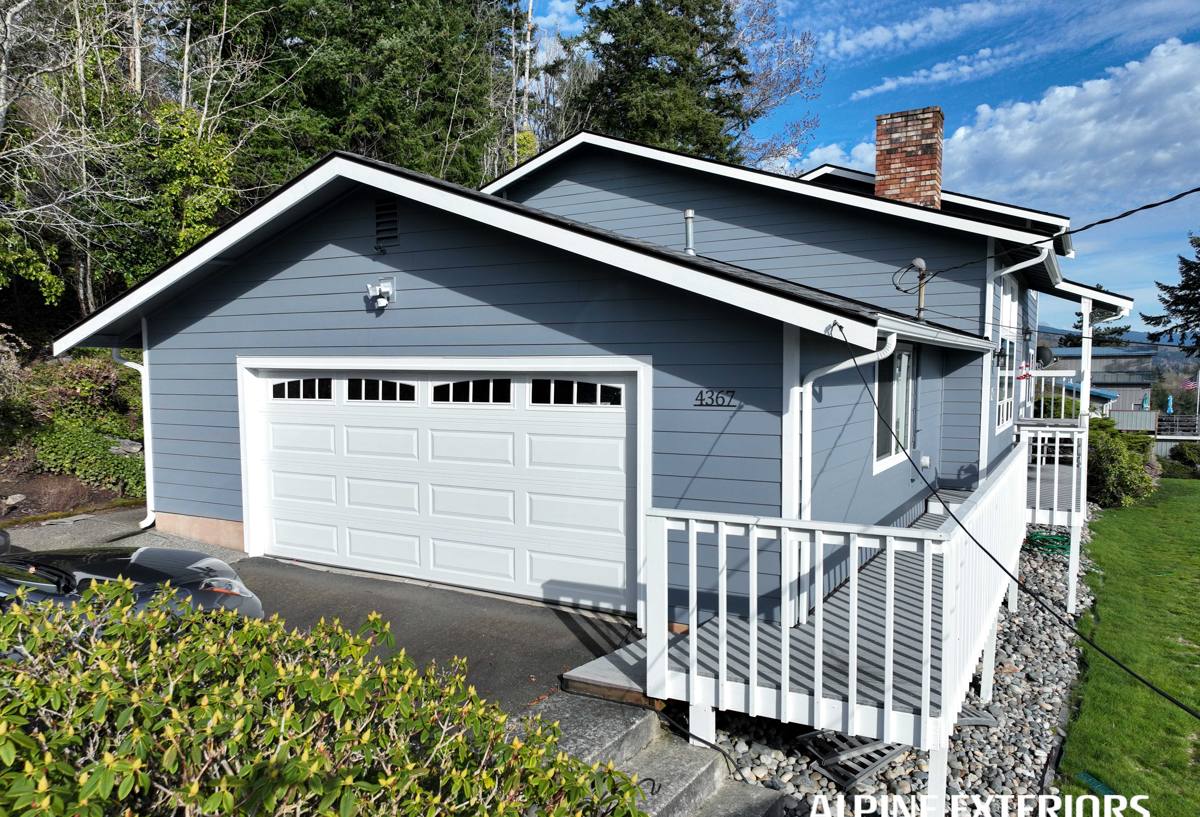
What Birch Bay's Climate Actually Does to a Deck
Salt Air and Hardware
Homes closer to the water get a steady dose of salt-carrying air, even without direct ocean spray. Over time this accelerates corrosion on anything that isn't rated for it — cheap deck screws, un-coated joist hangers, and mismatched hardware all show rust and staining faster near the bay than they would further inland. This isn't a defect in the composite board itself; it's a hardware and fastener problem, and it's fixable by spec'ing the right materials up front.
Driving Rain and Water Management
Storms coming off the water tend to drive rain sideways, not just straight down. That means water gets pushed into gaps, seams, and the underside of rail posts that a calmer inland rain might never reach. A deck that isn't detailed for driving rain — proper flashing where it meets the house, correct board spacing, drainage that actually moves water off the structure — will show it in soft framing and staining well before the composite decking itself is the problem.
Moss, Algae, and the Long Damp Season
Whatcom County's wet season runs long, and Birch Bay's proximity to the water keeps humidity and surface moisture elevated even on days it isn't actively raining. Any deck surface — wood or composite — that doesn't get airflow underneath or occasional sun exposure will host moss and algae growth faster here than in a drier climate. Composite decking resists rot in a way wood can't, but it isn't immune to surface growth if the structure traps moisture against it.
Why Composite Makes Sense for This Location
We recommend composite decking for Birch Bay properties more often than not, and it's not a marketing position — it's a practical one given what the site conditions actually demand.
- No wood grain for moisture to wick into and hold, which slows the surface growth that's common near the water
- No annual staining or sealing cycle, which matters when the weather window for outdoor maintenance work is already short in this climate
- Consistent color and density across the board, so damp shaded areas under trees or on the north side of a house don't age differently than sun-exposed sections
- Better long-term dimensional stability in a climate with big swings between soaked winter conditions and dry summer stretches
Composite isn't maintenance-free — surface cleaning is still part of ownership here — but it removes the failure points that wood decking runs into fastest in a marine-influenced climate: splintering, rot at fastener points, and the endless refinishing cycle.
What a Correct Composite Deck Build Involves
Substructure First
The framing underneath is where most long-term deck problems actually start, and it's invisible once the job is done. For Birch Bay sites we pay particular attention to:
- Joist protection — a moisture barrier tape or coating on top of the joists so trapped water isn't sitting directly against structural lumber
- Fastener and hardware selection rated for coastal or high-moisture exposure, not the minimum-code option
- Ledger board flashing where the deck ties into the house, since this is the single most common source of hidden rot on any deck near the water
- Joist spacing and blocking appropriate to the specific composite product, since composite boards have their own span requirements that differ from dimensional lumber
Airflow and Drainage Underneath
A deck built low to the ground or without cross-ventilation underneath will trap the kind of persistent dampness that speeds up moss growth on the surface above. Where grading and height allow, we build in clearance and skirting details that let air move, rather than sealing the underside off completely.
Board Layout and Fastening
Correct board spacing accounts for both composite's thermal expansion and the drainage needs of a wet climate — too tight and water sits on the surface longer than it should; too loose and it looks and feels wrong underfoot. Hidden fastener systems, used correctly, keep the surface clean and reduce the exposed metal points that salt air tends to attack first.
Comparing Decking Approaches for a Birch Bay Property
| Factor | Composite Decking | Pressure-Treated Wood |
|---|---|---|
| Moisture/rot resistance | High — core resists rot even in sustained damp conditions | Moderate — treatment slows rot but doesn't stop it long-term |
| Surface moss/algae | Resists better with proper airflow; still needs periodic cleaning | More prone to surface growth, especially in shaded or low-airflow areas |
| Maintenance cycle | Occasional wash; no staining or sealing required | Sealing or staining every 1-3 years to hold up in this climate |
| Fastener/hardware sensitivity | Lower — board itself isn't affected by hardware corrosion | Higher — corroding fasteners can streak and stain the wood |
| Upfront cost | Higher material cost | Lower material cost |
| Long-term cost over 15-20 years | Generally lower once maintenance labor is factored in | Generally higher once repeated maintenance is factored in |
Cost Factors Specific to This Job
Every Birch Bay deck project is different, but a few factors consistently move the price more than homeowners expect:
| Factor | Why It Matters Here |
|---|---|
| Deck height and grading | Sites with limited underdeck clearance need extra ventilation detailing to manage moisture |
| Proximity to water/salt exposure | Closer properties warrant upgraded fastener and hardware specs |
| Existing structure condition | Older wood decks near the bay often have hidden joist or ledger damage that needs repair before new decking goes on |
| Rail and stair system | Composite rail systems and stair complexity add labor beyond the deck surface itself |
| Access for demolition/hauling | Waterfront and bluff-adjacent lots sometimes limit equipment access, affecting labor time |
We give straightforward, itemized estimates rather than a single vague number, so homeowners can see exactly what's driving the cost on their specific site.
Our Process on a Birch Bay Deck Project
- On-site assessment — we look at the existing structure (if there is one), grading, sun/shade exposure, and proximity to the water to understand what the site actually needs
- Substructure evaluation — any rot, undersized framing, or inadequate ledger flashing gets identified and priced separately from the decking itself, so nothing is a surprise mid-project
- Material selection — we walk through composite board and rail options suited to the site's exposure level, not just the showroom favorite
- Build — framing repairs or upgrades first, then moisture barrier, then decking installed with fastener and spacing specs matched to the product and the climate
- Final walkthrough — we go over basic care so the deck holds up, including simple seasonal cleaning to keep moss and algae from taking hold
Why a Crew That Already Works Birch Bay Matters
Framing and fastener specs that work fine in a drier part of Whatcom County can fall short right on the water. A crew that regularly works Birch Bay and the surrounding Ferndale area already knows which details matter here — the flashing points that fail first in driving rain, the hardware grade worth spending a little more on given the salt air, and how much airflow a given lot's grading actually allows underneath a new deck. That local pattern recognition is the difference between a deck that's built to a generic spec sheet and one that's built for the specific conditions a Birch Bay property deals with every year.
If you're considering a new composite deck or replacing an aging wood deck in Birch Bay, we're glad to come take a look and give you a straightforward, no-pressure estimate — just fill out the form below.