 Ferndale Siding
 Building Decks for the Blaine Area's Coastal Climate
Homes in and around Blaine sit close to the water — Semiahmoo Bay, Drayton Harbor, and the broader Salish Sea shoreline are never far away. That proximity is part of why people love living here, but it's also exactly why decks in this part of Whatcom County fail faster than decks built the same way fifty miles inland. Salt-laden air corrodes fasteners and hardware from the inside out, long wet seasons keep wood surfaces damp for months at a time, and the moss and algae that thrive in our shoulder seasons turn untreated boards slick and, eventually, structurally soft. A deck built to a generic national spec sheet is not built for Blaine. One built by a crew that already services this stretch of the county is a different product entirely.
We're a Ferndale-based crew that works Blaine regularly, so this isn't theoretical for us — it's the difference between a deck we're comfortable standing behind in year one and a deck we're comfortable standing behind in year fifteen.
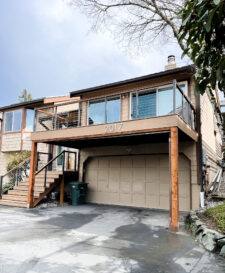
What Salt Air Actually Does to a Deck
Salt air doesn't just make metal rust faster — it accelerates a specific kind of corrosion called galvanic and pitting corrosion, and it does most of its damage where you can't see it: inside joist hangers, around fastener heads, and at the ledger board connection to the house. A deck can look fine on the surface for years while its hidden hardware is quietly failing underneath.
Where the damage shows up first
- Fastener heads and screw threads, especially where coatings are thin or scratched during installation
- Joist hangers and structural connectors, particularly at bent corners and nail holes
- Railing post hardware and any exposed bolts or brackets
- Ledger flashing where it meets the house siding
- Any dissimilar-metal contact points, where one metal accelerates corrosion in the other
The fix isn't complicated, but it does cost more up front: stainless steel or heavy-duty coated fasteners rated for coastal exposure, connectors rated for the same, and careful attention to any point where two different metals touch. It's a small percentage increase in material cost for a large increase in how long the structural bones of the deck actually last.
Driving Rain and Where It Actually Gets In
Whatcom County rain isn't always gentle. When it comes in sideways off the water, it finds every gap a deck wasn't built to shed water from — and the ledger connection to the house is the single most important detail to get right, because that's the spot where a water problem becomes a house problem instead of just a deck problem.
The details that keep water out
- Ledger flashing: a properly lapped, corrosion-resistant flashing system between the deck ledger and the house wall, integrated with the existing siding drainage plane rather than just caulked over it
- Board spacing and drainage: gapping that lets water pass through instead of pooling on the surface
- Post base drainage: post bases set to keep end grain off standing water, whether the posts are wood or composite-wrapped
- Slope: a slight pitch away from the house on the framing itself, not relied upon from the decking alone
Caulk is not flashing. We see decks that were "sealed" with caulk at the ledger instead of properly flashed, and that's usually the first place we find rot when we're called out to look at an older deck.
Moss, Algae, and the Long Wet Season
Western Washington's moss season is long, and a deck that stays shaded or doesn't get enough airflow underneath will grow moss and algae on its surface almost every winter. Beyond being a slip hazard, sustained moss growth holds moisture against the board surface, which shortens the life of both wood and some composite products if the wrong material was chosen for the site.
| Site Condition | What It Means for the Deck |
|---|---|
| Shaded, low-airflow site | Higher moss/algae risk — favors composites with mold-resistant caps, or wood with a real maintenance commitment |
| Open, wind-exposed site near the water | Higher fastener and hardware corrosion risk — favors stainless hardware regardless of decking material |
| Tree cover overhead | Debris buildup between boards — favors wider board gapping and easier-to-clean profiles |
| Low clearance to grade | Poor underdeck airflow — favors venting or elevated framing where the site allows it |
Choosing Decking Material for a Blaine-Area Site
There's no single "best" decking material — there's a best material for a given site, budget, and how much upkeep the homeowner actually wants to do. We walk every site with these tradeoffs in mind rather than pushing one product for every job.
Wood decking
Cedar and pressure-treated lumber remain popular for good reason — natural look, lower upfront cost, and easy to repair board-by-board. The tradeoff in our climate is a real annual maintenance commitment: cleaning, re-sealing, and watching for the early signs of moss or soft spots before they spread. Skip a year or two of maintenance near the water and it shows.
Composite and PVC decking
Capped composite boards resist moisture absorption and moss staining far better than wood and don't need annual sealing. The tradeoffs are a higher upfront material cost and, on lower-end composite products, a real risk of moisture wicking at cut ends if they aren't properly capped or sealed during installation — which is a workmanship detail as much as a product one. We only install composite systems where the cut ends and fastener points are treated the way the manufacturer's warranty actually requires, because that's the part that gets skipped when a job is rushed.
Hardware and fasteners, regardless of decking choice
Whatever decking material a homeowner chooses, the structural frame underneath — joists, hangers, ledger, posts, and every fastener — gets specified for coastal exposure. This is the part of the deck nobody sees after the ribbon is figuratively cut, and it's the part that determines whether the deck is still sound in fifteen years or needs framing repairs in seven.
Design Choices That Matter Locally
Beyond materials, a few design decisions make a real difference for decks in this area:
- Railing material: metal cable and aluminum railing systems look great but need the same corrosion-resistant hardware consideration as the deck frame; wood and composite rail systems avoid that concern entirely
- Fastener visibility: hidden fastener systems look cleaner but make future board inspection harder — worth weighing against a site's moss/moisture risk
- Underdeck use: if the space below the deck will be used for storage or living space, an integrated drainage system under the deck surface is worth planning for from the start rather than retrofitting later
- Stairs and grade transitions: stair stringers and landing pads need the same drainage and hardware attention as the main deck — they're often the first place we find problems on older builds because they get less attention during construction
Permits, Setbacks, and Whatcom County Requirements
Deck construction in unincorporated Whatcom County and within Ferndale city limits generally requires a building permit once the deck exceeds a certain height or size threshold, and any deck close to a property line or shoreline area may have additional setback rules to account for. Requirements vary by exact location and lot, so we pull the specific permit and setback requirements for each property before finalizing a design rather than assuming a standard set of rules applies everywhere. This matters more near water in this region, where shoreline-adjacent parcels can carry additional review requirements beyond a standard residential permit.
How Our Process Works
We keep the process straightforward because most of the value is in getting the unglamorous parts right, not in a complicated sales process.
Our typical process
- Site walk: we assess sun/shade exposure, wind exposure, grade, drainage, and how close the site is to open water, since that changes our hardware and material recommendations
- Design and material discussion: we walk through the wood-vs-composite tradeoffs above in the context of the specific site and budget, not a generic pitch
- Permit and setback check: we confirm what's required for the specific property before finalizing plans
- Framing and flashing: ledger flashing, joist layout, and coastal-rated hardware get installed to spec, not shortcut
- Decking and rail installation: final surface materials and railing go in with proper gapping and fastening for drainage and long-term inspection access
- Walkthrough: we go over basic maintenance expectations for whatever material was chosen, so there are no surprises in year two
A Simple Pre-Estimate Checklist
Before we come out, it helps to think through a few basics — it speeds up the conversation and helps us bring the right information to the site visit:
- Roughly how close is the deck site to open water or exposed to prevailing wind?
- Is the area mostly shaded, mostly open, or mixed?
- Is this a new deck, a replacement, or an expansion of an existing structure?
- Any known moss, staining, or soft-spot issues on a current deck?
- General budget range and how much annual maintenance you want to take on?
- Any known property line or shoreline proximity concerns?
Why a Crew That Already Works Blaine Matters
Deck-building fundamentals don't change from town to town, but the *emphasis* does. A crew that mostly builds decks well inland can still build a structurally sound deck, but they may not default to coastal-rated hardware, may not think through moss-prone shading the way a crew that sees it every winter does, and may not have a working sense of how Whatcom County permitting handles a given lot near the water. We work this specific area regularly, so those aren't judgment calls we're making for the first time on your project — they're standard practice for us.
If you're planning a new deck, replacing an aging one, or dealing with an existing deck that's showing early signs of moss, corrosion, or soft spots, we're happy to come take a look. The estimate is free, there's no pressure, and you'll get a straight answer about what your specific site needs — use the form below to get started.