 Ferndale Siding
 Bellingham's Climate Is Hard on Siding
Homes in and around Bellingham sit close enough to the water to catch salt-laden air off Bellingham Bay, and close enough to the foothills to get the long, wet winters Whatcom County is known for. That combination is rough on exterior building materials in ways that don't show up right away. Salt air accelerates corrosion on fasteners and trim metal. Driving rain, pushed sideways by wind off the water, finds its way into every gap, seam, and poorly flashed penetration. And the region's mild, damp winters create a moss and algae season that can run six months or longer on north-facing walls and anything shaded by trees.
None of this is unusual for western Washington, but it means siding decisions that work fine in a drier inland climate can fail early here. Paint that would last a decade in Spokane might chalk and peel in five years in Bellingham. Wood-based products that hold up in a dry summer town can start showing rot at butt joints and bottom edges within a few winters if they're not detailed correctly. Any siding installed on a Bellingham home needs to be chosen and installed with this specific climate in mind, not a generic Pacific Northwest average.
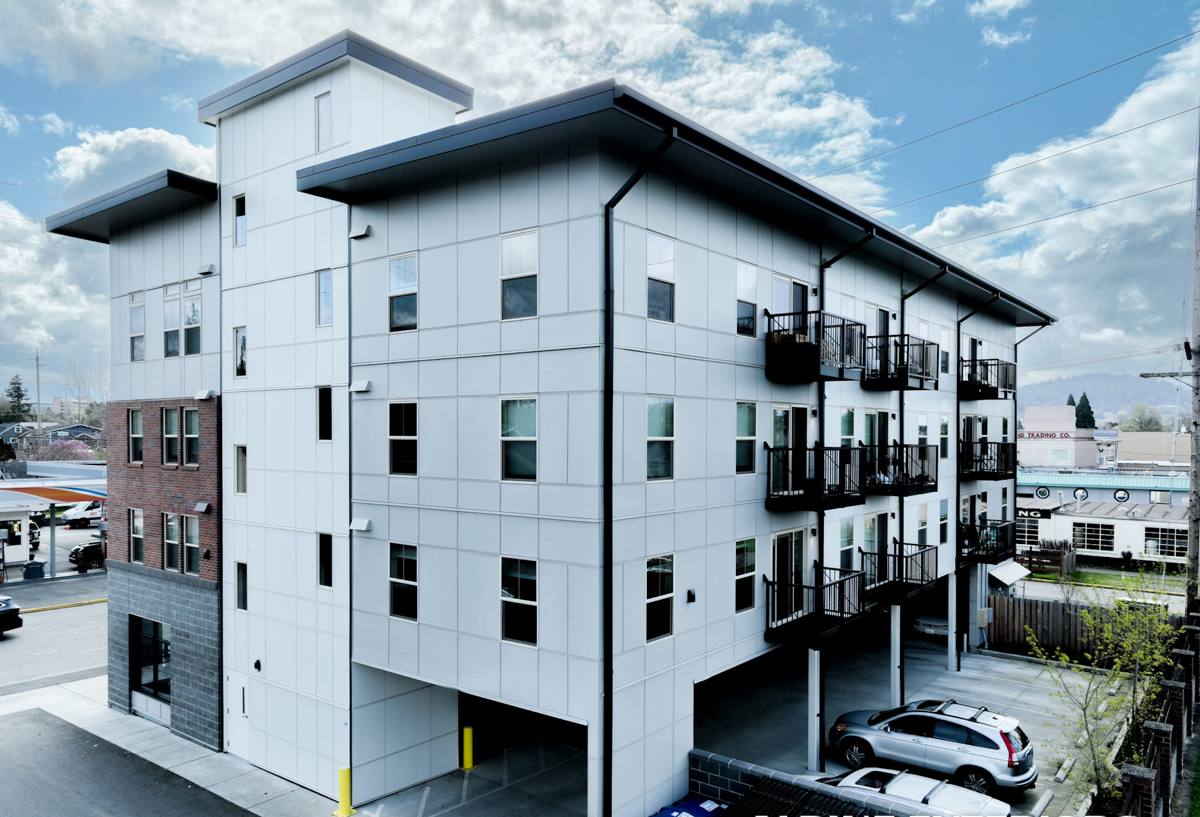
Why James Hardie Fits This Climate
James Hardie fiber cement is engineered specifically for regional climate demands, and the company's HZ5 product line is built for exactly the conditions Whatcom County sees: sustained moisture exposure, freeze-thaw cycling, and coastal humidity. Fiber cement itself is not organic material, so it doesn't feed rot fungus or provide the same food source for moss and algae that wood-based sidings do. That doesn't mean a Hardie wall will never see algae growth in a shaded, damp spot — nothing is immune to a Bellingham north wall — but the material itself isn't degrading from the exposure the way wood or wood-composite products can.
The factory-applied ColorPlus finish matters here too. It's baked on in a controlled environment rather than field-applied with a brush or sprayer, which means better adhesion and more consistent coverage than a job-site paint job — a real advantage in a climate where the paint itself is fighting salt air and near-constant moisture for years at a stretch. Hardie also backs its products with a transferable limited warranty, which carries real weight in coastal or high-moisture markets where premature paint failure and material degradation are common complaints with lower-grade products.
Product Lines We Install
Not every Hardie product is the right fit for every wall, roofline, or architectural style. Part of doing this correctly is matching the product to the home. Here's how the main lines compare for a typical Bellingham-area project:
| Product | Best Use | Notes for This Climate |
|---|---|---|
| HardiePlank lap siding | Most wall areas, traditional and modern homes | Available in smooth or cedar-textured finish; the workhorse choice for coastal exposure |
| HardiePanel vertical siding | Accent walls, modern designs, gable ends | Clean vertical lines; needs correct joint treatment to shed driving rain |
| HardieShingle siding | Accent gables, Craftsman and cottage styles | Staggered or straight-edge panels; good for breaking up larger elevations |
| HardieTrim boards | Corners, window and door casing, fascia | Non-combustible, dimensionally stable trim that won't cup or split like wood |
| HardieSoffit panels | Eaves and overhangs | Vented options help manage attic moisture in a wet climate |
Color selection matters too. Darker ColorPlus tones absorb more heat and can accelerate expansion-contraction cycling on south and west exposures, while lighter tones tend to hide chalking and mineral deposits from hard water or salt spray better over time. We walk through these trade-offs with homeowners rather than just handing over a color chart.
What Correct Installation Looks Like Here
James Hardie's product performance depends heavily on installation quality — this is true everywhere, but it matters more in a climate that gives moisture more chances to find a mistake. A technically correct Hardie job in Bellingham includes:
- Proper water-resistive barrier and rainscreen or drainage plane behind the siding, not siding fastened directly to sheathing
- Flashing integrated at every window, door, and roof-to-wall intersection — not caulk used as a substitute for flashing
- Correct fastener type and spacing per Hardie's published installation specs, using corrosion-resistant fasteners appropriate for coastal exposure
- Minimum clearance maintained between the bottom edge of siding and grade, decks, patios, and roof lines to keep splash-back and ponding water off the material
- Properly caulked and sealed joints at butt seams, trim intersections, and penetrations, using sealants rated for the exposure
- Field-cut edges primed or sealed before installation, since factory ColorPlus coating doesn't extend to a fresh cut
Skipping any one of these doesn't usually cause an obvious problem in year one. It shows up two, five, or eight winters later as a soft spot at a butt joint, staining below a poorly flashed window, or premature paint failure at an unsealed cut edge. This is the gap between a siding job that looks right at completion and one that actually performs for the life of the warranty.
Our Process, Start to Finish
We approach every Bellingham-area project the same structured way:
- Assessment: we inspect the existing siding, sheathing, and water-resistive barrier condition, and check problem areas like window flashing, deck ledgers, and grade clearance before quoting anything.
- Prep and repair: any damaged sheathing or framing found during tear-off gets addressed before new siding goes on — we don't cover up rot.
- Drainage plane and flashing: weather-resistive barrier and rainscreen materials go on correctly, and flashing is integrated at every penetration before siding starts.
- Installation: Hardie boards, panels, and trim go up to manufacturer spec — fastener pattern, clearances, joint treatment, and cut-edge sealing included.
- Final detailing: caulking, touch-up painting at fasteners and cuts, and a walk-through so the homeowner sees exactly what was done.
- Warranty registration: we handle the paperwork so the transferable Hardie warranty is properly on file.
Cost Factors to Expect
Every project is different, but the same handful of factors drive most of the cost variation we see on Bellingham-area Hardie jobs:
| Factor | Why It Matters |
|---|---|
| Tear-off vs. new construction | Removing existing siding and dealing with what's underneath (rot, old barrier systems) adds labor |
| Wall complexity | Multiple gables, dormers, and cut-ins take more time than flat, simple elevations |
| Product mix | Combining lap siding with shingle accents or vertical panel sections adds material and labor cost |
| Trim scope | Full trim replacement (corners, fascia, window casing) versus reusing sound existing trim |
| Access and site conditions | Slopes, tight lot lines, and landscaping near the foundation affect staging and scaffolding needs |
| Color and finish | Standard ColorPlus colors versus premium or custom finishes |
We give homeowners a real number after a walk-through, not a phone estimate — too much of the cost depends on what we find once we're actually looking at the walls.
Maintenance in a Marine Climate
One of the practical advantages of fiber cement in a place like Bellingham is how little ongoing maintenance it asks for compared to wood-based sidings, but "low maintenance" isn't "no maintenance." A yearly rinse-down helps keep salt residue, pollen, and organic buildup from settling into the surface, especially on north-facing and tree-shaded walls where moss and algae take hold fastest. Caulked joints and seams should get a visual check every year or two, since sealant is the one component that does wear out and need occasional renewal well before the siding itself does. Gutters and downspouts should stay clear so runoff isn't dumping extra water down a wall section during the winter rain season. None of this is heavy work, but skipping it entirely does shorten the effective life of any siding system, Hardie included.
Signs a Bellingham Home May Need New Siding
Homeowners in this area often wait until a problem is visible from the street, but a few earlier warning signs are worth acting on sooner:
- Soft or spongy spots when pressed, especially near the bottom courses or around window sills
- Persistent staining or dark streaking below windows, gutters, or roof-to-wall intersections
- Paint that's chalking, bubbling, or peeling well before you'd expect based on its age
- Visible gaps opening up at butt joints, corners, or trim intersections
- Moss or algae that keeps returning to the same spots no matter how often it's cleaned
Any of these can indicate moisture is getting behind the cladding, which is worth investigating before it reaches the sheathing or framing.
Why a Local Crew Matters
A crew that regularly works in the Bellingham area already knows how local conditions differ block to block — which streets catch the worst of the wind off the bay, which lots hold shade and moisture longer into spring, and how Whatcom County's permitting and inspection process typically runs. That local familiarity shows up in small decisions during a project: where to add extra flashing attention, which color finishes actually hold up on a given exposure, and how to sequence work around the area's wet-season weather windows. It's the difference between a crew following a generic install manual and one applying that manual with real judgment about this specific climate.
If you're weighing a siding project for a Bellingham-area home, we're happy to walk the exterior with you and give you a straight assessment — no pressure, no sales script, just an honest look at what your home actually needs. Reach out through the form below to get started.