 Ferndale Siding
 Why Semiahmoo's Coastal Climate Is Hard on Siding
Homes in and around Semiahmoo sit close to open water, which means siding here deals with a combination of stresses that inland Whatcom County homes are largely spared. Salt-laden air carries fine mineral particles that settle on exterior surfaces and slowly break down finishes, fasteners, and caulking. Add wind-driven rain that gets pushed sideways into laps, corners, and trim joints, and a long, wet moss season that keeps north- and shade-facing walls damp for weeks at a stretch, and you have a climate that finds every weak point in a siding system faster than most.
None of this means siding fails quickly here — it means siding installed without the coastal conditions in mind fails faster than it should. The product choice matters, but so does the installation detail: how water is shed away from the wall, how fasteners are protected from corrosion, and how much air gap is left for surfaces to dry out between storms. Get those details right and a home holds up for decades. Skip them and problems show up in five to ten years instead of twenty-five or thirty.
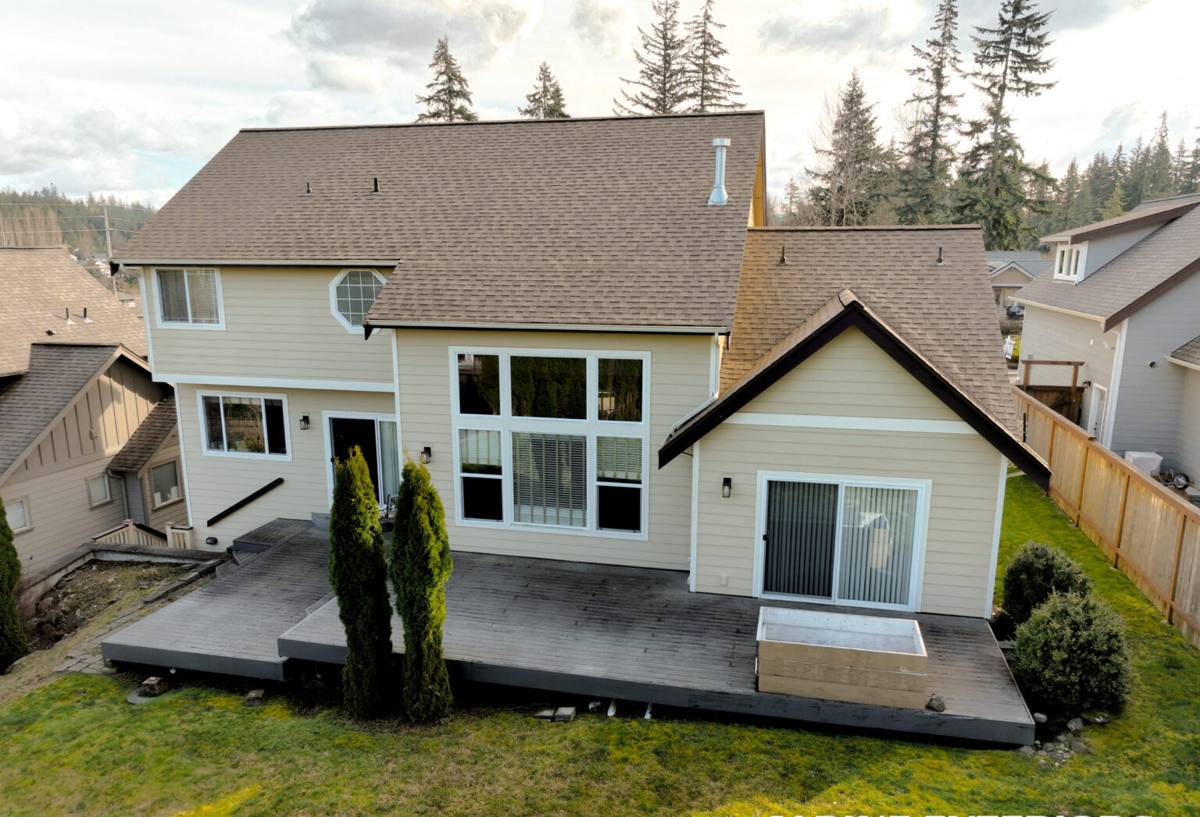
What Correct Siding Installation Actually Involves
Flashing and Water Management
Most siding failures near the water aren't failures of the siding material itself — they're failures of the flashing and water-resistive barrier behind it. Window and door heads, deck ledgers, roof-to-wall transitions, and butt joints between siding courses all need flashing that directs water back out, not into the wall assembly. In a driving-rain environment, a flashing detail that's "close enough" inland isn't close enough on a waterfront-adjacent lot.
Fastening and Gaps
Fiber cement siding needs to be fastened with corrosion-resistant fasteners driven correctly — not overdriven, not underdriven — and it needs proper gapping at butt joints, trim, and penetrations so the panel can expand and contract without binding or cracking. Salt air accelerates corrosion on the wrong fastener type, which is why fastener spec isn't a detail we treat as optional.
Drainable Wall Assembly
A water-resistive barrier paired with a drainage gap behind the siding gives any moisture that does get past the cladding a way out. In a climate where walls stay damp longer because of fog, rain, and shade, that drainage path is what keeps sheathing and framing dry underneath a siding system that looks fine on the surface.
Why We Install Only James Hardie Fiber Cement
We standardized on James Hardie fiber cement siding and don't install vinyl, LP SmartSide, or other engineered wood or fiber cement alternatives. In a coastal, high-moisture climate like Whatcom County's, the reasons are practical rather than promotional:
- Non-combustible core — fiber cement doesn't feed a fire the way wood-based products can.
- Factory-applied ColorPlus finish — baked-on color that resists the fading and chalking that salt air and UV exposure accelerate on field-painted or lower-grade finishes.
- HardieZone engineering — Hardie manufactures its products to regional moisture and climate profiles, and the HZ5 line used in the Pacific Northwest is built for exactly the wet, marine conditions Semiahmoo sees.
- Dimensional stability — fiber cement doesn't expand, contract, or warp with moisture swings the way vinyl and some engineered wood products can, which matters when a wall is cycling between soaked and dry all winter.
- Strong transferable warranty — backed by a manufacturer with decades of track record in wet climates, which carries real weight if a home changes hands.
We're not going to tell you every other product on the market is worthless — vinyl and engineered wood sidings have real uses and loyal installers. But for the moisture load and salt exposure a Semiahmoo home takes on, we've made a professional judgment call: Hardie fiber cement, installed to spec, is the product we're willing to put our name behind.
Our Installation Process
- On-site assessment. We walk the home, note wind and rain exposure on each elevation, check existing sheathing and framing condition, and identify any moisture damage that needs to be addressed before new siding goes on.
- Tear-off and substrate inspection. Old siding comes off and we inspect the sheathing underneath. Anything soft, rotted, or compromised gets repaired or replaced — covering damaged sheathing with new siding just hides the problem.
- Water-resistive barrier and flashing. A new WRB goes on, with flashing detailed at every window, door, penetration, and transition before a single piece of siding is hung.
- Drainage plane installation. Depending on the wall assembly, a drainage gap or rainscreen is built in so water and moisture vapor have somewhere to go besides the wood behind your siding.
- Siding installation to Hardie spec. Panels or lap siding go up with correct fastener spacing, gapping, and clearances from grade, roofing, and trim — all per manufacturer installation requirements, which is also what keeps the warranty valid.
- Trim, caulking, and final detailing. Corners, trim boards, and joints are sealed with products rated for the exposure, and every penetration is checked before we call the job finished.
- Final walkthrough. We go over the finished work with you so you know what was done and what to expect from the siding going forward.
Choosing the Right Hardie Product for This Exposure
Not every Hardie product line is the right fit for every wall on every home. Exposure, architectural style, and budget all factor in.
| Product | Best Use | Why It Fits a Coastal Exposure |
|---|---|---|
| HardiePlank Lap Siding | Most wall areas, traditional and modern styles | Widest range of textures and widths; ColorPlus finish holds up well against salt air and UV |
| HardiePanel Vertical Siding | Modern designs, accent walls, gable ends | Fewer horizontal laps means fewer joints for wind-driven rain to find |
| HardieTrim Boards | Corners, window and door surrounds, fascia | Matches the same climate-engineered core as the field siding, avoiding mismatched material behavior at transitions |
| HardieSoffit Panels | Eaves and overhangs | Resists the moss and mildew growth that shaded, damp soffits are prone to in this climate |
What Drives Siding Installation Cost
Every home is different, so we won't quote a number without seeing the job — but these are the main factors that move the cost of a siding installation up or down.
| Factor | Cost Impact | Why |
|---|---|---|
| Full tear-off vs. new construction | Medium–High | Removing and disposing of existing siding, plus repairing whatever's found underneath, adds labor |
| Sheathing or framing repair | Variable | Moisture damage found during tear-off has to be fixed before new siding can go on correctly |
| Home size and wall complexity | Medium | More corners, gables, and dormers mean more cutting, flashing, and trim work |
| Product line and profile | Low–Medium | Panel widths, textures, and trim details vary in material cost |
| Site access | Low–Medium | Waterfront and hillside lots can complicate staging and scaffolding |
Maintenance in a Moss-Prone, Salt-Air Environment
Correctly installed fiber cement siding is low-maintenance, not no-maintenance. A little seasonal attention goes a long way in this climate.
- Rinse salt residue and grime off exterior walls once or twice a year, especially on elevations facing open water or prevailing wind.
- Keep gutters clear so overflow doesn't run down the face of the siding and feed moss and algae growth.
- Trim back vegetation and tree cover that keeps any wall shaded and damp longer than it needs to be.
- Check caulking at trim joints, windows, and penetrations annually and re-caulk anything that's cracked or pulled away.
- Watch for moss or dark streaking on north-facing or shaded walls and address it early with a gentle wash rather than pressure that can damage the finish.
- Repaint or refinish trim boards on the manufacturer's recommended schedule if they're not factory-finished ColorPlus material.
Why Hire a Crew That Already Works Semiahmoo
A siding contractor who's spent time on homes near the water in Whatcom County knows which walls in a given exposure need the most flashing attention, how long moss season really runs here, and how a home's orientation to wind and rain off the water should shape installation details. That's not something you can fully substitute with a generic installation manual — it's judgment built from doing the work in this specific climate, on this specific coastline, repeatedly.
It also means fewer surprises during the job. A crew unfamiliar with coastal Whatcom County conditions may treat a Semiahmoo home the same as a dry, inland job — and that's exactly the gap where corners get cut without anyone intending to cut them.
Signs Your Current Siding May Need Attention
- Visible warping, buckling, or gaps opening up at seams and corners
- Soft or spongy spots when pressed, especially near the bottom of walls or under windows
- Persistent moss or algae staining that keeps returning after cleaning
- Peeling or chalking paint on older wood or engineered wood siding
- Rust streaks around fasteners or trim
- Rising energy bills that may point to compromised insulation or air sealing behind the siding
If a home shows one or more of these signs, it's worth having someone take a real look before small problems turn into sheathing or framing repairs.
If you're weighing a siding project for a home in the Semiahmoo area, we're happy to take a look and talk through what your walls actually need — no pressure, no obligation. Use the form below to request a free estimate.