 Ferndale Siding
 Semiahmoo's Waterfront Setting Is Hard on a Deck
Semiahmoo sits right on the water, close to the Canadian border, and that location is a mixed blessing for the homes here. The views are worth it, but a deck exposed to open water and Whatcom County's marine climate ages differently than one built ten miles inland. Salt-laden air, driving rain off the water, and a moss season that can stretch from fall through spring all work on a deck at the same time, and most homeowners only notice the combined effect once something starts to give — a soft board, a rusted fastener, a railing that flexes more than it used to.
Salt Air and Fasteners
Airborne salt accelerates corrosion on any exposed metal. Nails, screws, and joist hardware that would last decades in a dry inland yard can start weeping rust stains or losing holding power much sooner near Semiahmoo Bay. Once a fastener corrodes, the wood around it loosens, water gets a path into the framing, and the problem compounds quietly under the decking where you can't see it.
Driving Rain and Ledger Boards
Wind-driven rain off the water doesn't just fall — it gets pushed sideways into siding-deck connections, under flashing, and into any gap where two boards meet. The ledger board, where the deck attaches to the house, is the single most important structural connection on most decks and also the one most exposed to this kind of wind-blown moisture. When flashing there fails or was never installed correctly, water tracks into the house framing, not just the deck.
The Long Moss Season
Whatcom County's wet, mild winters give moss and algae a long runway to establish themselves on any shaded or north-facing deck surface. Beyond the slip hazard, moss holds moisture against the wood far longer than open air would, which speeds up rot in exactly the spots that are hardest to inspect from a standing position.
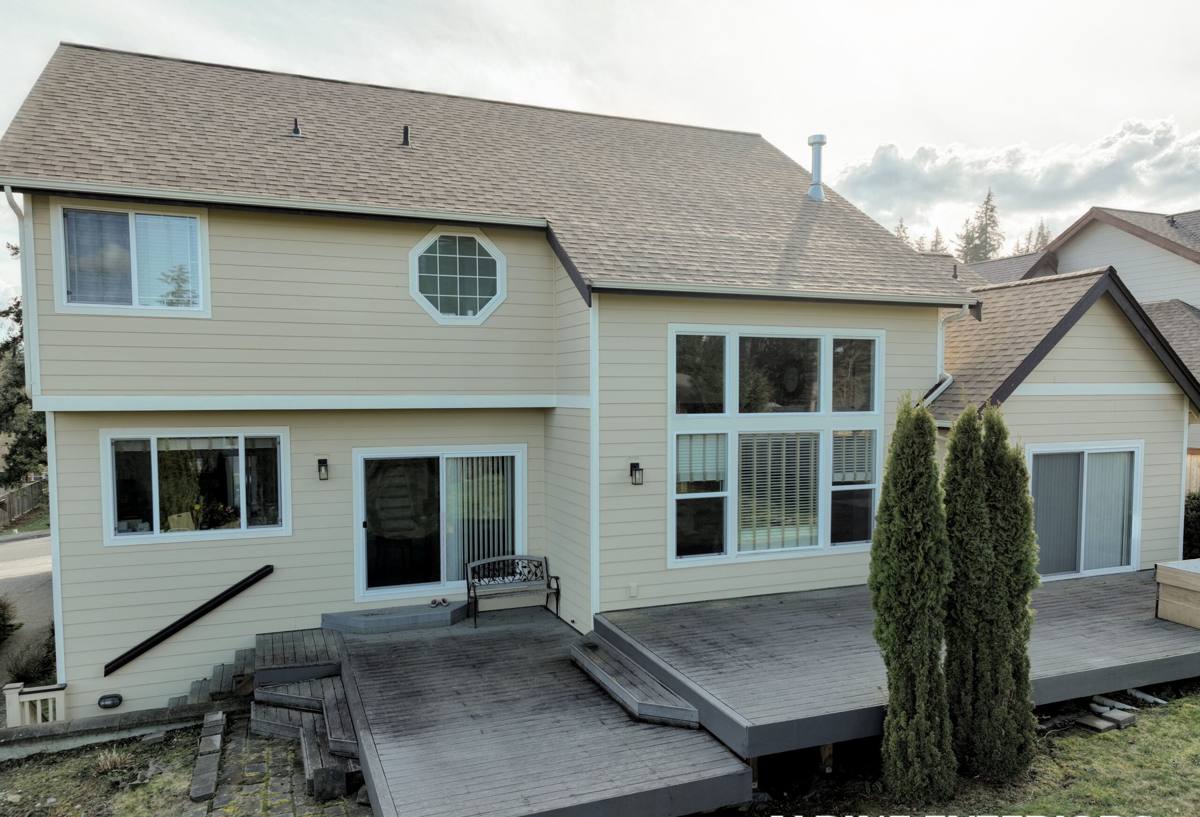
Signs a Deck Needs Repair, Not Just a Cleaning
Pressure washing and a fresh coat of stain fix the surface. They don't fix a compromised structure underneath, and painting over a soft board only hides the problem until it's worse. Watch for these signs specifically:
- Boards that feel spongy or flex noticeably when you walk across them
- Railings or posts that wobble or have visible gaps at the base
- Rust streaks running down from screw or nail heads
- Gaps opening up where the deck meets the house siding
- Persistent moss or dark staining in the same spot every year, even after cleaning
- Stairs that feel less solid than they used to, especially near the bottom stringer
Any one of these can be minor on its own. Two or three together usually mean the underlying structure needs a real look, not just a wash.
What a Correct Deck Repair Actually Involves
Inspecting the Structure First
A repair that only replaces what's visible from the top is a temporary fix. Before we touch a single board, we get underneath the deck and check the ledger connection, the joists, the posts, and the footings. Surface rot is often a symptom of a moisture problem happening below — flashing that's missing, a joist hanger that's rusted through, or a ledger that was never properly sealed against the house.
Fasteners and Flashing
Given how hard salt air is on hardware here, repair work on a Semiahmoo deck should always upgrade fasteners and connectors to a corrosion-resistant grade, not just replace like-for-like with whatever was originally used. The same goes for flashing at the ledger board — if it's missing or degraded, that gets corrected as part of the repair, not left for next time.
Matching or Upgrading the Decking
Sometimes a repair means replacing a handful of boards to match the existing deck. Other times, especially on an older deck, it makes sense to talk about whether the decking surface itself should be upgraded to something better suited to this climate while the structure is already open. We'll give you both options honestly rather than pushing one by default.
Repair or Replace? What Actually Drives the Decision
Homeowners often ask us to just tell them a number before we've looked at anything, but the honest answer depends on a handful of factors that vary a lot from deck to deck. Here's what we actually weigh:
| Factor | Favors Repair | Favors Replacement |
|---|---|---|
| Extent of rot | Isolated to a few boards or one area | Found in multiple structural members |
| Framing condition | Joists and ledger are sound | Joists, posts, or ledger show soft or rusted damage |
| Age of the deck | Under 12-15 years, built to a solid standard | Original construction is older or was built to a lower standard |
| Code compliance | Railings, spacing, and footings already meet current code | Railing height, spacing, or footings fall short of current code |
| Homeowner plans | Deck size and layout still work for how it's used | Homeowner wants a different size, shape, or added features |
Most of the time we can repair a deck that has isolated damage and a sound frame. Where the frame itself is compromised, patching the surface just delays a bigger job — and we'll tell you that plainly rather than sell a repair we don't believe will hold.
Our Process for Semiahmoo Deck Repairs
- Inspection. We look above and below the deck, checking the ledger, joists, posts, footings, and fastener condition, not just the visible surface.
- Honest diagnosis. We walk you through exactly what we found, what's causing it, and what your realistic options are — repair, partial rebuild, or full replacement.
- Written estimate. You get a clear scope of work and price before anything starts, with no vague allowances hiding extra cost later.
- Repair work. We address the structure first — ledger, framing, flashing, hardware — then the visible decking, railings, and stairs.
- Final check. We walk the deck with you when it's done so you can see and feel the difference, not just take our word for it.
Material Choices That Make Sense on Semiahmoo Bay
Fasteners and Hardware
For decks this close to open water, we lean toward stainless steel or high-grade coated fasteners and connectors over standard galvanized hardware, especially at the ledger and any structural joist hangers. It costs a bit more up front and saves you from replacing the same connection again in a few years.
Wood vs. Composite for Repairs
Natural wood decking is a reasonable choice when it's stained and sealed on a regular schedule, and it blends easily when you're only replacing a section of an existing wood deck. Composite decking costs more initially but doesn't need staining, resists moss growth better on shaded sections, and doesn't have the same soft-spot risk once water gets past the surface. Neither is wrong — it's a real trade-off between upfront cost and ongoing maintenance, and we'll lay out both honestly for your specific deck rather than assume one is automatically better.
A Simple Maintenance Checklist for Semiahmoo Homeowners
Between visits from a contractor, a few habits go a long way toward keeping a waterfront deck out of trouble:
- Sweep debris and standing water off the surface after storms, especially in shaded corners
- Check and clean gutters and downspouts near the deck so runoff isn't draining onto it
- Look underneath once or twice a year for rust streaks or soft framing, not just at the surface
- Treat moss as soon as it appears rather than waiting for the dry season
- Re-stain or reseal wood decking on the schedule the product calls for, not just when it looks faded
- Test railings and stair stringers by hand periodically — don't wait for a visible problem
Why It Matters to Hire a Crew That Already Works This Area
Deck problems in Semiahmoo aren't generic — they're shaped by the specific combination of salt exposure, wind-driven rain, and a long wet season that this part of Whatcom County deals with every year. A crew that repairs decks all over Western Washington without paying attention to that combination will often use standard fasteners, skip the flashing detail at the ledger, or miss how much faster moss takes hold on a shaded, water-facing deck here. We work in Ferndale and the surrounding waterfront communities regularly, so we're not guessing at what holds up here — we're building and repairing to what we've actually seen fail and what actually lasts.
If your deck has a soft spot, a wobbly rail, or you just want an honest read on its condition, we're glad to take a look. Fill out the form below for a free, no-pressure estimate.