 Ferndale Siding
 Roof Replacement Built for Point Roberts' Exposure
Point Roberts sits in a category of its own, even within Whatcom County. It's a small peninsula community bordered by water on most sides, and it's a U.S. exclave — connected to the rest of Washington only by water, air, or a drive that passes through Canada. That geography shapes more than commute times. It shapes what a roof on a Point Roberts home has to withstand, and it shapes how a roofing job actually needs to be planned and run.
The climate stresses are familiar to anyone who's worked coastal Whatcom County roofs: salt-tinged marine air that quietly corrodes exposed metal, wind-driven rain that gets forced sideways and upward under shingle edges instead of running straight off, and a moss season that settles into shaded, north-facing roof slopes and doesn't fully let go for months. On a peninsula with water close on nearly every side, those stresses tend to be a notch more constant than they are a few miles inland. This page covers what a correct roof replacement looks like for a Point Roberts home specifically, and why the location itself changes some of the practical decisions around the job.
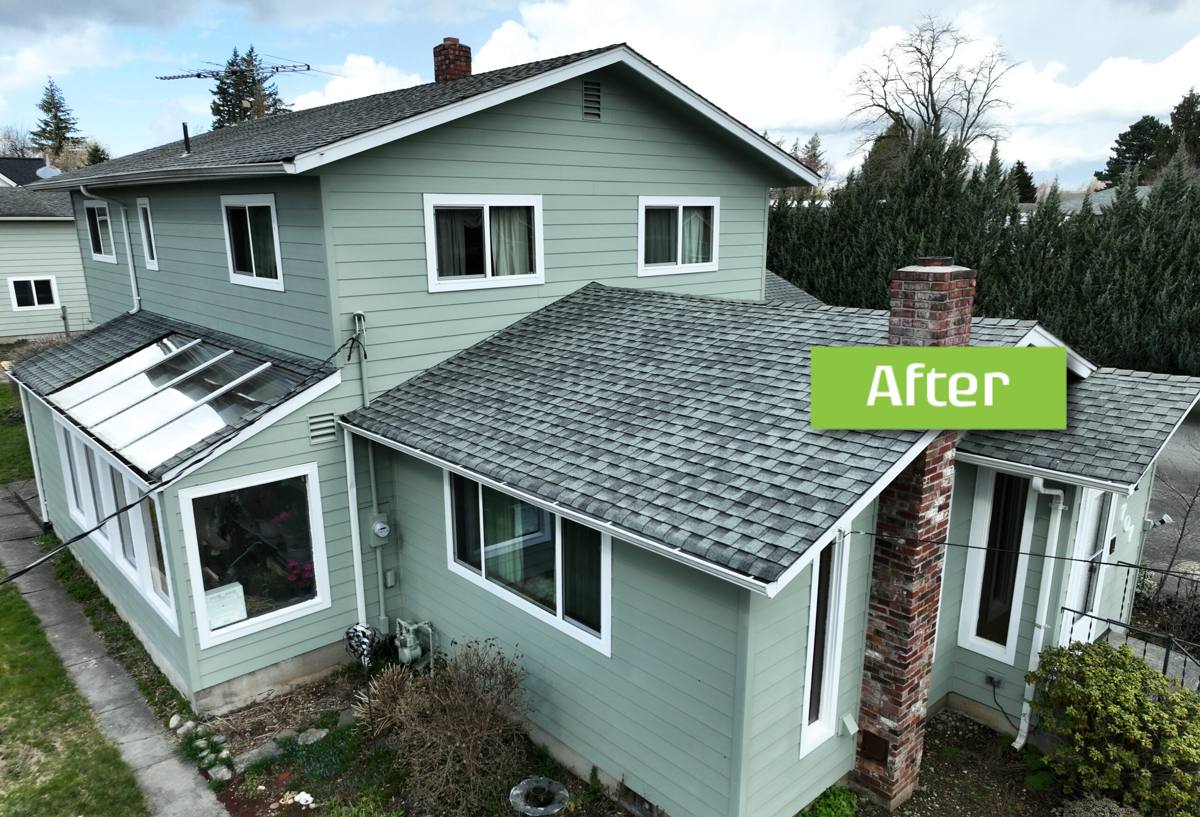
A Peninsula Takes More Weather Than an Inland Lot
Salt Air From Nearly Every Direction
Most coastal Whatcom County homes face salt exposure from one general direction. A home on the Point Roberts peninsula often has open water on multiple sides, which means salt-laden air isn't limited to a single prevailing wind pattern the way it can be elsewhere. Over years, that steady exposure works on fasteners, flashing metal, and any exposed hardware, and it does it faster on lower-grade materials than on components chosen for coastal service. A roof that looks fine from the ground can already have corrosion developing at flashing joints and nail heads that a casual inspection from the yard won't reveal.
Wind-Driven Rain and a Long Moss Season
Open water on multiple sides also means less natural windbreak than an inland lot might have, so rain gets pushed harder and from more variable directions. That matters at every lapped seam in a roofing system — underlayment, shingle courses, and flashing all have to handle water that isn't simply running downhill. Shaded and north-facing roof planes, meanwhile, hold moisture long enough through the wet months that moss and algae growth becomes an ongoing maintenance issue rather than an occasional one, particularly on older roofs that were never treated with algae-resistant materials to begin with.
What Being a U.S. Exclave Means for This Job
Point Roberts' geography isn't just a climate factor — it's a logistics factor, and it's one that's easy for an unfamiliar contractor to underestimate. Materials, equipment, and crews reaching the peninsula from the rest of Washington typically travel through Canada, which means border-crossing time and the normal variability of that crossing become part of the schedule, not an afterthought bolted onto it.
Material Delivery and Scheduling
A same-day supply run that would be routine on a job elsewhere in the county isn't automatic here. Ordering shingles, underlayment, flashing stock, and ventilation components has to be planned with enough lead time that a delay at the border doesn't leave a torn-off roof exposed longer than it should be. A crew that works Point Roberts regularly builds this into how they stage a job from the start — ordering early, confirming delivery windows, and keeping a buffer in the schedule rather than assuming everything arrives exactly on the original timeline.
What Happens If Weather Turns Mid-Project
Every roof replacement carries some weather risk once the old roofing is off and the deck is exposed. On a job that requires crossing the border to get additional crew, materials, or emergency tarping supplies on site, that risk needs a real plan behind it — enough material staged on site to finish or secure the section in progress, and a crew that isn't caught off guard by the extra time a border crossing can add if something has to be brought in on short notice.
Many Point Roberts Homes Sit Vacant Part of the Year
A meaningful share of homes in Point Roberts function as part-time or seasonal residences rather than full-time, daily-occupied houses. That's a natural feature of a small border community like this one, and it changes how a roof should be evaluated and built. On a home someone lives in every day, a lifted shingle edge or a small flashing leak often gets noticed early — a stain on a ceiling, a draft, a sound during a storm. On a property that sits empty for stretches at a time, that same early warning sign can go unnoticed for weeks or months, giving a minor problem time to become a deck-level moisture issue before anyone's aware of it.
That reality argues for leaning toward durability and low-maintenance performance rather than cutting corners to save on upfront cost, and for thorough ventilation that keeps an unattended attic from trapping moisture in the meantime. It's also a good reason to have the roof properly inspected rather than assumed sound, since a problem that's already been quietly developing won't have announced itself the way it would in a home that's occupied every day.
What a Correct Roof Replacement Involves
A roof replacement done right is a layered system, not a single step of stripping old material and laying down new. Each layer does a specific job, and skipping or shortcutting one shows up later as a leak, not immediately.
Tear-Off and Deck Inspection
A full tear-off down to the decking is the only reliable way to find rot or hidden moisture damage that's been building underneath the old roofing, sometimes for years. On a home that's been used seasonally, this step matters even more, since nobody's been watching for interior warning signs during the periods it sat empty. A layover — new shingles installed directly over the old layer — skips this inspection entirely and simply seals whatever is already underneath.
Underlayment and Flashing
Synthetic or self-adhered underlayment gives the deck a real secondary barrier against wind-driven rain, with ice-and-water shield membrane at eaves, valleys, and other vulnerable transitions adding another layer where water is most likely to find a way in. Flashing at valleys, chimneys, skylights, and wall intersections is where most roof leaks in this region actually start, so it needs to be properly lapped and integrated with the underlayment as part of the system, not caulked on afterward.
Fastening and Wind Resistance
Open water exposure on multiple sides means wind loading deserves real attention here, not a generic approach. Fastener count, placement, and pattern need to follow manufacturer specification so shingles stay locked down rather than lifting at the edges over time, and corrosion-resistant fastener and flashing metal is worth insisting on given the steady salt exposure.
Ventilation
Balanced intake and exhaust ventilation keeps the underside of the roof deck dry, which matters for shingle lifespan under normal conditions and matters more on a property that may sit unoccupied for stretches, since there's no one inside generating the kind of household activity that can sometimes mask a ventilation problem until it's advanced.
Comparing Roofing Material Options for a Point Roberts Home
| Material | Typical Lifespan | Fit for Point Roberts Conditions |
|---|---|---|
| Architectural Asphalt Shingles | 25-30 years | Strong wind rating and algae-resistant options make this the practical default for most homes here |
| Metal Roofing | 40-50+ years | Excellent wind and moisture performance; upfront cost is higher, and fastener/coating quality matters even more given salt exposure |
| Cedar Shake | 20-30 years with upkeep | Attractive but higher-maintenance in a damp, moss-prone climate; requires disciplined upkeep to avoid early moisture damage |
For most Point Roberts homes, architectural asphalt shingles with algae-resistant granules remain the most practical balance of cost and performance. Metal roofing is worth serious consideration on a property where long-term, low-maintenance performance matters more than upfront cost — particularly relevant for a home that isn't occupied year-round and won't get routine attention between visits.
Cost Factors Worth Understanding
| Factor | Why It Matters Here |
|---|---|
| Tear-off vs. layover | A full tear-off is the only way to catch deck damage that may have gone unnoticed during periods the home sat vacant |
| Underlayment grade | Determines how well the roof resists wind-driven rain coming from more directions than a sheltered inland lot faces |
| Fastener and flashing metal quality | Corrosion resistance directly affects how long the roof holds up against steady salt exposure |
| Material delivery lead time | Border-crossing logistics mean supplies need to be ordered and staged earlier than a typical inland job |
| Ventilation upgrades | Protects an attic that may go unmonitored for weeks at a time between visits to the property |
A written estimate that itemizes each of these separately, rather than a single lump-sum number, gives you something real to compare against another bid — and it's a fair question to ask any contractor to walk through their number line by line.
How Our Process Works
- In-person inspection: We walk the roof and attic ourselves and document what we actually find, rather than estimating from a photo or a drive-by.
- Written estimate: A clear, itemized bid covering tear-off, underlayment, flashing, fastener and material selection, ventilation, and cleanup.
- Scheduling with real lead time: Materials are ordered and staged with the border-crossing logistics built into the timeline, not treated as an afterthought.
- Tear-off and deck repair: Old roofing comes off completely, and any deck damage found is addressed before new roofing goes down.
- Underlayment, flashing, and roofing installation: Each layer installed to manufacturer specification, with extra attention at valleys, penetrations, and wall transitions.
- Final walkthrough and cleanup: We review the finished roof with you or, for part-time residents, document it thoroughly, and complete a full site and magnetic nail sweep before calling the job done.
Why Hiring a Crew That Already Works Point Roberts Matters
A contractor who regularly works this peninsula already knows how to plan around the border crossing without it becoming a source of delays, has seen firsthand how salt exposure from multiple directions accelerates wear on underspecified materials, and understands why a thorough inspection matters more on properties that sit vacant part of the year. That's practical knowledge that shows up in the small decisions made throughout a job — decisions a crew doing a one-off Point Roberts job for the first time may not think to make.
It also matters after the work is finished. A workmanship warranty is only as good as a company's ability to actually respond if a question comes up later, and that's a more meaningful commitment from a crew with an established, ongoing presence serving the area than from one that treated the job as a single out-of-territory trip.
- Do they perform a full tear-off with deck inspection, not just a layover?
- Does the estimate account for delivery lead time and border-crossing logistics rather than assuming same-day supply access?
- Is fastener and flashing metal quality specified, given the level of salt exposure here?
- Do they carry current WA state contractor licensing, liability insurance, and workers' compensation?
- Can they point to recent work in Point Roberts or the immediate area?
- Does the bid clearly separate the manufacturer's material warranty from their own workmanship warranty?
If you own a home in Point Roberts and want a straightforward, no-pressure look at your roof, we're glad to come take a look and put together a written estimate you can compare against anything else you've received. Use the form below to request a free estimate.